DMC vs Anchor Thread — 489 vs 446 Colors, Conversion & Regional
DMC 310 and Anchor 403 are both labeled "black," but they're not the same black. Here's how to choose the right brand for your situation.
Quick comparison:
- DMC: 489 colors, global standard, widely available in North America. Slight sheen, consistent batch-to-batch.
- Anchor: 446 colors, softer feel, preferred in UK/Europe/Australia. Slightly matte finish, easier to thread.
- Conversion: Not 1:1 — use the DMC ↔ Anchor converter for match quality percentages.
Hold DMC 310 and Anchor 403 next to each other. Both are labeled "black." They're not the same black. DMC 310 leans neutral; Anchor 403 runs slightly warmer. Stitch half a project with one and switch to the other, and you'll see the seam under natural light. Thread-Bare stitched five thread brands side by side using their color equivalents — the visual comparison shows exactly how much DMC and Anchor diverge in practice, especially in the mid-tones. This is the core of the DMC vs Anchor debate—not quality (both are excellent), but consistency and which brand fits your situation.
The DMC vs Anchor question isn't about which brand is "better." Both produce high-quality six-strand cotton floss that serious stitchers have used for decades. The real question is which one makes sense for your situation—your location, your patterns, your existing stash, and whether you're stitching for yourself or selling finished pieces. (Already decided and need to convert thread codes between brands? Jump straight to the conversion tool.)
| DMC | Anchor | |
|---|---|---|
| Solid colors | 489 | 446 |
| Thread feel | Slightly crisper | Softer, more "buttery" |
| Best availability | North America | UK, Europe, Australia |
| US price (per skein) | $0.50–0.70 | $0.80–1.20 |
| UK price (per skein) | £1.00–1.50 | £0.80–1.00 |
| Pattern compatibility | Most patterns use DMC codes | Conversion chart usually needed |
| Number system | Grouped by color family | No obvious logic |
| Owned by | DMC (France, est. 1746) | DMC (acquired Aug 2023) |
Why the brand choice matters more than you’d think
Thread brand affects three things most stitchers underestimate:
Color matching across a project. DMC and Anchor use different dye formulas. Even when conversion charts suggest two colors are "equivalent," they're approximations. DMC 321 (Christmas Red) and Anchor 9046 (its supposed match) look noticeably different side by side. For small motifs, this rarely matters. For a 200-hour project with 40 colors, consistency matters a lot.
Availability and cost over time. If you start a large project with one brand and can't find a specific color six months later, you're in trouble. Regional availability varies dramatically—DMC dominates in North America, while Anchor is often easier to find in the UK, Europe, and Australia.
Pattern compatibility. Most commercial patterns specify DMC codes. If you prefer Anchor, you'll need conversion charts—and conversions aren't perfect. Some DMC colors have no good Anchor equivalent, and vice versa.
DMC: the global standard
DMC(Dollfus-Mieg et Compagnie) has been making embroidery thread in Mulhouse, France since 1746. They're the default brand for most pattern designers, which makes them the path of least resistance for stitchers worldwide.
The DMC catalog:
- 489 solid colors in the standard 6-strand cotton floss range—browse them all in the DMC color chart, sampled from official scanned thread cards
- Specialty lines: Étoile (sparkle), Light Effects (metallic), Color Variations (variegated)
- Consistent dye lots: DMC is known for exceptional batch-to-batch consistency—a skein of DMC 815 bought in 2015 should match one bought today
Where DMC shines
Pattern availability. The vast majority of cross-stitch patterns—whether from indie designers on Etsy or major publishers—use DMC color codes. You won't need conversion charts, and your finished piece will match the designer's original vision.
Color organization. DMC's numbering system groups colors by family (300s are browns, 600s are pinks/magentas, 700s are greens). Once you learn the system, you can often guess approximately what a color looks like from its number.
Global availability. In North America, DMC is stocked at every major craft store—Joann, Michaels, Hobby Lobby—and countless independent shops. Online, you'll find every color in stock from dozens of suppliers.
Where DMC falls short
Texture. Some stitchers find DMC slightly stiffer than Anchor, particularly noticeable in satin stitch or other techniques where drape matters. This is subjective—many stitchers prefer the crispness.
Price in some regions. In the UK and Europe, DMC is often imported and priced higher than locally-available Anchor.
Limited variegated range. DMC's Color Variations line has fewer options than Anchor's Multicolor range.
Anchor: the European favorite
Anchorthread is now owned by DMC (acquired in August 2023), with production primarily in Hungary. Despite the common ownership, the brands maintain distinct color ranges and formulas. Anchor has been a staple of European stitching for generations and has devoted fans who swear by its handling properties.
The Anchor catalog:
- 446 solid colors in standard 6-strand cotton (Stranded Cotton)—see all shades in the Anchor color chart
- Specialty lines: Multicolor (variegated), Lamé (metallic)
- Soft hand: Known for a slightly silkier, more pliable feel than DMC
Where Anchor shines
Thread feel. Many stitchers describe Anchor as softer and more "buttery" than DMC—this comes up constantly in communities like r/CrossStitch and the Cross Stitch Forum. It lays flatter, separates more easily, and some find it less prone to tangling. For techniques requiring smooth coverage—like long stitches or tent stitch on needlepoint canvas—this can matter. Use the fabric calculator to check how strand count and fabric choice affect your finished dimensions.
UK and European availability. In Britain, Australia, and much of Europe, Anchor is the default brand in local shops. Prices are competitive, and finding all 446 colors is straightforward.
Variegated options. Anchor's Multicolor range offers color combinations you won't find in DMC's variegated lines. If you love working with color-shifting threads, Anchor gives you more choices.
Where Anchor falls short
Pattern compatibility. You'll need conversion charts for most patterns, and conversions are imperfect. Approximately 15-20% of DMC colors have no exact Anchor equivalent—only "close enough" matches.
Numbering system. Anchor's numbers don't follow any obvious color logic. Anchor 403 is black, 2 is white, 275 is off-white. You'll learn your most-used colors, but the system isn't intuitive.
North American availability. Finding Anchor in US craft stores is hit-or-miss. Online ordering is usually required, and some colors go out of stock with suppliers.
The conversion problem: why 310 ≠ 403
Every stitcher eventually encounters a conversion chart claiming DMC X equals Anchor Y. Here's the catch: these are approximations, not equivalents.
Thread companies develop their dye formulas independently. When someone creates a conversion chart, they're making judgment calls—"this blue is close enough to that blue." But:
- Undertones differ. DMC 318 (steel gray) leans slightly blue; its Anchor "equivalent" 399 leans slightly warmer.
- Some colors have no match. DMC 3866 (an ultra-light mocha) has no close Anchor equivalent. Charts might suggest Anchor 926, but they're visibly different.
- Lighting changes everything. Two threads that look identical under fluorescent light may diverge under natural light or LED.
Practical guidance:
For small projects (under 5,000 stitches), mixing brands with converted colors usually works fine. Most people won't notice.
For large projects or anything you're selling, pick one brand and stick with it. The subtle inconsistencies compound across thousands of stitches.
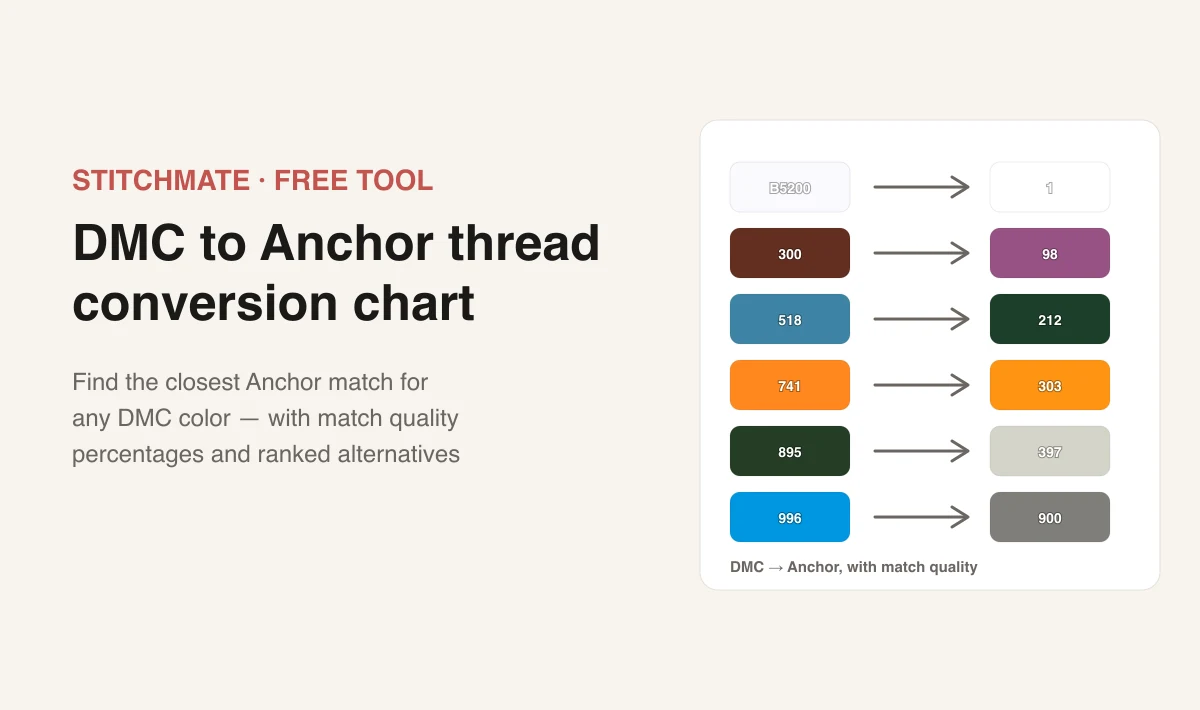
If you must convert mid-project, test first. Stitch a small sample with both threads side by side before committing. The DMC to Anchor conversion tool shows match quality percentages, so you'll know how close each substitute actually is before you buy replacement thread.
Need to convert thread codes? Use the DMC ↔ Anchor conversion tool — it shows match quality percentages, so you'll know how close each substitute actually is before you buy replacement thread.
Regional availability: what you can actually buy
Your location largely determines which brand makes practical sense.
North America:
- DMC: Available everywhere, including same-day pickup at major chains
- Anchor: Online ordering required in most areas; limited colors at some independents
United Kingdom:
- Anchor: Widely stocked at Hobbycraft, John Lewis, and independents
- DMC: Available but often pricier; better selection online
Australia and New Zealand:
- Anchor: The traditional choice, good availability
- DMC: Increasingly available, especially in cities and online
Continental Europe:
- Both widely available, with regional preferences varying by country
- Germany and Eastern Europe lean toward Anchor; France (unsurprisingly) favors DMC
Online anywhere: Both brands ship worldwide from multiple suppliers. If availability isn't driving your decision, you have complete freedom to choose based on preference.
Price comparison: what you’ll actually pay
Thread prices vary by retailer and region, but here's a realistic comparison (as of 2025):
United States (per skein):
- DMC: $0.50-0.70 at chain stores, often cheaper in multi-packs
- Anchor: $0.80-1.20 online, limited discount opportunities
United Kingdom (per skein):
- Anchor: £0.80-1.00 at craft stores
- DMC: £1.00-1.50, sometimes higher
The real cost consideration:
For most stitchers, the per-skein difference is negligible. A 20,000-stitch project might use 30 skeins total. At $0.30 per skein difference, that's $9 across a project you'll spend 100+ hours on.
The more significant cost is finding out mid-project that you can't source a color you need, forcing a conversion or a substitution, or ordering from overseas with long shipping times.
How to decide: a practical framework
Choose DMC if:
- You're in North America or want maximum pattern compatibility
- You prefer working from patterns without converting colors
- You're building a stash and want the most versatile collection
- Color consistency across decades matters (archives, heirloom projects)
Choose Anchor if:
- You're in the UK, Europe, or Australia where it's readily available
- You prefer a softer hand and silkier thread feel
- You're working from vintage British patterns (many specify Anchor)
- You love variegated threads and want the widest selection
Choose "both, strategically" if:
- You stitch from patterns using both systems
- You're experienced enough to manage conversion with confidence
- You have specific color needs that one brand meets better than the other
Mixing brands: when it works and when it doesn’t
Safe to mix:
- Different projects entirely (obviously)
- Specialty threads (metallic, variegated) with solid colors from the other brand
- Small accent areas isolated from the main stitching
- Backstitching in a different brand from the cross stitches
Risky to mix:
- Adjacent areas of "the same" color from different brands
- Large blocks where subtle shade differences accumulate
- Projects you plan to sell or gift (inconsistency suggests carelessness)
A practical rule: Use one brand for all your solid floss on a single project. Mix in specialty threads from either brand as needed.
What about Cosmo? Cosmo (Lecien) is a Japanese thread brand gaining popularity in the West, with 500 solid colors and an exceptionally smooth feel. It's a third option worth considering—especially if you appreciate soft thread handling and unique color blends. Browse the full range in the Cosmo color chart.
What about Madeira? Madeira is a professional-grade thread brand popular in machine embroidery but also used for hand stitching. If you work with Madeira alongside DMC, the DMC to Madeira conversion chart maps DMC codes to Madeira equivalents with match-quality ratings.
How Stitchmate handles both brands
Stitchmate's cross stitch pattern maker draws on a thread library that includes both DMC and Anchor catalogs with full color data. When you convert a photo to a pattern, you can match to either brand—or switch between them to see which gives you colors closer to your original image.
The pattern palette panel shows thread codes for your selected brand. If you're designing for sale, you can output DMC codes (what most customers expect) while keeping an Anchor version for your own stitching if that's your preference.
Color matching uses perceptual color distance (CIEDE2000), not just simple RGB values—so suggested threads actually look similar to your source colors, not just mathematically close.
See how your next pattern looks with DMC or Anchor colors
Common mistakes to avoid
Starting with whatever's on sale. Buying 50 skeins of random Anchor colors because they were discounted doesn't help if every pattern you want to stitch uses DMC. Build your stash around your actual needs.
Assuming conversion charts are precise. They're not. "DMC 310 = Anchor 403" means "these are reasonably similar," not "these are identical." Always verify critical colors yourself.
Switching brands mid-project without testing. That "equivalent" color might be close enough, or it might not be. A two-minute test swatch can save hours of regret.
Ignoring regional availability. Choosing DMC in the UK means higher prices and more online ordering. Choosing Anchor in the US means the same. Let geography inform your default choice.
Overthinking it. For casual stitching of small projects, this entire discussion barely matters. Both brands make beautiful, high-quality thread. The nuances matter most for large projects, commercial work, or building a long-term stash.
Washing and colorfastness
Both DMC and Anchor threads are colorfast when washed according to instructions—cold water, mild detergent, no bleach. However, some dark and saturated colors (particularly reds and dark blues) can bleed if soaked too long or washed in warm water.
DMC explicitly markets its threads as colorfast and provides washing instructions on each skein label. Many stitchers report excellent results washing DMC-stitched pieces years after completion.
Anchor also produces colorfast threads, though some stitchers report slightly more bleeding with very dark Anchor colors (particularly Anchor 150 and 1005). The safe practice with either brand: wash a test strand of any very dark color before committing.
Bottom line: Neither brand has a significant colorfastness advantage. If you're making something that will be washed regularly (a baby bib, a kitchen towel), pre-wash your thread strands in both brands.
Quick DMC to Anchor conversion — 10 most popular colors
| DMC | Name | Anchor equivalent |
|---|---|---|
| 310 | Black | 403 |
| Blanc | White | 2 |
| 321 | Red | 9046 |
| 817 | Coral Red | 13 |
| 3799 | Dark Pewter Gray | 236 |
| 436 | Tan | 363 |
| 726 | Light Topaz | 295 |
| 740 | Tangerine | 316 |
| 699 | Green | 923 |
| 3371 | Black Brown | 382 |
For the full conversion table with all 489 DMC colors, use the DMC to Anchor conversion tool.
Ready to see how your next pattern looks?
Upload a photo and Stitchmate will match it to DMC or Anchor colors—or both—so you can compare before you buy thread.
Try the Photo ConverterNo account required to start.
FAQ
Can I use DMC and Anchor threads in the same project?
Which has more colors, DMC or Anchor?
Are DMC to Anchor conversion charts accurate?
Is one brand higher quality than the other?
What if my pattern only lists one brand and I want to use the other?
Which brand do professional cross stitchers use?
Should I convert my entire stash inventory between brands?
Is Anchor the same as DMC now that DMC owns them?
Related Guides & Tools

DMC Color Chart
Browse all 489 DMC colors with names, codes, and brand equivalents.

Anchor Color Chart
Browse all 446 Anchor colors with DMC equivalents.
DMC to Anchor Conversion
Convert thread codes between brands instantly.
Cross Stitch Thread Types
Beyond DMC and Anchor — hand-dyed, metallic, silk, variegated, and more.
How Many Colors for Cross Stitch?
Find the right color count for your pattern type.
Thread Blending Guide
Combine strands from different colors — or different brands — on one needle for custom shades.
How to Reduce Colors in a Pattern
Cut thread count without sacrificing detail.
What Is Confetti in Cross Stitch?
What causes scattered stitches and how to handle them.