| Project type | Stitch count | Estimated hours | At 1 hr/day |
|---|---|---|---|
| Small motif (50×50) — bookmarks, coasters, ornaments | 1,500–2,500 | 14–23 hours | 2–3 weeks |
| Medium piece (100×100) — small framed pieces, samplers | 7,500–10,000 | 70–93 hours | 2–3 months |
| Large project (200×200) — detailed portraits, landscapes | 30,000–40,000 | 280–373 hours | 9–12 months |
| Full coverage (300×300) — large wall pieces, HAEDs | 67,500–90,000 | 630–840 hours | 1.5–2.5 years |
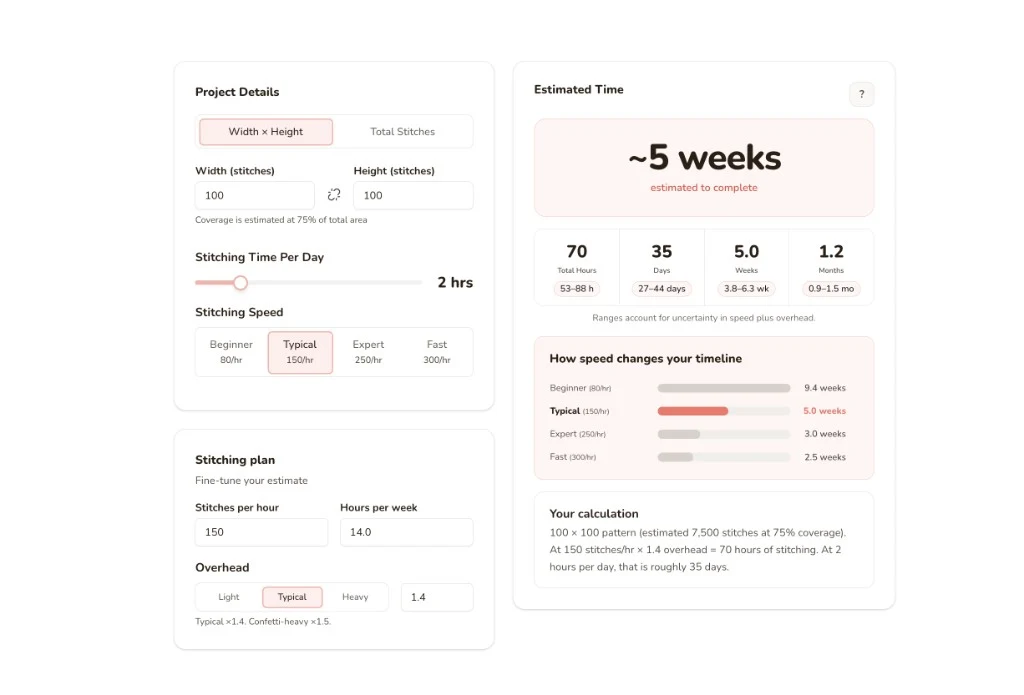
Cross Stitch Time Calculator
Realistic cross-stitch time estimate in hours and weeks — includes overhead for thread changes and counting.
Project Details
100
100
Coverage is estimated at 75% of total area
Stitching plan
Fine-tune your estimate
150
14
1.4
Typical ×1.4. Confetti-heavy ×1.5.
Estimated Time
?~5 weeks
estimated to complete
70
Total hours
53–88 h35
Days
27–44 days5.0
Weeks
3.8–6.3 wk1.2
Months
0.9–1.5 moRanges account for uncertainty in speed plus overhead.
How speed changes your timeline
Your calculation
100 × 100 pattern (estimated 7,500 stitches at 75% coverage). At 150 stitches/hr × 1.4 overhead = 70 hours of stitching. At 2 hours per day, that is roughly 35 days.
How long does cross stitch take?
The short answer: a small bookmark takes 2–5 weeks. A detailed portrait can take over a year. But the real answer depends on three things most online estimates ignore — and getting them wrong is why projects always seem to take longer than expected.
A 10,000-stitch pattern at average speed takes roughly 50–100 hours of actual work. Not stitching time — work time, including thread changes, counting, breaks, and the occasional mistake. That distinction matters more than most calculators admit.
Use the calculator above to get a realistic estimate for your specific project. Below, we break down exactly what affects your timeline — and what you can do about it.
Average cross stitch speed
Most stitchers work at 100–200 stitches per hour once they're past the learning curve. That number accounts for the full cross stitch (two diagonal passes), checking the chart, managing thread, and switching colors.
Here's what speed actually looks like at each level:
Beginners (60–100 stitches/hr) are building muscle memory for counting, maintaining even tension, and handling thread. Most people report landing around 80 stitches per hour after their first few projects. This is completely normal — accuracy matters more than speed at this stage.
Average stitchers (100–200 stitches/hr) are comfortable with their technique and stitch at a relaxed pace. Forum stitchers who time themselves — an important caveat, since people who track tend to be faster — typically report 100–160 stitches per hour.
Experienced stitchers (200–300 stitches/hr) use techniques like railroad stitching (laying each strand flat before completing the cross) and often work with a stitching stand. Around 250 stitches per hour is documented as "pretty fast by most people's standards" in timed community sessions.
Burst speed (350–400 stitches/hr) is sometimes reported on large single-color blocks with no chart-checking required. This is not a sustainable rate across a full pattern with color changes — it drops significantly once you factor in threading, counting, and switching between colors.
The biggest factor in finishing a cross stitch project isn't speed — it's consistency. A stitcher who works 30 minutes a day finishes more than one who binges for eight hours once a month.
Why online estimates feel too low
Here's the thing most calculators get wrong: they divide stitch count by stitches per hour and call it done. That gives you pure stitching time — needle-in-fabric time with no interruptions.
Real projects don't work that way.
Every color change costs 30–60 seconds for ending, threading, and starting. A 25-color pattern might have hundreds of color changes across its full area. Counting and chart-checking eat time, especially on complex sections. Breaks happen — hands cramp, eyes need rest, cats require attention.
This is what stitchers call overhead, and it typically adds 30–50% to pure stitching time. Our calculator uses an overhead multiplier (default ×1.4) to account for this. A pattern that looks like 50 hours of stitching is realistically 65–75 hours of project time.
The overhead isn't fixed, either. A pattern with large color blocks and 15 colors has much lower overhead than a confetti-heavy pattern with 40 colors. More on that below.
What makes a pattern slow or fast?
Two 10,000-stitch patterns can take wildly different amounts of time. The stitch count is the same — what changes is the texture of the work.
Color count matters more than you'd expect. Every additional color means more thread changes, more bobbins to manage, and more chart-checking. A 15-color landscape is noticeably faster per stitch than a 40-color portrait, even at the same size. The sweet spot for most projects is 20–30 colors — enough detail to look good, few enough to keep the work flowing.
Confetti is the biggest time sink. Stitchers call isolated single stitches scattered across a pattern "confetti" — and they're dramatically slower than color blocks. Each confetti stitch means threading a new color, making one or two crosses, ending the thread, and moving on. A pattern with heavy confetti can take 30–50% longer than one with clean color regions, even at the same stitch count. This is the main reason photo conversions feel slower than they "should."
Fabric count changes your pace. Lower count fabric like 11ct Aida has larger holes and bigger stitches, making it faster to work on. Higher counts like 18ct Aida or 28ct evenweave over two require more precision — most stitchers report being 20–30% slower on 18ct compared to standard 14ct.
Backstitch and specialty stitches add up. French knots, backstitching, and partial stitches all take significant time on top of the cross stitch count. They're not included in stitch totals, so a pattern marked "10,000 stitches" with extensive backstitching will take notably longer than that number suggests.
Typical cross stitch project times
These estimates assume an average speed of 150 stitches per hour with ×1.4 overhead, stitching one hour per day. Your actual timeline will vary — use the calculator above for a personalized estimate.
These numbers assume roughly 75% coverage (most patterns don't fill every square). Full-coverage designs like HAEDs will be at the higher end. Patterns with heavy confetti or 40+ colors may exceed these estimates by 20–30%.
How to stitch faster
The biggest gains come from your setup, not your hand speed.
Use a stitching stand. This is the single highest-impact change. A stand frees both hands, letting you work with one on the front and one on the back of the fabric. Many stitchers report nearly doubling their pace after switching from hand-held hoops to a floor or lap stand.
Get proper lighting. An LED daylight lamp (5000–6500K) reduces eye strain, makes counting easier, and helps you distinguish similar thread colors. Squinting at a chart under dim light is slower than you realize until you fix it.
Use the cross country method for color blocks. Complete all stitches of one color in an area before switching to the next. This is generally faster than parking for patterns with defined color regions. For confetti-heavy sections, parking — leaving threaded needles at the next stitch position — reduces re-threading time, even though it's slower per stitch. Scarlet Quince's parking tutorial is the community's most-referenced guide to this technique.
Reduce confetti before you start. If you're converting a photo to a pattern, reducing the color count often eliminates 80% of scattered single stitches. The tradeoff is less subtle color gradation, but for most projects, 20–25 colors produces a cleaner, faster, and more satisfying stitch than 40+. This is the single most effective way to reduce project time.
Pre-sort your threads. Organize bobbins on a ring or numbered card before you start so color changes are quicker. This sounds minor, but across hundreds of color changes, the seconds add up.
Use the loop start method. Cut one strand at double length, fold in half, thread the two cut ends through the needle, and catch the loop with your first half-stitch on the back. It's faster and neater than knotting, and it works with any even number of strands.
Not all stitches are created equal
This is where most time estimates fall apart. They treat every stitch as identical, but the arrangement of stitches matters as much as the count.
A 10,000-stitch pattern with 15 colors arranged in clean blocks might take 70 hours. The same stitch count with 40 colors and heavy confetti could take 110+ hours. The stitches are the same — what changed is the overhead.
Stitchmate's FLOW score measures this directly. It evaluates a pattern's stitchability — how fragmented the colors are, how well they cluster into workable regions, and how much thread waste you'll generate. Two patterns with identical stitch counts can have very different FLOW scores, and that score is a better predictor of actual project time than stitch count alone.
If you're converting a photo and want to know whether the result will be pleasant to stitch or painfully slow, upload it and check the FLOW score before you commit. It takes about 30 seconds and can save you from a frustrating multi-month project.
Related Guides & Tools

Cross stitch calculator
Finished fabric size, framing margins, needle size and time estimate in one pass.
How Long Does Cross Stitch Take?
Deep dive on realistic time — speed, overhead, confetti, and why online estimates feel too low.
Fabric Calculator
Finished size and fabric to cut from stitch count and fabric count — margins for framing included.

Photo to Cross Stitch
Turn a photo into a pattern with stitch count, color count, and FLOW stitchability score.
What Is FLOW Score?
How Stitchmate scores stitchability so you can spot frustrating patterns before you start.
What Is Confetti in Cross Stitch?
Why scattered stitches slow you down and what to do about it.
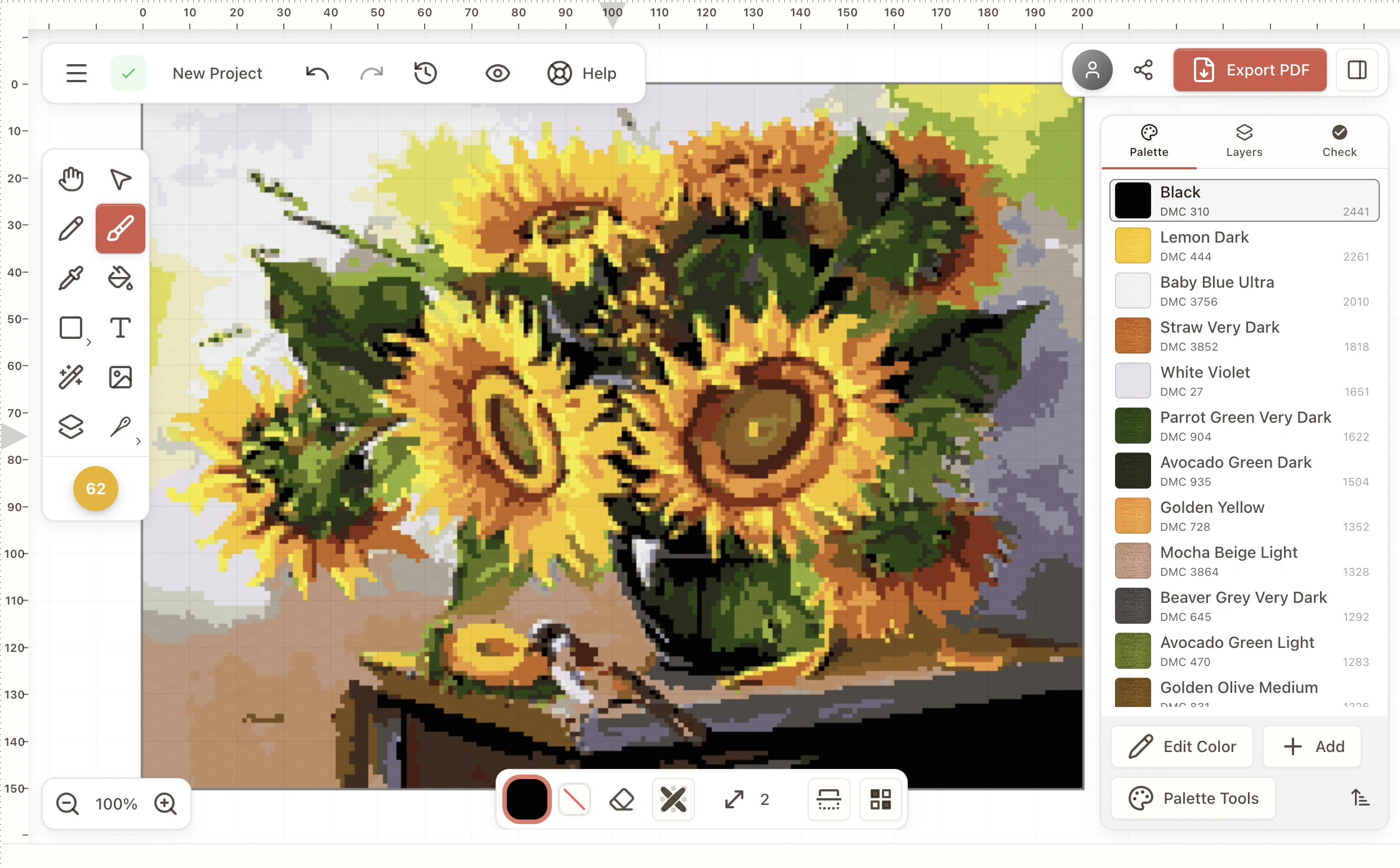
Cross Stitch Chart Maker
Create patterns from scratch — draw, match threads, export printable charts.
Time depends on more than stitch count
Thread changes, confetti stitches, and color complexity all affect how a project feels to stitch — two patterns with the same stitch count can take very different amounts of time. Stitchmate's FLOW score measures stitchability so you can spot problem patterns before you start.
FAQ
What's a realistic stitches-per-hour rate?
Most people land between 100 and 160 stitches per hour at a comfortable pace. Beginners typically start at 60–80 and speed up over the first few projects. If you want to know your personal rate, time one focused 30-minute session, count completed stitches, and double it.
What overhead multiplier should I use?
Start with ×1.4 if you're not sure — that's typical for a pattern with moderate color changes. Use ×1.2 for patterns with large single-color blocks and few colors. Use ×1.5 or higher for confetti-heavy patterns with 30+ colors.
Why does my project always take longer than estimated?
Most likely because the estimate didn't account for overhead. Pure stitching time (stitch count ÷ speed) only measures needle-in-fabric time. Real projects include thread changes, counting, breaks, mistakes, and frogging. Multiply by 1.3–1.5 for a realistic number.
Does confetti really add that much time?
Yes. Isolated single stitches require a full thread change — end, cut, thread, start — for one or two crosses. In a confetti-heavy pattern, you might make hundreds of these micro-changes. Forum stitchers consistently report 30–50% longer completion times on confetti-heavy patterns versus clean-block patterns of the same size.
Is parking faster than cross country?
For color blocks, cross country is faster. For confetti-heavy sections, parking reduces re-threading by leaving needles in place, but it's slower per stitch and creates a messier working surface. Most experienced stitchers use a hybrid — cross country within blocks, parking through confetti areas.
How long does a full-coverage HAED take?
HAEDs (Heaven and Earth Designs) are typically 200×300 to 400×500+ stitches with 80–120 colors at full coverage. At average speed with one hour per day, a medium HAED takes 2–4 years. Large ones can take 5+ years. These are commitment projects — check the FLOW score and overhead multiplier before starting.
Does fabric count affect speed?
Yes. Most stitchers are 20–30% slower on 18ct compared to 14ct because the holes are smaller and the work requires more precision. Going the other direction, 11ct is noticeably faster but produces a coarser finished piece. 14ct is the most common starting point for a reason — it balances speed, detail, and ease of counting.
See how your photo converts
Cross stitch is a real commitment — real thread, real hours, real frustration if the pattern doesn't work. Stitchmate lets you see exactly what you're getting into before you buy the first skein.
Upload an image, adjust the settings, check the FLOW Score — about 30 seconds to know if it'll work. Everything up to PDF export is free, no account needed.
Upload Your Photo Free