| Fabric count | 1 strand | 2 strands | 3 strands |
|---|---|---|---|
| 11-count Aida | ~1,510 | ~750 | ~500 |
| 14-count Aida | ~1,920 | ~960 | ~640 |
| 16-count Aida | ~2,190 | ~1,100 | ~730 |
| 18-count Aida | ~2,470 | ~1,230 | ~820 |
| 22-count Aida | ~3,020 | ~1,510 | ~1,000 |
| 28-count evenweave over 2 | ~1,920 | ~960 | ~640 |
Cross stitch thread & floss calculator
Embroidery floss and thread calculator for cross stitch and needlework. DMC, Anchor, Cosmo, Madeira, and 50+ brands — adjusted for fabric count and strands.
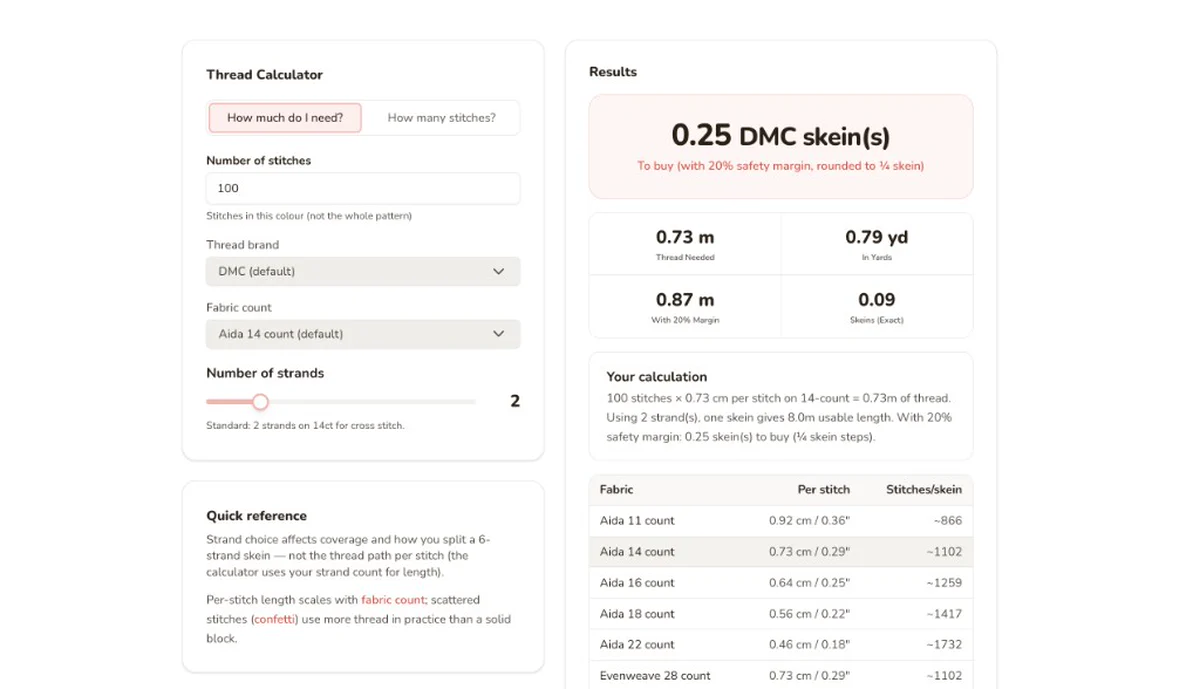
Thread Calculator
100
Stitches in this color (not the whole pattern)
Standard: 2 strands on 14ct for cross stitch.
Quick reference
Strand choice affects coverage and how you split a 6-strand skein — not the thread path per stitch (the calculator uses your strand count for length).
Per-stitch length scales with fabric count; scattered stitches (confetti) use more thread in practice than a solid block.
Results
0.25 DMC skein(s)
To buy (with 20% safety margin, rounded to ¼ skein)
2.50 m
Thread needed
2.73 yd
In yards
3.00 m
With 20% margin
0.10
Skeins (exact)
Your calculation
100 stitches × 2.50 cm per stitch on 14-count = 2.50m of thread. Using 2 strand(s), one skein gives 24.0m usable length. With 20% safety margin: 0.25 skein(s) to buy (¼ skein steps).
| Fabric | Per stitch | Stitches/skein |
|---|---|---|
| Aida 11 count | 3.18 cm / 1.25" | ~754 |
| Aida 14 count | 2.50 cm / 0.98" | ~960 |
| Aida 16 count | 2.19 cm / 0.86" | ~1097 |
| Aida 18 count | 1.94 cm / 0.77" | ~1234 |
| Aida 22 count | 1.59 cm / 0.63" | ~1508 |
| Evenweave 28 count | 2.50 cm / 0.98" | ~960 |
Thread per stitch by fabric count (2 strands); stitches/skein uses DMC skein length (8.0m).
How many stitches are in a skein of DMC floss?
One 8-meter DMC skein covers roughly 960 full cross stitches on 14-count Aida using 2 strands. On 18-count that rises to about 1,230, because each stitch is smaller. On 11-count it drops to around 750. Those figures already allow for tails and waste — the theoretical maximum is higher.
Strand count matters as much as fabric count. A 6-strand skein splits into three 2-strand bundles or six 1-strand bundles, so dropping from 2 strands to 1 doubles how far a skein goes.
Those are averages. For an actual per-color skein count on your own pattern, use the calculator above.
How much cross stitch thread do I need?
Running out of embroidery floss mid-project isn't just annoying — it's risky. Replacement skeins from a different dye lot can be a slightly different shade, and the difference shows in the finished piece. Buying too much is the safer mistake, but skeins add up fast on large projects with 30+ colors.
This cross stitch and embroidery thread calculator tells you the exact floss length and number of skeins needed for any color in your pattern. It supports DMC, Anchor, Cosmo, Madeira, and 50+ thread brands — and adds a safety margin so you buy enough the first time.
Enter the stitch count for a single color (not the whole pattern), pick your fabric and brand, and get the number.
How the thread calculation works
Each cross stitch uses a specific length of thread determined by the size of the stitch — which depends on your fabric count. On standard 14-count Aida (14 stitches per inch), each full cross stitch uses approximately 2.5cm (1 inch) of thread. That accounts for both diagonal passes of the cross plus the thread traveling across the back of the fabric between stitches.
Higher count fabric means smaller stitches and less thread per stitch. Lower count means larger stitches and more thread. Here's how it breaks down:
| Fabric | Thread per stitch | Stitches per skein (2 strands) |
|---|---|---|
| 11-count Aida | 3.2cm / 1.3" | ~750 |
| 14-count Aida | 2.5cm / 1.0" | ~960 |
| 16-count Aida | 2.2cm / 0.9" | ~1,100 |
| 18-count Aida | 1.9cm / 0.8" | ~1,230 |
| 22-count Aida | 1.6cm / 0.6" | ~1,510 |
| 28-count over 2 | 2.5cm / 1.0" | ~960 |
These numbers assume a standard stitching style with moderate tension. Your actual usage will vary — stitchers who pull tight use less thread per stitch, and those who stitch loosely use more.
The strand count affects how many usable lengths you can pull from each skein, not the thread path per stitch. Using 2 strands means you can separate the 6-strand skein into three bundles of two. Using 3 strands gives you two bundles. The calculator adjusts automatically.
How many strands for cross stitch on 14 count?
The standard is 2 strands for cross stitches and 1 strand for backstitch on 14-count Aida. This is what the vast majority of patterns call for, and it gives full coverage without the stitches looking bulky.
For other fabric counts, the strand count can change:
11-count Aida sometimes uses 3 strands for fuller coverage, since the larger grid leaves more fabric visible between stitches. Some stitchers prefer 2 strands even on 11-count for a lighter, more textured look — it depends on the design.
16-count and 18-count Aida typically use 2 strands. The stitches are smaller but 2 strands still provides good coverage. Dropping to 1 strand on 18-count creates a very delicate, almost watercolor effect, but coverage will be incomplete.
28-count evenweave or linen over 2 is functionally equivalent to 14-count Aida in stitch size, so 2 strands is standard. Stitching over 1 thread on 28-count (creating tiny stitches) usually calls for 1 strand.
If your pattern doesn't specify strand count, 2 strands on 14-count is the safe default. For a full breakdown of strand counts by fabric type and thread brand, see the thread types guide.
How much floss is in a DMC skein?
A standard DMC embroidery floss skein contains 8 meters (8.7 yards) of 6-strand thread. Since you separate the strands before stitching, the usable length depends on how many strands you use:
| Strands used | Bundles per skein | Usable thread length |
|---|---|---|
| 1 strand | 6 bundles | 48m (52.5 yd) |
| 2 strands | 3 bundles | 24m (26.2 yd) |
| 3 strands | 2 bundles | 16m (17.5 yd) |
| 6 strands | 1 bundle | 8m (8.7 yd) |
Other thread brands have different skein sizes. Anchor skeins are also 8 meters. Madeira skeins are 10 meters — so you get more usable thread per skein. Cosmo skeins are 8 meters. The calculator adjusts for each brand automatically.
In practice, you never use 100% of a skein. Thread tails at the start and end of each length, waste from mistakes, and unusable short remnants mean the real yield is roughly 80–85% of the theoretical maximum. The calculator accounts for this with a built-in safety margin.
Why the safety margin matters
The calculator adds a 20% safety margin to the raw thread calculation. That might sound generous, but it's based on where thread actually goes:
Starting and ending each length costs 2–3cm of thread for anchoring. If you're using 45cm (18-inch) cut lengths — the standard recommendation — and your pattern has a color that appears in 40 separate areas, that's 40 start/stop cycles for one color. At 2–3cm each, you lose 80–120cm just to anchoring. On a small color that only needs one skein, that's a meaningful chunk.
Mistakes and frogging consume thread you can't recover. The thread gets stressed and fuzzy from being pulled through fabric, removed, and potentially re-stitched. Most stitchers cut a fresh length after frogging rather than reusing the old one.
Confetti stitches are especially wasteful. A color that appears as scattered single stitches across a pattern requires many short thread runs with frequent start/stop cycles. The same color arranged in a solid block would use significantly less total thread because you'd make fewer cuts and waste fewer tails.
Dye lots vary. This is the real reason to buy enough upfront. DMC's quality control is good, but skeins from different production batches can show subtle shade differences — especially in lighter colors and pastels. Side by side in your hand, two skeins might look identical. Stitched next to each other on fabric, the difference can be visible. Buying all your skeins for a color at once, from the same shop visit, minimizes this risk.
How long should I cut my thread?
The standard advice is 18 inches (45cm) — roughly fingertips to elbow. This length balances efficiency against thread wear.
Shorter lengths (12–15 inches) mean more re-threading but less tangling, less fraying, and less thread stress. Use shorter lengths for metallic threads (which fray quickly), dark colors on light fabric (where thread wear shows), and confetti-heavy sections (where you're starting and stopping frequently anyway).
Longer lengths (20–24 inches) are tempting for large single-color areas, but the thread passes through the fabric dozens of times and gets progressively thinner and fuzzier. The last few stitches from a long thread look noticeably different from the first few. Most experienced stitchers stay at or below 18 inches.
One practical tip: if you're using the loop start method (the community's preferred anchoring technique), you'll cut your thread at double length — 36 inches — and fold it in half. The loop start only works with even strand counts (2, 4, or 6 strands).
Thread calculator vs. pattern thread estimates
Many cross stitch patterns include a thread list with estimated skein counts. These estimates are usually calculated by the pattern software (PCStitch, WinStitch, etc.) and tend to be optimistic — they assume minimal waste and don't always account for confetti distribution.
This calculator gives you a per-color estimate based on the actual stitch count for that color, your specific fabric count, and your strand count. It's useful in three situations:
Checking a pattern's estimates. If a pattern says you need 2 skeins of DMC 310 (black) but your calculator says 3, buy 3. The pattern estimate might be using different assumptions about fabric count or waste.
Planning a project without a thread list. Some patterns — especially free ones and PDF imports — don't include skein estimates. If you know the stitch count per color (which Stitchmate shows in the editor palette), you can calculate exact requirements.
Switching fabric counts. A pattern designed for 14-count will use different thread amounts on 18-count — see the fabric calculator for finished size implications. The stitch count stays the same, but the thread per stitch changes. Recalculating after a fabric change prevents surprises.
Related Guides & Tools

Cross stitch calculator
Finished fabric size, framing margins, needle size and time estimate in one pass.

DMC color chart
All 489 DMC colors with hex values, color families, and closest matches across brands. Sampled from official scanned thread cards.
Fabric calculator
Know your finished size and how much fabric to cut before you start. Includes framing margins.
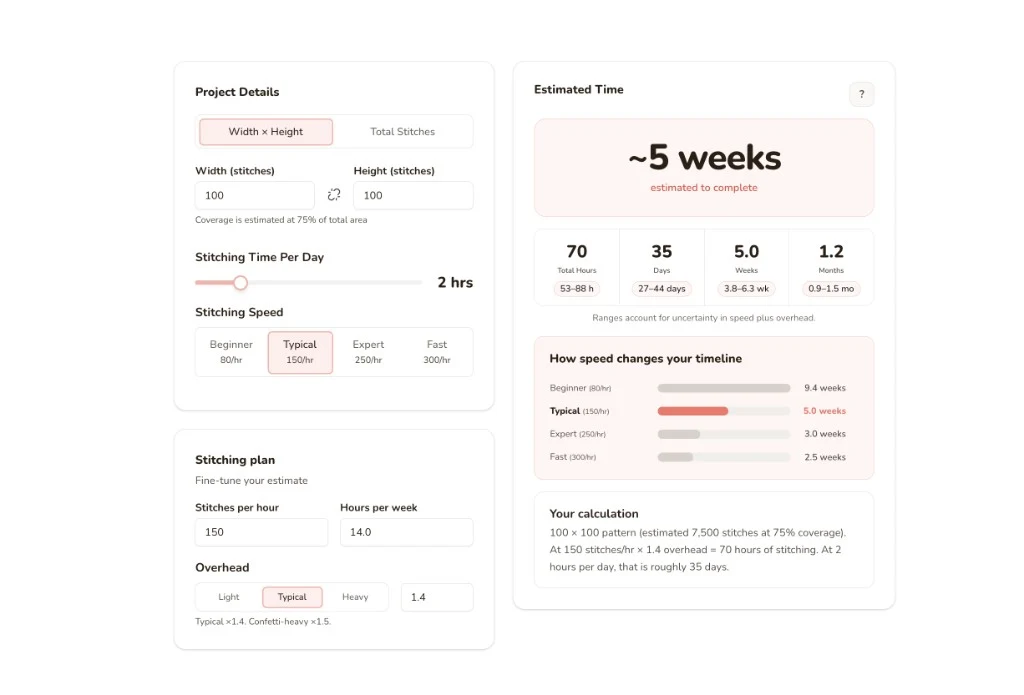
Time calculator
Estimate how long your project will take — including overhead for thread changes, counting, and breaks.

Photo to cross stitch converter
Convert any photo into a pattern with automatic per-color stitch counts, so you know exactly what to plug into this calculator.
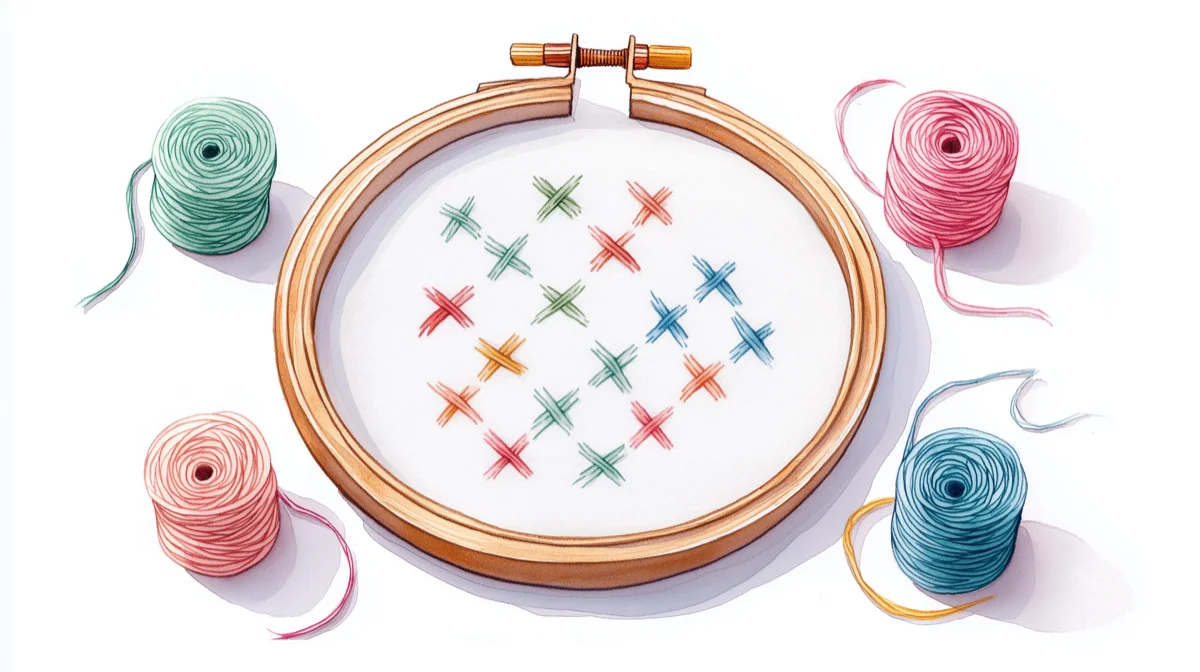
What is confetti in cross stitch?
Why scattered stitches use more thread than you'd expect, and how to reduce them.
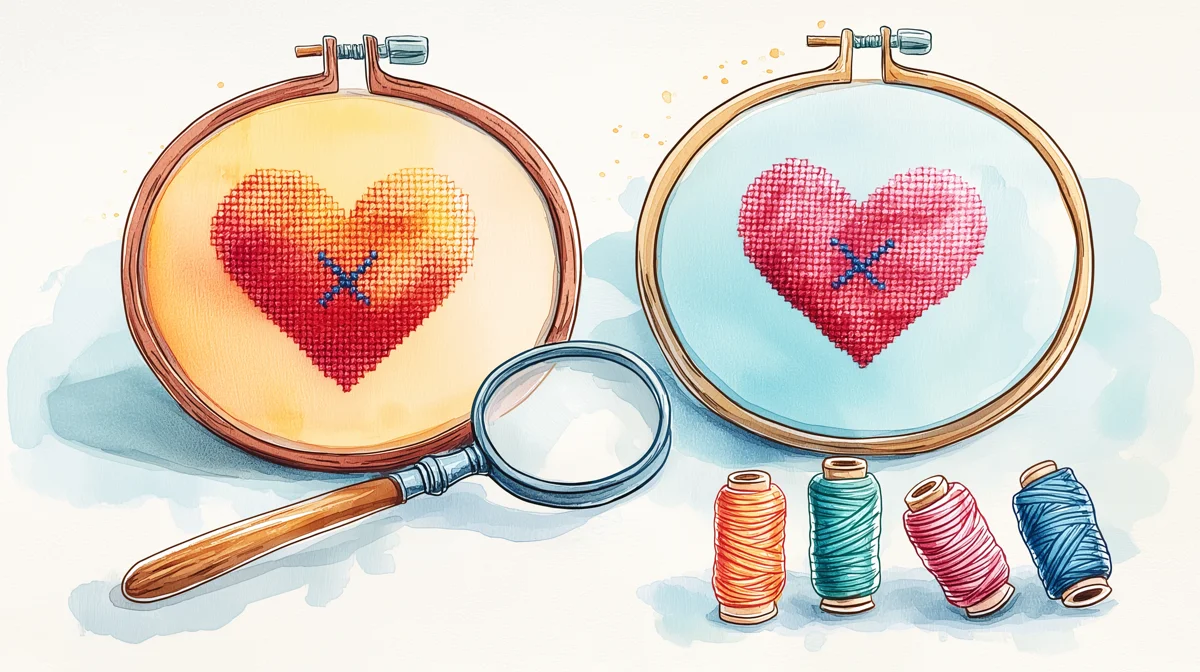
DMC vs Anchor thread
Skein sizes, color range, coverage, and when to choose one over the other.
FAQ
How many stitches does one skein of DMC cover?
On 14-count Aida with 2 strands, one DMC skein (8 meters) covers approximately 960 full cross stitches. On 18-count, that number rises to about 1,230 because each stitch is smaller. These are practical estimates with typical waste factored in — the theoretical maximum is higher.
How many yards are in a DMC skein?
8 meters, which is 8.7 yards. That is the length of the full 6-strand skein. Because you separate the strands before stitching, a skein gives you roughly 26 yards of 2-strand thread or 52 yards of single-strand thread.
How much embroidery floss do I need for my project?
Count the stitches for one color, then divide by the stitches-per-skein figure for your fabric count and strand count — about 960 on 14-count Aida with 2 strands. The calculator above does this per color and adds a safety margin, so you can buy the right number of skeins in one trip.
Do I need to calculate thread for backstitch separately?
Yes. Backstitch uses different amounts of thread than cross stitches, and it's typically done with 1 strand instead of 2. A rough rule: 1cm of backstitch line uses about 2cm of thread (accounting for the back-and-forth path through fabric). If your pattern has extensive backstitch outlining, it can add 10–20% to your total thread needs for those colors.
What if my pattern uses blended colors (two colors in one needle)?
Each color in a blend uses thread at the same rate as if it were stitched alone with fewer strands. A 2-strand blend of DMC 310 + DMC 3371 uses the same amount of each color as 1-strand stitching would — half the coverage per stitch per color, so you need the same total length but split across two skeins.
Is Anchor thread the same thickness as DMC?
They're similar but not identical. Anchor tends to be very slightly thinner, which some stitchers find gives marginally less coverage per stitch on lower-count fabrics. For thread calculation purposes, the difference is negligible — both come in 8-meter skeins with 6 strands.
Should I buy extra skeins of dominant colors?
Yes. If a color covers large portions of your pattern (backgrounds, skin tones, sky), buy one extra skein beyond what the calculator says. Dominant colors are the most visible, so a dye lot mismatch mid-project is most noticeable there. For colors with fewer than 200 stitches, one skein is almost always sufficient.
How do I find the stitch count per color?
Most pattern software shows per-color stitch counts in the thread legend or palette panel. In StitchMate, the palette sidebar shows the stitch count next to each color. For patterns without this information, you'd need to count manually — or import the pattern into an editor that calculates it automatically.
Does this calculator work for hand embroidery, not just cross stitch?
Yes. The thread-per-stitch math differs (embroidery stitches vary in length more than cross stitches), but for estimating skein counts based on a known stitch count, the calculation is the same — both crafts use the same DMC, Anchor, and Cosmo 6-strand floss. For embroidery, you may want to increase the safety margin since stitch lengths are less uniform.
See how your photo converts
Cross stitch is a real commitment — real thread, real hours, real frustration if the pattern doesn't work. Stitchmate lets you see exactly what you're getting into before you buy the first skein.
Upload an image, adjust the settings, check the FLOW Score — about 30 seconds to know if it'll work. Everything up to PDF export is free, no account needed.
Upload Your Photo Free