Cross Stitch Thread Types — Practical Guide to Choosing
For 95% of projects, it's stranded cotton, two strands, DMC or Anchor. But knowing when to reach for something different can make a real difference to the finished piece.
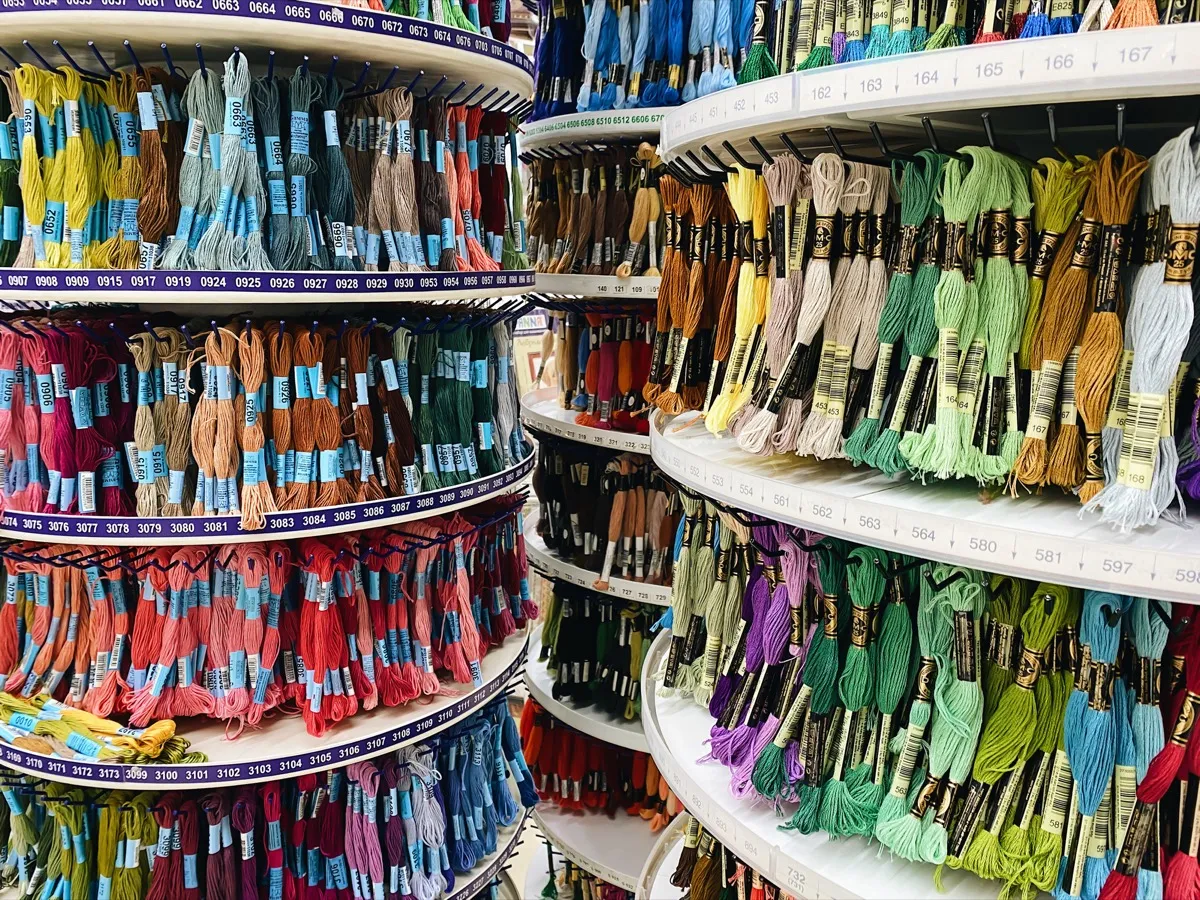
Quick answer: For most cross stitch, use stranded cotton (embroidery floss) — two strands on 14-count Aida. DMC and Anchor are the go-to brands. But metallics, hand-dyed threads, silk, and variegated threads each have their place when you want something different. Lord Libidan has a good overview of matching thread types to project styles — this guide goes deeper into each type, the major brands, and practical tips.
Stranded cotton (embroidery floss)
The standard. The default. The one you'll use on almost everything.
Stranded cotton is six loosely twisted strands of mercerized cotton. You separate them and use however many the pattern calls for — usually two on 14-count Aida. Each strand is smooth, colorfast, and predictable. One DMC 310 skein stitches exactly like the next one.
That predictability is the point. When a pattern says "DMC 3371," the designer knows exactly what color you'll get, and you know exactly how it'll look on the fabric.
The main stranded cotton brands
DMC — The most widely used brand worldwide. 489 colors, available in virtually every craft shop and online store. Most patterns specify DMC color codes. If you're ever unsure which brand to buy, DMC is the safe choice. Each skein is 8 meters of thread, which works out to about 24 meters of usable thread (since you typically use two of the six strands). Browse all 489 colors on the DMC color chart.
Anchor — Made by Coats, especially popular in the UK and Europe. Around 460 colors. Anchor uses its own numbering system — Anchor 403 is not the same color as DMC 403. If your pattern calls for one brand and you want to use the other, you'll need a conversion tool. The quality is comparable to DMC; which brand you prefer often comes down to availability and which color range better matches what you need.
For a detailed comparison, see our DMC vs Anchor guide.
Cosmo — A Japanese brand by Lecien, with around 500 colors. Cosmo threads have a slightly softer twist and a silkier feel than DMC. The color palette leans toward muted, earthy tones — gorgeous for nature scenes, Scandinavian-style designs, and anything with a warm, understated aesthetic. Less widely available outside Japan, but increasingly stocked by online needlework shops. Browse the Cosmo color chart.
Madeira — A Portuguese brand with roughly 380 colors. Known for vibrant saturation and smooth stitching. Often specified in European patterns and kits. Browse the Madeira color chart.
Sullivans — A budget-friendly alternative to DMC with a similar color range. Quality is decent for the price. Worth considering if you're stocking up for a large project and cost matters.
CXC — A Chinese brand that copies DMC's numbering system directly (CXC 310 is intended to match DMC 310). The price is significantly lower — roughly a third of DMC. Quality varies: some stitchers find it perfectly acceptable for practice pieces and gifts; others report inconsistent dye lots and a slightly rougher texture. The cross stitch community has strong opinions about CXC. Try a few skeins before committing to a full stash.
How many strands to use
This is one of the most common questions beginners have, and the honest answer is: it depends on your fabric, your tension, and your personal preference. But here's where most stitchers start:
| Fabric | Strands for cross stitch | Strands for backstitch | Notes |
|---|---|---|---|
| 11-count Aida | 3 | 1–2 | Full, chunky coverage |
| 14-count Aida | 2 | 1 | The most common pairing |
| 16-count Aida | 2 | 1 | Standard coverage |
| 18-count Aida | 1–2 | 1 | Test on scrap fabric — some prefer 1, some prefer 2 |
| 28-count evenweave (over 2) | 2 | 1 | Same as 14-count Aida |
| 32-count evenweave (over 2) | 2 | 1 | Same as 16-count Aida |
| 36-count linen (over 2) | 1–2 | 1 | Fine work — test first |
The goal is full coverage without over-bulking. If the fabric shows through between stitches, add a strand. If the thread bunches and won't lie flat, drop a strand.
There's no cross stitch police here — if you prefer the look of three strands on 14-count, that's your choice. Just be consistent across the project.
For more about how fabric count affects strand choice, see our Aida count guide.
Hand-dyed and overdyed threads
This is where threads get interesting — and where no two skeins are exactly alike.
Hand-dyed threads are stranded cotton that's been individually dyed (usually by hand, in small batches) to create subtle color variations within each strand. Instead of a flat, uniform color, you get gentle shifts — a brown that moves from chocolate to caramel, or a green that drifts between sage and olive.
The effect when stitched is beautiful. Solid DMC stitching looks clean and precise; hand-dyed stitching looks warm, aged, and organic. It's the difference between a photograph and a watercolor.
The big three hand-dyed brands
Weeks Dye Works — 355 colors. Six-strand, 100% Egyptian cotton, sold in 5-yard skeins (shorter than DMC's 8.7-yard standard). The color variations are subtle and blend naturally. WDW is the default for sampler patterns — designers like Little House Needleworks, Blackbird Designs, and With Thy Needle & Thread specify WDW colors constantly. Serendipity Needleworks has an excellent deep-dive into working with WDW, including tips on stranding and preserving color flow. Browse all colors on the Weeks Dye Works color chart.
Classic Colorworks — Formerly Crescent Colors. Similar to WDW in concept — hand-overdyed six-strand cotton. Around 300 colors with names like "Nutmeggie" and "Ye Olde Gold." Slightly less colorfast than WDW (the manufacturer explicitly notes this), so wash with care. Browse the Classic Colorworks color chart.
The Gentle Art (Sampler Threads) — Around 240 colors. Slightly thinner strands than DMC or WDW, so you may want to adjust your strand count. The color palette is very muted and autumnal — beautiful for primitive and folk-art designs.
When to use hand-dyed threads
Hand-dyed threads shine in sampler patterns, primitive designs, nature themes, and anything where you want a vintage or antique feel. They're also lovely for large single-color backgrounds, where the subtle variation prevents the flatness that solid thread can create.
The tradeoff: hand-dyed threads cost more (roughly $2.50–3.00 per 5-yard skein vs $0.50–0.80 for DMC), they're shorter per skein, and dye lots can vary between purchases. Buy all the skeins you need for a project at once — preferably from the same dye lot.
Also worth knowing: DMC conversion charts exist for most hand-dyed colors, but the whole point of using hand-dyed thread is the variation. Substituting DMC will give you the approximate hue but not the character. If a pattern specifies WDW, the designer chose it for a reason.
Metallic threads
Let's be honest: metallic threads are beautiful in the finished piece and frequently maddening to stitch with. Hannah Hand Makes has a thorough walkthrough of the entire DMC thread range — including Light Effects, Étoile, and Diamant — if you want to see all the metallic options side by side.
They add sparkle and shimmer to specific areas — stars, jewelry, Christmas ornaments, water highlights, snow. The finished effect is genuinely stunning. The stitching experience involves a lot of patience, some creative language, and short thread lengths.
What makes them difficult
Metallic threads twist, fray, shred, and break more easily than cotton. The metallic coating creates friction against the fabric, and the thread doesn't have the flexibility of cotton. It's not impossible — millions of stitchers use metallics regularly — but it requires adjustments to your technique.
How to work with metallics (without losing your mind)
- Cut short lengths — 30 cm (12 inches) maximum. Longer lengths fray from repeated pulling through fabric.
- Use a larger needle — go up one size from your usual. This opens a slightly bigger hole in the fabric, reducing friction.
- Let the needle dangle periodically to untwist the thread. Metallics twist more than cotton.
- Consider thread conditioner (Thread Heaven or beeswax) to smooth the thread and reduce shredding.
- Blend metallic with cotton — one strand of metallic with one strand of matching stranded cotton. You get the sparkle without all the difficulty, and the cotton strand stabilizes the metallic. This is probably the most useful tip here.
Metallic thread brands
Kreinik — The most popular metallic brand for cross stitch. Available in different thicknesses: Blending Filament (finest, designed for blending with cotton), Very Fine #4 Braid (most common for cross stitch), and Fine #8 Braid (thicker, for needlepoint). Over 200 colors. Kreinik is smoother and easier to work with than most metallic alternatives.
DMC Light Effects — DMC's metallic thread line. Each metallic shade has a matching stranded cotton color (Light Effects E815 matches DMC 815, for example). Divisible like regular floss. Includes some non-metallic special effects — neon, glow-in-the-dark. Community opinion is divided: some stitchers love them, others find them significantly harder to manage than Kreinik. If you try them and struggle, it's the thread, not you.
DMC Diamant — A single-strand metallic on a spool, equivalent to about two strands of Light Effects. Easier to handle because you don't need to separate strands. Available in gold, silver, and a few other shades.
DMC Étoile — Cotton with a subtle sparkle woven in, rather than a full metallic. Much easier to stitch with than Light Effects or Kreinik, with a gentle shimmer rather than bold sparkle. A good compromise if you want a hint of shine without the metallic thread struggle. Étoile colors match regular DMC numbers (C815 matches DMC 815).
Variegated and color-changing threads
Variegated threads shift color along their length. Instead of a solid shade, you get gradual transitions — a blue that moves from navy to sky, or a green that shifts from forest to lime.
Variegated (single color family)
DMC Color Variations — Each skein transitions through shades within one color family. Subtle, natural-looking changes. Around 50 colors.
These work well for backgrounds, water, foliage, and decorative borders. The color shift happens gradually, so each stitch is slightly different from its neighbor without jarring transitions.
One thing to know: the color placement depends on where you cut and which section you're stitching with. If you want consistent gradients, stitch each cross individually (don't work in rows of half stitches). This keeps the color flow moving naturally through your stitches.
Coloris (multi-color)
DMC Coloris — Each skein contains four coordinated colors that repeat along the thread. The transitions are more dramatic than Color Variations — these are designed to create visible color-changing effects in your stitching. Around 24 color combinations.
Coloris threads work best for small motifs, alphabets, and decorative borders where the multi-color effect adds visual interest. They're less predictable for large areas because you can't fully control which color falls where.
Silk threads
The premium option. Silk has a natural luster that cotton can't replicate — stitches look luminous, smooth, and almost liquid.
When to use silk: Heirloom pieces, wedding samplers, elegant designs where the sheen matters, or anywhere you want a noticeably luxurious finish.
Brands: Au Ver à Soie (French, considered the gold standard), Caron Collection, Silk Mill, Needlepoint Inc. If you're exploring needlepoint, silk thread is even more central — see the needlepoint thread guide for mesh-specific recommendations.
The tradeoffs: Silk costs 3–5x more than cotton per skein. The color range is smaller. It requires more careful handling — silk snags, and some types aren't colorfast. For most projects, stranded cotton is the practical choice. Save silk for pieces where the finished quality justifies the cost and care.
Perle cotton (pearl cotton)
A twisted, non-divisible thread with a rounded, raised appearance and a subtle sheen. Available in different thicknesses: No. 3 (thickest), No. 5, No. 8, No. 12 (finest).
Perle cotton isn't the standard for counted cross stitch — it's more common in surface embroidery, Hardanger, and decorative stitching. But some stitchers use No. 5 or No. 8 for bold, textured cross stitch, especially on lower-count fabrics (8–11 count) where the raised thread creates a distinctive look.
You don't separate perle cotton — use it as-is, straight off the skein. DMC and Anchor both make it in a wide range of colors.
Quick reference: which thread for which project
| Project type | Best thread choice | Why |
|---|---|---|
| Following a kit or pattern (beginner) | Stranded cotton — whatever the pattern specifies | Designed and tested with that exact thread |
| Photo conversion pattern | Stranded cotton (DMC) | Widest color range, best for accurate color matching |
| Sampler or primitive design | Weeks Dye Works / Classic Colorworks | Warm, vintage character that solid colors can't replicate |
| Christmas ornament with sparkle | Kreinik blending filament + stranded cotton | Sparkle without the full metallic struggle |
| Wedding or heirloom piece | Silk or DMC Étoile | Luster and elegance for something precious |
| Large background area | DMC Color Variations | Subtle color shifts prevent flat, monotonous backgrounds |
| Bold, textured decorative piece | Perle cotton No. 5 | Raised, rounded stitches with visible texture |
| Budget-friendly practice piece | Sullivans or CXC | Decent quality at lower cost — good for learning |
Practical tips
Thread length: Cut to about 45 cm (18 inches). Longer threads tangle, fray from repeated pulling through fabric, and lose their sheen. With metallic threads, go even shorter — 30 cm max.
Separating strands: Always separate strands individually, even if you're using two. Pull one strand straight up and out of the skein, then repeat for the second. Thread them through the needle together. This makes each strand lie flatter and gives better coverage than pulling two strands out together.
Storage: Wind thread onto bobbins or floss drops, labeled with the color code. Store away from direct sunlight — UV fades thread over time, and it's heartbreaking to discover halfway through a project. A bobbin box or ring organizer keeps your stash tidy and accessible.
Thread conditioner: Thread Heaven or beeswax reduces tangling and extends thread life. Run your cut thread length through the conditioner once before stitching. Essential for metallics, optional but helpful for cotton.
Carrying thread: Don't carry thread more than about 2.5 cm (1 inch) across the back of the fabric. End the thread and start again at the next section. Long carries can show through the front of the fabric, especially on lighter colors, and they create loops that catch your needle on future stitches.
Dye lots: DMC is generally consistent between skeins, but hand-dyed threads (WDW, Classic Colorworks, Gentle Art) vary between batches. For hand-dyed threads, buy all the skeins you need at once, ideally from the same dye lot. Your local needlework shop (LNS) or online specialist can often match lots if you ask.
Explore the full color range for your favorite brand: DMC · Anchor · Cosmo · Madeira · Weeks Dye Works · Classic Colorworks — or use the brand conversion tool to find equivalents across brands.
Further reading
- Lord Libidan — How to choose the right cross stitch thread — practical guide matching thread types to project styles, with good coverage of when to break from the standard
- Hannah Hand Makes — The different DMC threads for cross stitch explained — thorough walkthrough of the entire DMC range including Light Effects, Étoile, Diamant, Coloris, and Variations
- Serendipity Needleworks — All about Weeks Dye Works floss — deep-dive into working with WDW, including stranding technique and preserving color flow
- The Cross Stitch Guild — Thread basics for cross stitching — concise overview with good guidance on matching strand count to fabric
- Willow Fabrics — Types of embroidery threads for cross stitch — well-organized reference covering DMC, Anchor, and specialty threads with a helpful comparison table
Your Next Step
Now that you know which thread to use, explore the full color palette for your brand — or start designing your pattern.
Browse DMC ColorsAll 489 DMC colors with hex codes. Free to use.
FAQ
What is the best thread for cross stitch?
What's the difference between DMC and Anchor?
How many strands should I use?
Are hand-dyed threads worth the extra cost?
How do I stitch with metallic thread without it shredding?
Can I substitute one thread brand for another?
How much thread do I need for a project?
What is mercerized cotton?
Related Guides & Tools
DMC vs Anchor Thread
Compare embroidery floss brands — color range, feel, availability, and price.

What is Aida Count?
How fabric count affects stitch size, strand count, and finished dimensions.
Cross Stitch Fabric Types
Aida, evenweave, linen, and specialty fabrics — which to choose and why.
How Many Colors Should a Pattern Have?
Why 15-30 colors is usually the sweet spot, and how to avoid the dreaded confetti problem.

How to Convert a Photo to a Cross Stitch Pattern
Learn which photos convert well, optimal settings, and step-by-step conversion guide.
Thread Blending Guide
How to combine two thread colors on one needle for custom shades, metallic sparkle, and color transitions.