Cross stitch fabric types: Aida, evenweave, linen, and more
The fabric you stitch on affects everything: how your finished piece looks, how long it takes, and how enjoyable the process is. Here's what actually matters when picking cross stitch fabric.
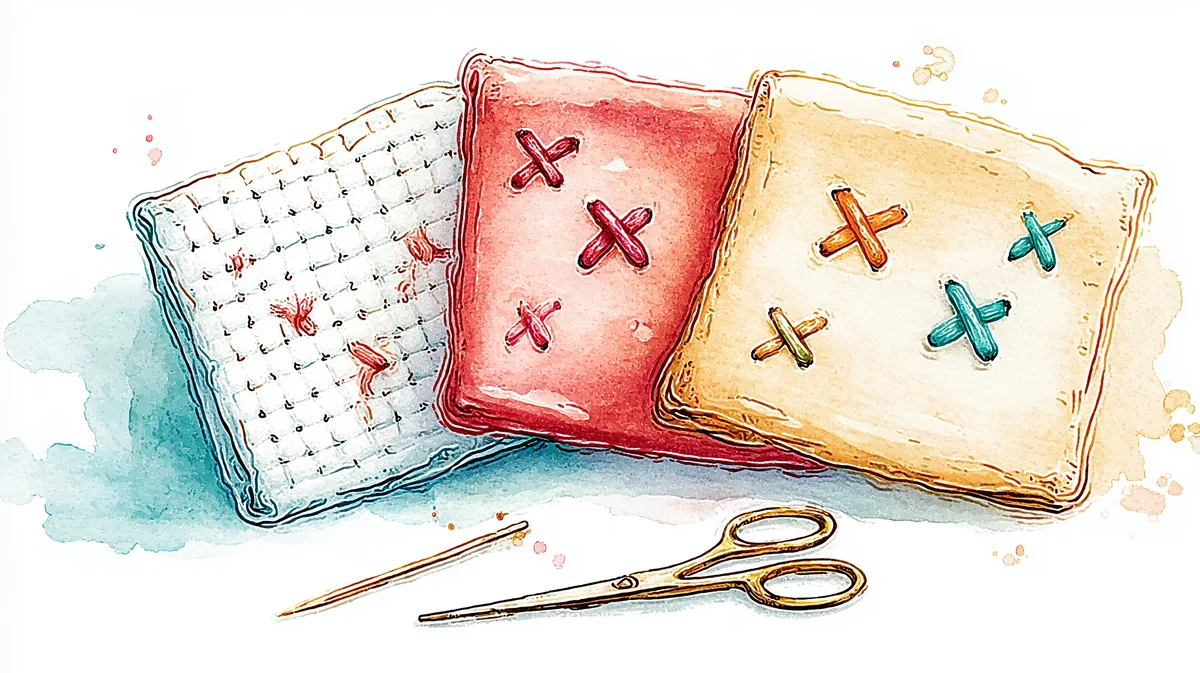
Most beginners grab 14-count Aida without thinking — and honestly, that's a fine instinct. But cross stitch fabric types vary more than you'd expect, and the one you choose affects everything: how your finished piece looks, how long it takes, and how enjoyable the process is.
Here's what actually matters when picking fabric, and how to match the right type to what you're making. Caterpillar Cross Stitch has a thorough companion guide with video if you'd rather watch than read.
The three main fabric types
Cross stitch fabric falls into three families. Each has a different weave structure, a different feel under the needle, and a different finished look.
Aida cloth
Aida is the standard. Its weave groups threads together in blocks, creating a visible grid of squares with obvious holes at each corner. You place one cross stitch in each square — no counting threads, no ambiguity about where the needle goes.
That grid structure is why most stitchers start with Aida and why most patterns assume you're using it. The stitches sit in pre-formed squares and have a slightly raised, dimensional look. On large or full-coverage pieces, most stitchers add a second grid of their own every ten blocks — see how to grid cross stitch fabric for the pen, thread, and pre-gridded options.
Where Aida works best: Most projects, especially patterns with full coverage (every square stitched). Samplers, character designs, geometric patterns, and anything where crisp, uniform stitches matter.
Where Aida falls short: The grid structure is visible on areas of exposed fabric, which can look stiff on pieces where bare fabric is part of the design. Large wall art and heirloom pieces sometimes look more polished on evenweave or linen.
Common Aida brands: Zweigart (the original — look for the orange selvedge thread), Charles Craft, and DMC. Cheap unbranded Aida varies in quality — thread count can be inconsistent, and the fabric may feel cardboard-stiff before washing.
For a complete breakdown of every Aida count from 11 through 22 — with needle sizes, strand recommendations, and visual comparisons — see the Aida count guide.
Evenweave
Evenweave fabrics have individual threads woven one-over-one, with the same number of threads per inch in both directions. The result is a softer, more flexible fabric without Aida's rigid grid.
To cross stitch on evenweave, you stitch over two threads in each direction. This means the fabric count is double the effective stitch count: 28-count evenweave gives you the same stitch size as 14-count Aida (28 threads ÷ 2 = 14 stitches per inch).
The finished look is noticeably different from Aida. Stitches lay flatter and the fabric drapes more naturally. Exposed fabric looks like fine cloth, not a grid — which is why evenweave is popular for designs with open backgrounds. Stitched Modern has good close-up photos comparing stitch appearance across all three fabric types.
Where evenweave works best: Decorative pieces where exposed fabric is part of the design, wedding samplers, birth records, delicate florals, and projects that will be framed without glass.
The tradeoff: Counting is harder than on Aida because individual threads are less distinct than Aida's grouped blocks. Most stitchers learn on Aida first and move to evenweave after a few completed projects. Gridding (marking every 10 stitches with a washable pen) helps enormously.
Common evenweave brands: Zweigart Lugana (the most popular — soft hand, consistent weave), Zweigart Murano, and Zweigart Brittney. For a deep dive into each brand with counts and comparisons, see the evenweave fabric guide.
Linen
Linen is the traditional choice — cross stitch has been done on linen for centuries. Like evenweave, you stitch over two threads. Unlike evenweave, linen threads are naturally irregular in thickness, giving the finished piece a subtle organic texture that no manufactured fabric can replicate.
That irregularity is the appeal and the challenge. Stitches on linen have a handmade quality that looks beautiful in finished pieces, but counting on linen requires more concentration because the threads aren't perfectly uniform.
Where linen works best: Heirloom pieces, reproduction samplers, traditional designs, and projects where the slightly imperfect, handcrafted look is part of the charm. Many serious stitchers eventually gravitate to linen for its feel under the needle and the warmth of the finished piece.
The tradeoff: Linen is more expensive than Aida or evenweave, harder to count on, and less forgiving of mistakes. It's also stiffer to start with (it softens with handling). Not recommended for a first project — but worth trying after you have three or four finishes under your belt.
Common linen brands: Zweigart Belfast (32-count, the most popular cross stitch linen), Zweigart Cashel (28-count, slightly easier), and Zweigart Edinburgh (36-count, very fine). Willow Fabrics has a practical guide to choosing between Zweigart linens if you're narrowing down your options.
Specialty fabrics
Beyond the three main types, a few specialty fabrics serve specific purposes.
Waste canvas is a temporary grid you baste onto clothing, tote bags, or other surfaces that aren't designed for counted stitching. Stitch through both layers, then dampen the waste canvas and pull the threads out one by one. The result is a cross stitch design on a t-shirt, denim jacket, or pillowcase. Water-soluble canvas works similarly but dissolves completely when rinsed. Studio Koekoek covers specialty fabrics including interlock canvas and perforated leather if you're exploring beyond the standard three.
Perforated paper is stiff paper with evenly punched holes, typically at 14-count. It's used for ornaments, bookmarks, and three-dimensional projects where fabric would be too floppy. Stitches on perforated paper look crisp and structured. The tradeoff: you can't fold it, wash it, or fix mistakes as easily — pulling stitches risks tearing the paper.
Plastic canvas is a rigid grid sheet (usually 7-count or 10-count) for three-dimensional projects like boxes, coasters, and tissue box covers. The large count makes it fast to stitch but limits detail. It's a different stitching experience than fabric-based cross stitch — more like needlepoint.
How fabric count affects your project
Count is the single most important number when choosing fabric. It determines your finished size, level of detail, stitching time, and which strand count to use.
Here's the same hypothetical 140×100 stitch pattern on different counts:
| Fabric count | Strands | Finished size | Detail level | Approx. time | Best for |
|---|---|---|---|---|---|
| 11-count Aida | 3 | 12.7" × 9.1" | Low — bold, chunky stitches | 35–70 hrs | Kids' projects, quick gifts, wall art viewed from a distance |
| 14-count Aida | 2 | 10.0" × 7.1" | Medium — the standard | 50–100 hrs | Most projects — the safe default |
| 16-count Aida | 2 | 8.8" × 6.3" | Medium-high — noticeably finer | 65–130 hrs | Detailed designs, portraits with some simplification |
| 18-count Aida | 1–2 | 7.8" × 5.6" | High — fine detail, smooth gradients | 80–160 hrs | Photo conversions, detailed portraits, fine art reproductions |
| 28-count evenweave (over 2) | 2 | 10.0" × 7.1" | Same as 14-count, softer finish | 50–100 hrs | Same use cases as 14-count Aida but with a more refined look |
| 32-count linen (over 2) | 1–2 | 8.8" × 6.3" | Same as 16-count, organic texture | 65–130 hrs | Heirloom and traditional pieces |
The time estimates above assume full coverage at roughly 100–200 stitches per hour (a typical intermediate pace). Your actual speed will vary — the time calculator can give you a personalized estimate based on your pattern's stitch count and coverage.
Use the fabric calculator to find your exact finished size before cutting fabric. Cutting too small is the most common beginner mistake, and it's not fixable without starting over.
How to choose the right fabric
There's no universally "best" fabric. The right choice depends on what you're making and how you want it to look. Here's a practical decision guide:
For your first project: 14-count Aida. Don't overthink it. The holes are visible, counting is straightforward, and most patterns are designed for this count. Start here, finish something, then experiment.
For photo conversions and portraits: 18-count Aida or 36-count linen (over 2). Photo patterns need fine detail to capture facial features and smooth color transitions. 14-count works for stylized photo conversions, but realistic portraits look significantly better on higher counts. When converting a photo to a pattern, try different size settings and check the preview — you'll see immediately whether the detail level works.
For pieces with open backgrounds: Evenweave or linen. If your design has large areas of unstitched fabric (florals, scattered motifs, text-heavy samplers), the fabric itself is part of the finished look. Aida's grid texture shows through on bare areas. Evenweave and linen look like fine cloth. If your design includes outline stitching, it's worth understanding how backstitch on different fabric types behaves — the thread sits differently on Aida's rigid grid versus linen's irregular weave.
For gifts and fast projects: 11-count or 14-count Aida. Lower counts mean bigger stitches, faster progress, and finished pieces in days instead of months. A small ornament on 14-count takes an evening. The same design on 18-count takes a weekend.
For selling patterns: Design on 14-count as the default, but provide finished size information for 16-count and 18-count as well. Pattern buyers appreciate knowing their options. If you're creating patterns for sale, the PDF export should include fabric recommendations for at least two counts.
For garments and wearables: Waste canvas or water-soluble canvas on top of the garment. Match the canvas count to your desired stitch size — 14-count waste canvas gives the same stitch size as 14-count Aida.
Fabric and thread strand count
The number of floss strands you use depends on the fabric count and the coverage you want. Too few strands and the fabric shows through the stitches. Too many and the thread bunches up and won't lie flat.
| Fabric count | Recommended strands | Coverage notes |
|---|---|---|
| 11-count | 3 | Full coverage with good dimension |
| 14-count | 2 | The standard — most patterns assume this |
| 16-count | 2 | Full coverage, slightly thinner look |
| 18-count | 1–2 | 2 strands for full coverage, 1 for a delicate effect |
| 22-count | 1 | Any more and the thread won't fit through the holes cleanly |
| 28-count evenweave (over 2) | 2 | Same as 14-count Aida |
| 32-count linen (over 2) | 1–2 | Same as 16-count Aida |
These are starting points, not rules. The coverage you get depends on the thread brand, your tension, and the specific fabric. When in doubt, stitch a small test area before committing to a full project. The thread usage calculator can estimate how many skeins you'll need once you've settled on a strand count.
The DMC color chart includes all 489 DMC stranded cotton colors. If you're working with Anchor or other brands, the same strand counts apply — the guidance is about fabric count, not thread brand. For a full comparison of thread types beyond stranded cotton — including hand-dyed, metallic, and silk — see the thread types guide.
Common mistakes with fabric choice
Cutting fabric too small. Always add at least 3 inches on each side beyond your finished design dimensions. For projects you plan to frame, add 4 inches. Fabric is cheaper than starting over.
Using the wrong strand count for the fabric. Two strands on 11-count looks sparse. Three strands on 18-count creates bulging, uneven stitches. Match the strand count to the fabric count using the table above.
Choosing high-count fabric for your first project. 18-count Aida is beautiful but requires concentration and good lighting. Start with 14-count, finish something, and then try a higher count on your second or third project. The technique translates directly — it's just smaller.
Ignoring fabric color. White Aida is the default, but fabric comes in dozens of colors. If your design has a large unstitched background, using colored fabric instead of stitching the entire background saves enormous time. A night sky design on black Aida means you only stitch the stars and foreground — the "sky" is the fabric itself.
Assuming evenweave count equals stitch count. On evenweave and linen, you stitch over two threads. 28-count evenweave gives 14 stitches per inch, not 28. This is the most common sizing mistake when switching from Aida — always divide the fabric count by 2 to get your effective stitch count.
FAQ
What is the best fabric for cross stitch beginners?
What is the difference between Aida and evenweave?
What count fabric should I use for a photo conversion?
Can I use linen for counted cross stitch?
What does fabric count mean in cross stitch?
How much fabric do I need for a cross stitch project?
What is waste canvas used for?
Further reading
- Caterpillar Cross Stitch — Cross stitch fabric types explained — thorough walkthrough of Aida, evenweave, and linen with video tutorial and needle pairing guide
- Stitched Modern — How to pick fabric for cross stitch — clean pros-and-cons summary with close-up stitch photos on each fabric type
- Studio Koekoek — Differences between cross stitch fabrics — covers Magic Aida, Aida band, and specialty surfaces alongside the core three
- Willow Fabrics — Your guide to cross stitch fabric — UK perspective with good advice on fabric care, washing, and pressing
Find your ideal fabric size
Enter your pattern dimensions and fabric count — the calculator tells you exactly how much fabric to cut.
Open fabric calculatorFree to use. No account required.
Related Guides & Tools

What is Aida count?
A deep dive into Aida count numbers — what they mean, how they change finished size, and which count to choose.

How to convert a photo to a cross stitch pattern
Step-by-step guide to turning any photo into a stitchable pattern — including fabric and size recommendations.
How long does cross stitch take?
Realistic time estimates by pattern size and fabric count — so you know what you're signing up for.
DMC vs Anchor thread
Comparing the two most popular cross stitch thread brands — color accuracy, availability, and conversion.
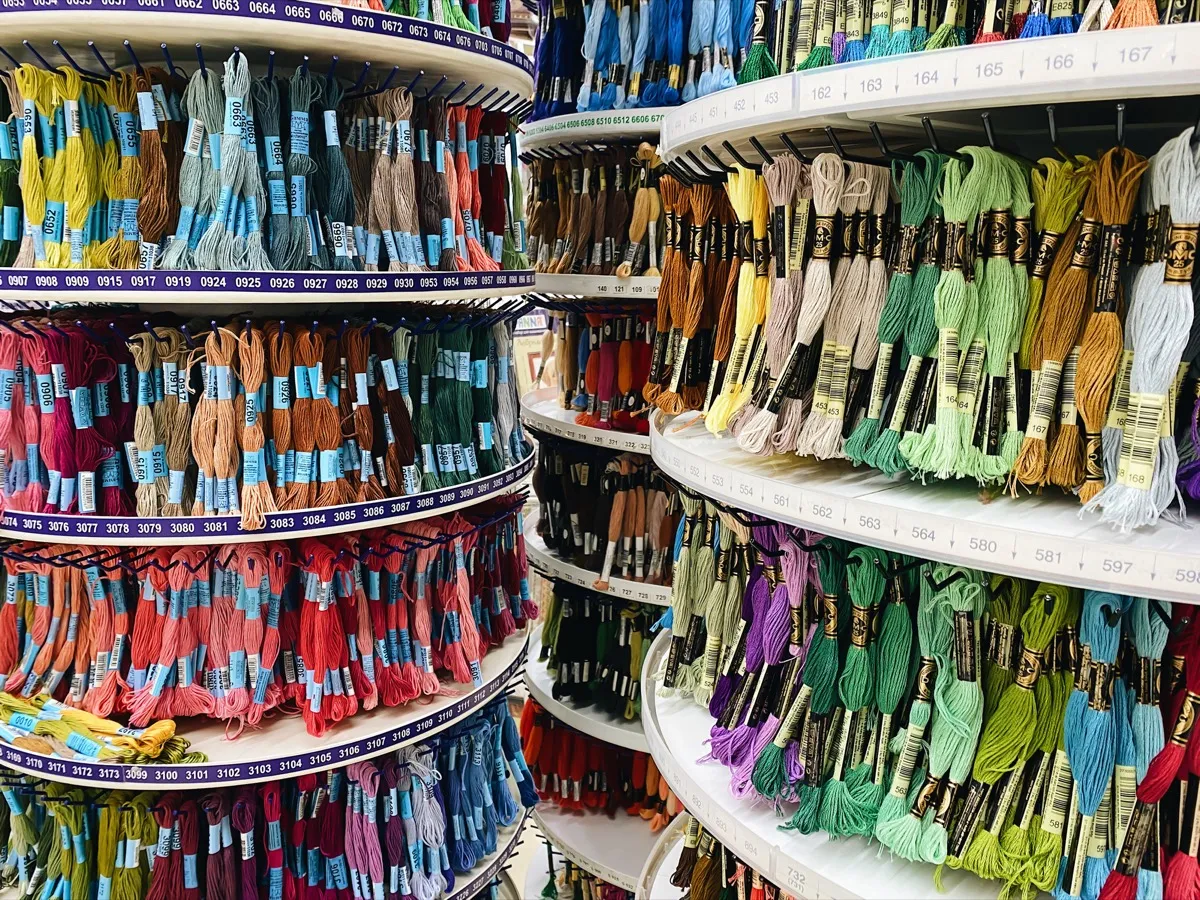
Cross stitch thread types
Stranded cotton, hand-dyed, metallic, silk, and more — which thread for which project.
Evenweave fabric guide
Lugana, Cashel, Jobelan, and more — specific evenweave brands compared with counts, tips, and when to choose each.
How to frame cross stitch
Washing, mounting methods, glass options, and preservation — everything you need after the last stitch is done.