Needlepoint Mesh Count: 10, 13, 14 and 18 Mesh Compared
Mesh count determines your stitch size, thread choice, project time, and finished dimensions. Here is how to choose the right canvas for your project.
Mesh count is the number of holes per inch on a needlepoint canvas. 13-mesh canvas has 13 holes per inch. 18-mesh has 18. Higher mesh means smaller stitches, finer detail, and a longer project.
That's the entire concept — but the mesh count you choose affects everything else about your project: which threads you can use, how long it takes, how detailed the design looks, and how big the finished piece will be. Here's how to choose the right one.
Every common mesh count, compared
| Mesh count | Holes per inch | Stitches per sq. inch | Best for | Difficulty |
|---|---|---|---|---|
| 5 | 5 | 25 | Rugs, large wall hangings | Very easy |
| 7 | 7 | 49 | Quick projects, plastic canvas crafts | Easy |
| 10 | 10 | 100 | Beginners, kids' projects, decorative items | Easy |
| 12 | 12 | 144 | Cushions, moderate detail | Easy–moderate |
| 13 | 13 | 169 | Most popular — standard needlepoint | Moderate |
| 14 | 14 | 196 | Detailed cushions, handbags | Moderate |
| 18 | 18 | 324 | Fine detail, portraits, ornaments, belts | Advanced |
| 22–24 | 22–24 | 484–576 | Petit point, miniatures, jewelry | Expert |
The vast majority of needlepoint projects use either 13-mesh or 18-mesh canvas. If you're browsing kits or hand-painted canvases, those are the two sizes you'll encounter most often.
13 mesh vs 18 mesh
If you only ever choose between two canvas counts, it will be these. The short version: 13-mesh for most projects, 18-mesh when detail matters more than time.
| 13 mesh | 18 mesh | |
|---|---|---|
| Stitch size | ~2mm x 2mm | ~1.4mm x 1.4mm |
| Stitches per sq. inch | 169 | 324 |
| Relative stitching time | Baseline | ~1.9x longer |
| 130-stitch design finishes at | 10.0 inches | 7.2 inches |
| Typical thread | Silk & Ivory, Persian wool (2 plies), DMC Soft Cotton | Vineyard Silk, DMC stranded cotton (2 strands), Persian wool (1 ply) |
| Magnification needed | Rarely | Often |
| Best for | Pillows, wall art, most kits | Ornaments, belts, portraits, lettering |
The 1.9x figure is the one people underestimate. The same physical area takes almost twice as long on 18-mesh, because you are placing 324 stitches per square inch instead of 169. A pillow front that takes 70 hours on 13-mesh is a 130-hour project on 18-mesh — same design, same size, same thread budget.
Detail is the reason to accept that trade. Small lettering, facial features, and smooth color gradients need the finer grid; on 13-mesh they turn blocky. If your design has none of those, 13-mesh is the better choice almost every time.
One practical note: 18-mesh is less forgiving about thread thickness. Too thick and the stitches bunch and distort the canvas; too thin and bare canvas shows between them. 13-mesh tolerates a much wider range, which is part of why shops steer beginners toward it.
Why mesh count matters more than you think
New needlepointers often pick a canvas based on the design they like, without thinking about mesh count. Then they discover that the 18-mesh canvas they chose requires 324 stitches per square inch (18 x 18), while a 10-mesh canvas only needs 100. That's more than three times the stitching for the same physical area.
Mesh count isn't just a technical spec. It determines:
- How long your project takes — a 10-mesh pillow might take 70 hours. The same design on 18-mesh could take 200+.
- Which threads work — thick wool won't fit through 18-mesh. Fine silk disappears on 10-mesh. See the thread guide for specifics.
- How much detail shows — lettering, facial features, and fine lines need higher mesh to render clearly.
- The finished size — a 100-stitch-wide design is 10 inches on 10-mesh but only 5.5 inches on 18-mesh.
Getting this right at the start saves you from the particular frustration of discovering 30 hours in that you picked the wrong canvas.
10-mesh canvas
Stitch size: Large and bold — each stitch covers about 2.5mm x 2.5mm.
10-mesh is the most forgiving canvas for beginners. The holes are easy to see, stitching goes quickly, and mistakes are simple to spot and fix. It's also the go-to for projects where you want fast results — a coaster, a simple ornament, or a project for a child.
Threads that work on 10-mesh:
- Appleton tapestry wool (2 strands of crewel, or 1 strand of tapestry weight)
- Persian wool (3 plies)
- DMC tapestry wool
- Silk & Ivory (for a silk-wool blend option)
- Worsted weight yarn (for rugs and large pieces)
The tradeoff: Limited detail. Lettering, small motifs, and facial features won't render well. Designs tend to look bold and graphic rather than nuanced.
Best for: First needlepoint project, gifts for non-stitchers, anything where speed matters more than detail.
13-mesh canvas
Stitch size: Medium — each stitch covers about 2mm x 2mm.
This is the workhorse of needlepoint. Most hand-painted canvases, most kits, and most needlepoint shop recommendations default to 13-mesh. It balances detail against stitching speed — you can render reasonably complex designs without spending a year on a single pillow.
Threads that work on 13-mesh:
- Persian wool (2 plies)
- Silk & Ivory — the community favorite for 13-mesh, a 50/50 silk-wool blend with beautiful sheen
- DMC Soft Cotton (Retors Mat) — affordable, matte finish, increasingly popular
- Appleton crewel wool (2 strands)
- Planet Earth silk or merino
- Perle cotton #5
The tradeoff: 13-mesh takes about 70% longer than 10-mesh for the same physical area. Fine details like small text or intricate shading are possible but limited.
Best for: Most projects. Pillows, wall art, ornaments, handbags, belts (though belts sometimes use 18-mesh for extra detail).
18-mesh canvas
Stitch size: Small — each stitch covers about 1.4mm x 1.4mm.
18-mesh is where needlepoint gets serious. The fine grid allows for photographic detail, smooth color gradients, and crisp lettering. It's the standard for high-end hand-painted canvases and is particularly popular for ornaments, small accessories, and pieces with intricate detail.
Threads that work on 18-mesh:
- Vineyard Silk — the community favorite for 18-mesh
- DMC stranded cotton (2 strands works for tent stitch)
- Perle cotton #8
- Silk & Ivory (can be stripped to single ply)
- Appleton crewel wool (1 strand)
- Persian wool (1 ply)
- Kreinik metallics for accent stitches
The tradeoff: 18-mesh takes roughly three times longer than 10-mesh per square inch. You'll need good light and possibly magnification. Thread coverage is more finicky — too-thick thread bunches up, too-thin leaves canvas showing through.
Best for: Ornaments, belts, detailed portraits, anything under about 8 x 10 inches where detail matters. Think twice before stitching a large piece on 18-mesh — a 12 x 12 inch design means 46,656 stitches.
How mesh count affects finished size
This is where mesh count becomes a practical planning tool. A pattern that's 130 stitches wide:
| Mesh count | Finished width |
|---|---|
| 10 | 13.0 inches |
| 13 | 10.0 inches |
| 14 | 9.3 inches |
| 18 | 7.2 inches |
The same design gets physically smaller as mesh count increases. This means you can use mesh count to control finished size: want a bigger pillow? Drop to 10-mesh. Need a belt-sized piece? Go to 18-mesh. The needlepoint canvas calculator does this math for any stitch count — finished size at each mesh, plus the canvas to buy with margins.
If you're converting a cross stitch pattern for needlepoint, the same principle applies. A 140-stitch-wide cross stitch pattern designed for 14-count Aida (10-inch finished width) will be 10.8 inches on 13-mesh needlepoint canvas or 7.8 inches on 18-mesh.
Choosing the right mesh count
For your first project
Start with 13-mesh. It's the most versatile size, the widest range of threads work on it, and most needlepoint shops can help you with thread selection and technique. The holes are large enough to see comfortably but fine enough that the finished piece looks polished. If you're designing your own first piece, the needlepoint pattern maker charts directly on a 13-mesh grid and handles names and monograms on any mesh count.
If you're especially concerned about eyesight or dexterity, start with 10-mesh instead. The stitching goes faster and the feedback loop is quicker — you'll see results sooner, which helps with motivation.
For specific project types
Pillows and home décor: 13-mesh. Large enough to finish in reasonable time, fine enough to look refined.
Ornaments: 18-mesh for detailed designs, 13-mesh for simpler or larger ornaments. Most ornament kits come on 18-mesh.
Christmas stockings: 13-mesh for most, 18-mesh for heirloom detail — the needlepoint stocking guide has sizes, stitch counts, and realistic timelines.
Belts: Usually 18-mesh, with a narrow working area about 1 to 1.25 inches tall, so you need the finer grid to fit enough detail into that small vertical space. Belt canvases are often initials or a name; the needlepoint lettering guide gives letter heights by mesh.
Rugs: 5 or 7-mesh. Rugs need thick, durable yarn and fast coverage. A 10-mesh rug is possible but takes significantly longer.
Portraits and photo conversions: 18-mesh minimum. Faces need fine detail to look right — on 13-mesh, features tend to look blocky. For photo-to-pattern conversion, the finer grid captures more nuance in skin tones and expressions.
For thread you already own
If you have a stash and want to work from it:
- Tapestry wool or thick silk blends → 10 or 13-mesh
- Crewel wool or Silk & Ivory → 13-mesh
- Stranded cotton (DMC floss) or fine silk → 18-mesh
- Perle cotton #5 → 13-mesh
- Perle cotton #8 → 18-mesh
For detailed thread recommendations by mesh count, see the needlepoint thread guide.
Canvas types within each mesh count
Mesh count isn't the only variable when buying canvas. You'll also choose between canvas constructions — compared in full in the canvas types guide:
Mono canvas — single threads in a simple weave. The most common and most versatile type. Offers good stitch definition and works with any stitch type. Prone to distortion on larger pieces if you don't use a frame.
Interlock canvas — threads are twisted together at each intersection, locking them in place. More stable than mono, less likely to distort. Slightly less flexible, which can matter for finishing. This is what most kits include.
Penelope canvas — double threads that can be split apart for fine detail areas. Less common today, but useful for designs that mix coarse and fine work in the same piece.
For beginners on 13-mesh, either mono or interlock works well. If you tend to stitch with uneven tension or pull hard, interlock is more forgiving.
Canvas quality matters more than you'd expect. Cheap canvas can have uneven hole spacing, which makes your stitches look irregular no matter how careful you are. Zweigart is the most widely respected brand for consistent quality.
How to measure mesh count on unlabeled canvas
If you've lost the label or received canvas without markings:
- Lay a ruler across the canvas
- Count the number of holes (not threads) in one inch
- Count in both directions — they should be the same
If you count 13 holes per inch, it's 13-mesh. If you count 18, it's 18-mesh.
A few things to watch for: measure in the middle of the canvas, not near the edge where tension may vary. Count holes, not thread intersections — on mono canvas these are the same, but on interlock they can be confusing. If you're getting a number that doesn't match any standard size (like 15), you may be measuring at an angle or your canvas may have stretched.
Mesh count vs Aida count
If you're coming from cross stitch, the numbers work the same way — both tell you how many stitches fit in one inch. A 14-count Aida and a 14-mesh canvas produce stitches of the same physical size.
The key differences are in the materials, not the math:
- Needlepoint canvas is rigid; Aida is flexible
- Needlepoint requires full coverage; cross stitch typically doesn't
- Needlepoint uses thicker threads; cross stitch uses stranded cotton
- Needlepoint stitches are diagonal (tent stitch); cross stitches are X-shaped
For more on how the two crafts differ, see needlepoint vs cross stitch.
Common mistakes with mesh count
Choosing 18-mesh for a large project. A 14 x 14 inch design on 18-mesh is 63,504 stitches. At a reasonable pace, that's 300+ hours. Unless you genuinely love fine work, consider 13-mesh for anything larger than about 8 x 10 inches.
Mismatching thread to canvas. Every mesh count has threads that work and threads that don't. Too-thick thread won't pull through cleanly and creates bulk. Too-thin thread leaves canvas showing between stitches. The thread guide has specific recommendations for each mesh count.
Not using a frame on fine mesh. 18-mesh and higher canvases distort easily under the diagonal pull of tent stitches. Stretcher bars or a scroll frame aren't optional at these sizes — they're essential for a flat, professional result.
Assuming all canvases of the same mesh count are equal. A cheap 13-mesh interlock from a craft chain and a premium 13-mesh mono from a specialty supplier stitch differently. The premium canvas has more consistent hole spacing, less stiffness variation, and better dye resistance. For a project you'll spend 80+ hours on, the canvas is not where to economize.
FAQ
Should I use 13 mesh or 18 mesh?
What mesh count should a beginner use?
Can I use DMC floss on needlepoint canvas?
What's the difference between mesh and gauge?
Is petit point the same as needlepoint?
How do I convert between mesh count and finished size?
See Your Design on Different Mesh Counts
Upload any image and instantly preview how it looks as a needlepoint pattern — adjust mesh count, colors, and finished size in seconds.
Try Stitchmate FreeNo account required. Works in your browser.
Related Guides & Tools
Best Needlepoint Thread for Each Mesh Count
Wool, silk, cotton, and blends — which thread covers which canvas, with specific brands and ply counts.
Needlepoint vs Cross Stitch
Materials, techniques, cost, and difficulty compared side by side.

What Is Aida Count?
The cross stitch equivalent of mesh count — how fabric count changes size, detail, and difficulty.
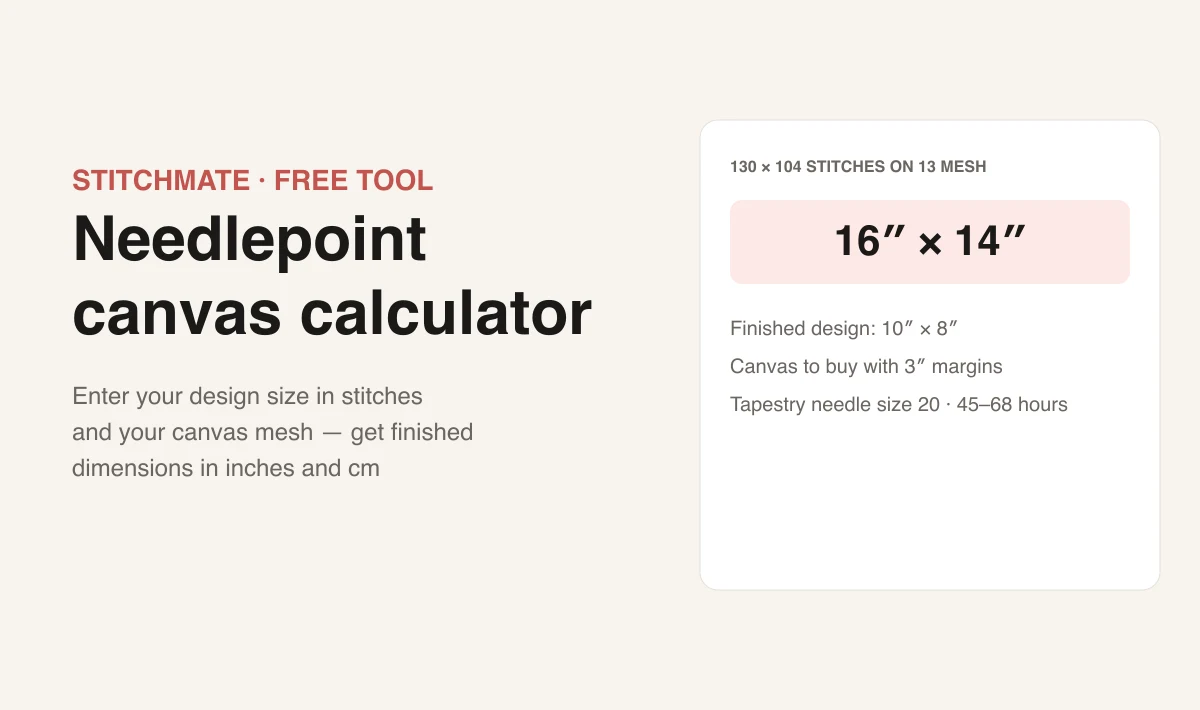
Needlepoint Canvas Calculator
Finished size, canvas to buy, needle size, and 13↔18 mesh resize targets — from your chart dimensions.
Needlepoint Stocking Patterns
Stocking sizes and stitch counts by mesh — plus timelines and the painted-vs-charted cost math.
Needlepoint Canvas Types
Mono vs interlock vs Penelope vs congress cloth, and which to buy for your project.
What Is Tent Stitch?
The diagonal stitch worked on every one of these mesh counts — continental, basketweave, and half cross compared.
Cross Stitch Patterns for Needlepoint
Aida-to-mesh sizing and the whole-stitch rule for stitching a cross stitch chart on canvas.