| Blanket | Inches | Centimeters | Blocks (1 in) | Total blocks | Yarn | 364 yd skeins |
|---|---|---|---|---|---|---|
| Lovey | 12 × 12 | 30 × 30 | 12 × 12 | 144 | 360 yd | 2 |
| Receiving / baby | 30 × 36 | 76 × 91 | 30 × 36 | 1,080 | 2,700 yd | 9 |
| Stroller | 30 × 35 | 76 × 89 | 30 × 35 | 1,050 | 2,625 yd | 8 |
| Crib | 36 × 54 | 91 × 137 | 36 × 54 | 1,944 | 4,860 yd | 15 |
| Toddler / lapghan | 36 × 48 | 91 × 122 | 36 × 48 | 1,728 | 4,320 yd | 14 |
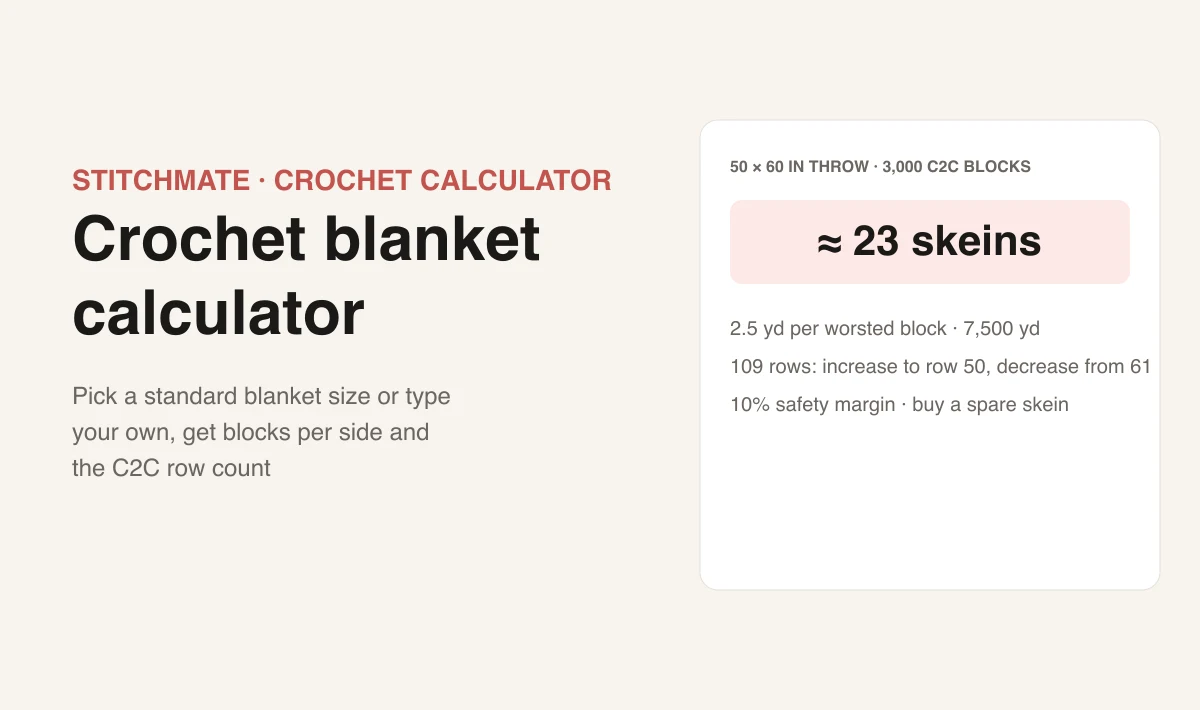
| Throw | 50 × 60 | 127 × 152 | 50 × 60 | 3,000 | 7,500 yd | 23 |
| Afghan | 50 × 65 | 127 × 165 | 50 × 65 | 3,250 | 8,125 yd | 25 |
| Twin | 66 × 90 | 168 × 229 | 66 × 90 | 5,940 | 14,850 yd | 45 |
| Full / double | 80 × 90 | 203 × 229 | 80 × 90 | 7,200 | 18,000 yd | 55 |
| Queen | 90 × 100 | 229 × 254 | 90 × 100 | 9,000 | 22,500 yd | 68 |
| King | 108 × 100 | 274 × 254 | 108 × 100 | 10,800 | 27,000 yd | 82 |
Crochet calculator
Crochet blanket calculator
Pick a standard blanket size or type your own, get blocks per side and the C2C row count, then turn the blocks into yards and skeins per color. Every yarn number is an estimate, and the page says what it assumes.
Blanket size to blocks
Sizes vary by a few inches between sources; these are the ones most patterns quote. Pick one, then adjust below.
50
60
5–5.5 mm hook · about 1 in. Measure a 10-block swatch and divide by 10 for your own figure; the blanket is only as accurate as this number.
Results
50 × 60 blocks
makes 50 × 60 in at 1 in per block
3,000
Total blocks
109
C2C rows, corner to corner
50 blocks
Longest row
127 × 152 cm
Finished size
Where the shaping changes
Increase one block a row through row 50. Then 10 straight rows, rows 51–60, increasing on one edge and decreasing on the other. Decrease on both edges from row 61 to row 109. The increase and decrease guide shows what each turn looks like on the hook.
Opens the editor with a 50 × 60 C2C graph. Draw or convert a photo, and the export writes every row. What the C2C maker does. Working blocks larger or smaller than an inch? The graph is the same; only this calculator's finished size changes.
How much yarn?
Switch to the with 3,000 blocks already filled in.
Two questions, one tool
Every blanket starts with the same two questions: how big and how much yarn. The Size tab answers the first in blocks, because that is the unit a crochet graph is drawn in. The Yarn tab takes those blocks and turns them into yards and skeins per color.
Pick a standard size or type inches or centimeters, tell it how big one of your blocks is, and it returns blocks wide by blocks tall, the finished size those blocks actually make, and, for corner to corner, the row count with the exact rows where the shaping changes. When the size looks right, Make the graph for this size opens the C2C pattern maker with the grid already set.
Standard crochet blanket sizes
Sources disagree by a few inches on most of these; a throw is 50 × 60 in one book and 52 × 60 in another. The table below is the set most patterns and yarn companies work from. Blocks and yarn assume one block to the inch, worsted weight, 2.5 yards per block, a 10 percent margin, and a 364 yard skein.
Bed sizes are the blanket, not the mattress. A queen mattress is 60 × 80 inches; the 90 × 100 blanket is what hangs over the sides. If you want a bedspread that reaches the floor, add 15 to 20 inches to each side and let the calculator do the rest.
How much yarn for a blanket
The C2C working figure is about 2.5 yards of worsted weight per block on a 5 to 5.5 mm hook. Nobody measured it in a lab; it is the number blanket makers converged on from weighing finished projects, and it holds up in practice for a chain-3 plus 3 double crochet block.
Worked through for a 50 × 60 inch throw at one block to the inch:
- 50 × 60 = 3,000 blocks
- 3,000 × 2.5 yd = 7,500 yd (about 6,860 m)
- plus a 10 percent margin = 8,250 yd
- 8,250 ÷ 364 yd per Red Heart Super Saver skein = 22.7, so 23 skeins
Without the margin it is 21 skeins. The margin is there because running out of a dye lot two rows from the end is the single worst thing that happens in this craft, and the cost of the other mistake is a leftover skein.
Three things move the real number more than the yarn does. Tension is the big one: a loose crocheter can use a third more yarn than a tight one for the same graph. Hook size goes with it. The block itself matters too: a half double crochet mini block uses well under half the yarn of a full block. So the calculator says estimate, shows the yards-per-block it assumed, lets you change it, and rounds up per color. Buy one spare skein of every color anyway.
Multi-color blankets are where the per-color rounding earns its keep. A color that appears in three blocks still needs a whole skein, and a graphghan with 12 colors can need 12 more skeins than its total yardage suggests. The Yarn tab takes a share per color, as a percentage or a block count, so the shopping list is by color rather than by total.
Block size and gauge
One block ≈ one inch is a worsted weight convention, not a law. The C2C pattern maker uses it as its only block size for the same reason the calculator defaults to it: it is what most graphghans are worked in.
| Block | Yarn and hook | Inches per block |
|---|---|---|
| Standard C2C, ch-3 + 3 dc | Worsted (CYC 4), 5–5.5 mm | about 1.0 |
| Mini C2C, ch-2 + 2 hdc | Worsted, 4–5 mm | about 0.6 |
| Bulky C2C | Bulky (CYC 5), 6.5–8 mm | about 1.25 |
To measure your own, crochet a 10 by 10 block swatch in the yarn and hook you will use, wash it the way the blanket will be washed, measure across the middle, and divide by ten. Enter that as the block size and the blanket comes out the size you planned instead of the size the convention promised.
C2C rows, and where the turn happens
A corner to corner blanket is worked on the diagonal, so its row count is not its height. For a graph W blocks wide by H blocks tall, the total is W + H − 1 rows. You increase by one block per row through the shorter side, work exactly |W − H| straight rows where one edge increases and the other decreases, then decrease to the far corner.
For the 50 × 60 throw that is 109 rows: increase through row 50, straight rows 51 to 60, decrease from row 61. The calculator prints those three numbers for any size, and the C2C increases and decreases guide shows what to do at each of them. If the graph itself is new to you, start with how to read a C2C graph.
From size to graph
The size is only half the pattern. Once the blocks per side are settled, the pattern maker draws the graph at that size, converts a photo onto it if you have one, writes the row by row instructions in US terms, and repeats this yarn estimate per color in the PDF's yarn key from the real block counts rather than a share you typed. The calculator's number is for buying yarn before the graph exists; the key's number is for buying it after.
FAQ
What are the standard crochet blanket sizes?
The sizes most patterns use, in inches: lovey 12 × 12, baby 30 × 36, stroller 30 × 35, crib 36 × 54, toddler or lapghan 36 × 48, throw 50 × 60, afghan 50 × 65, twin 66 × 90, full 80 × 90, queen 90 × 100, king 108 × 100. Different sources shift these by a few inches, so treat them as targets rather than rules. The calculator loads any of them as a preset.
How much yarn do I need for a crochet blanket?
For C2C in worsted weight, a working figure is about 2.5 yards per block. Multiply blocks by 2.5 for yards, add a 10 percent margin, and divide by the yards in your skein. A 50 × 60 inch throw at one block per inch is 3,000 blocks, about 7,500 yards, which is 23 skeins of Red Heart Super Saver at 364 yards each once the margin is in. It is an estimate: your tension changes it more than the yarn does.
How many skeins does a blanket take?
It depends on the skein. The same 7,500 yard throw is 23 skeins of a 364 yard skein, 10 of an 812 yard Caron One Pound, or 8 of a 1,000 yard blanket ball. Enter your skein's yardage from the label and the calculator rounds up per color, then buy one spare of each so a dye lot never runs out at row 340.
How big is a C2C block?
In worsted weight on a 5 to 5.5 mm hook, a chain-3 plus 3 double crochet block comes out at about one inch square, which is the figure the calculator and the pattern maker both default to. Mini C2C in half double crochet is closer to 0.6 inches, and bulky yarn runs about 1.25. Measure your own: crochet a 10 by 10 block swatch, measure across, divide by 10, and type that in.
How many rows is a C2C blanket?
Width plus height minus one, counting in blocks. A 50 by 60 block throw is 109 diagonal rows: you increase for 50 rows, work 10 straight rows with an increase on one edge and a decrease on the other, then decrease for 49 rows. The calculator prints the row where each phase changes.
Can I use this for a single crochet or granny square blanket?
The size tab works for any grid-based blanket if you enter the size of one unit, whether that is a stitch, a granny square, or a block. The row count is C2C-specific because it describes diagonal shaping. The yarn tab assumes 2.5 yards per unit, which is a C2C figure; for other stitches, measure how much yarn 10 units take and enter your own number.
Is this free?
Yes. No account, no limits, nothing sent to a server. It runs entirely in your browser, and the size you settle on opens straight into the C2C pattern maker.
See how your photo converts
Cross stitch is a real commitment — real thread, real hours, real frustration if the pattern doesn't work. Stitchmate lets you see exactly what you're getting into before you buy the first skein.
Upload an image, adjust the settings, check the FLOW Score — about 30 seconds to know if it'll work. Everything up to PDF export is free, no account needed.
Upload Your Photo Free