Diamond painting size calculator
Convert between canvas centimeters and drill counts for square (2.5 mm) and round (2.8 mm) drills — with total drills, the overage pad, and how many bags or grams to buy. Free, no signup.
Size Calculator
Kits list canvas centimeters; charts list drills. Enter whichever you have — the calculator fills in the other.
The design area, not the whole sheet — kit listings mean the drilled area by "30×40".
Square drills run exactly 4 per cm; round drills are 2.8 mm, so the same count needs a slightly larger canvas.
Spills, flipped drills, and tossers happen — 20% is the safe default for loose-drill orders.
Drill pitch does the math
Canvas size = drills × pitch. Square drills are 2.5 mm and round are 2.8 mm — which shape you pick changes the numbers, and which one you should pick is covered in the square vs round drills guide. Planning a photo piece? Scale-wise, diamond painting sits closest to 10-count aida, so faces need room — 30×40 cm is a sensible minimum for a portrait.
Results
Totals are whole-canvas numbers. Buying loose drills per color? Your chart's drill key lists a count per DMC code — apply the same pad to each color.
| Canvas | Drills (square) | Total |
|---|---|---|
| 20 × 20 cm | 80 × 80 | 6,400 |
| 20 × 30 cm | 80 × 120 | 9,600 |
| 30 × 30 cm | 120 × 120 | 14,400 |
| 30 × 40 cm (selected) | 120 × 160 | 19,200 |
| 40 × 40 cm | 160 × 160 | 25,600 |
| 40 × 50 cm | 160 × 200 | 32,000 |
| 50 × 70 cm | 200 × 280 | 56,000 |
| 60 × 80 cm | 240 × 320 | 76,800 |
Standard kit sizes at the square-drill pitch. 30×40 cm is the sensible minimum for a photo portrait; 40×50 gives faces room to breathe.
The diamond painting pattern maker designs on a true drill grid — round drills render as circles, not squares — or convert a photo at exactly the drill dimensions above, with a per-color drill key. Free, in your browser.
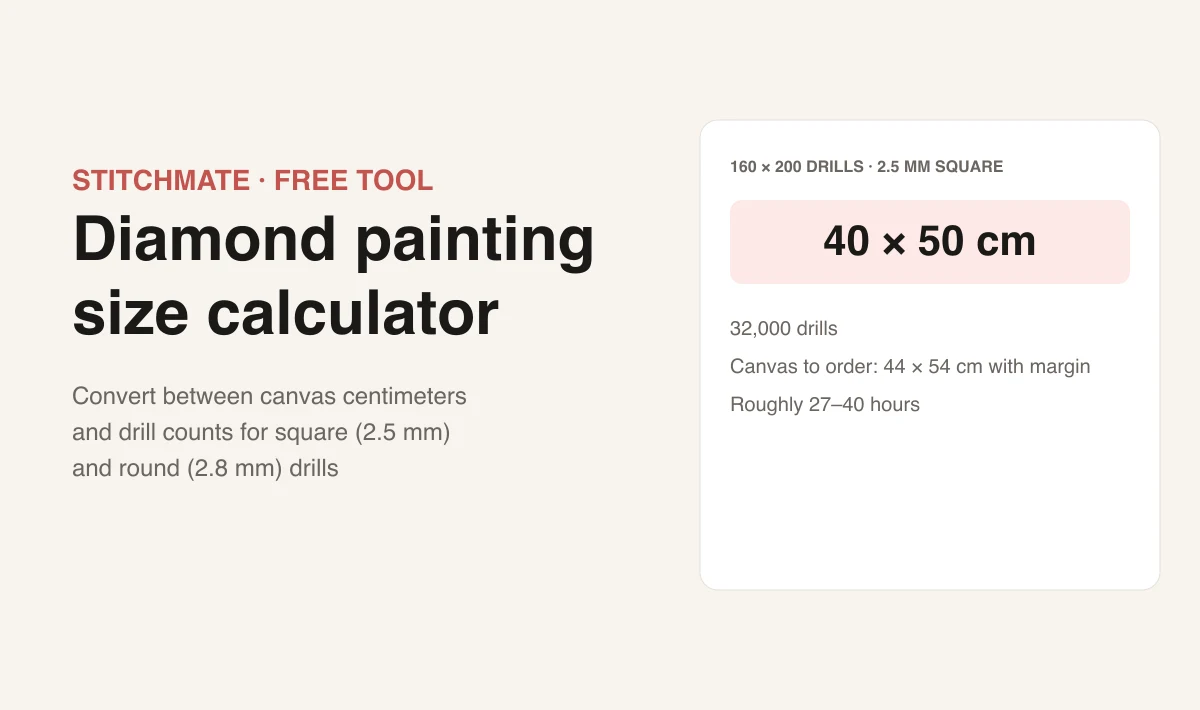
The math behind the calculator: canvas size = drill count × drill pitch. Square drills are 2.5 mm — exactly 4 per centimeter — and round drills are 2.8 mm, so the same chart runs slightly larger in round. Everything else here is multiplication: total drills, the overage pad, and how that converts to bags or grams when you buy loose drills.
Worked example
A 30 × 40 cm canvas with square drills:
- Drill grid: 30 × 4 = 120 across; 40 × 4 = 160 down
- Total drills: 120 × 160 = 19,200
- With a 20% pad: buy for 23,040 drills
- In bags: 24 bags of 1,000 (or 12 of 2,000)
- In grams: roughly 100–110 g at 210–230 square drills per gram
The same canvas in round drills holds about 107 × 143 — the 2.8 mm pitch means fewer, slightly larger drills, with small canvas gaps between them that are normal for round. Which shape to pick is its own decision, covered in the square vs round drills guide.
Reading kit listings
Kit sizes are quoted in centimeters and mean the drilled design area, not the whole sheet. The listing's cm number tells you the drill count once you know the shape — which is exactly the check worth doing before buying a custom kit, because a beautiful preview at screen size can be a muddy 6,400-drill grid at 20×20 cm. Faces need drills: 30×40 cm is the sensible minimum for a portrait, and converting your photo first shows you honestly what any size will look like before money changes hands.
Converting cross stitch charts
One chart square is one drill, so a cross stitch chart's stitch dimensions drop straight into this calculator. Scale-wise, diamond painting sits closest to 10-count aida — a 120×160 chart that would finish at 12×16 inches on 10-count comes out at 30×40 cm in square drills. The drill counts on kit legends are DMC codes, the same numbers cross stitchers already use; the DMC drill color chart has the full list.
Buying drills
Loose drills sell in 1,000 and 2,000-count bags or by the gram. The calculator's totals are whole-canvas numbers — your chart's drill key splits them per color, and the pad applies per color too, not just to the total. If you design the chart in the diamond painting pattern maker, the exported PDF's drill key doubles as the shopping list: every DMC code with its exact drill count.
Related Guides & Tools
Square vs Round Drills
Pitch, coverage, and which shape to pick for which art.
What Is Diamond Painting?
The craft explained — drills, canvas, 5D, and how kits work.
How to Do Diamond Painting
The full beginner workflow, from film peel to finished canvas.

DMC Color Chart for Diamond Painting
Every DMC drill code with names and hex values.
Photo to Diamond Painting
Convert a photo at exactly the drill dimensions you need.
Diamond Painting Pattern Maker
Design drill charts with a per-color drill key and PDF export.
FAQ
How many diamonds are in a 30x40 diamond painting?
How do I calculate diamond painting canvas size from drills?
What size diamond painting should I buy for a photo?
How many drills are in a gram?
How much extra should I buy per color?
Are square and round drill canvases the same size?
See how your photo converts
Cross stitch is a real commitment — real thread, real hours, real frustration if the pattern doesn't work. Stitchmate lets you see exactly what you're getting into before you buy the first skein.
Upload an image, adjust the settings, check the FLOW Score — about 30 seconds to know if it'll work. Everything up to PDF export is free, no account needed.
Upload Your Photo Free