What Is Diamond Painting? The Craft Explained for Beginners
It's the craft you've seen sparkling all over Instagram and craft store shelves — part cross stitch, part paint by numbers, no needle or brush required. Here's exactly how it works.
Diamond painting is a craft where you place small faceted resin pieces — called drills — onto a sticky canvas printed with a symbol chart, one piece per cell, until a sparkling mosaic image emerges. The community's own description is the best one: it's a mix of cross stitch and paint by numbers, minus the needle and the paint.
You'll also see it sold as diamond art, 5D diamond painting, gem art, or dot art. Those are all the same craft — more on the naming below. First, here's how the whole thing actually works.
How diamond painting works
The canvas does most of the thinking for you. It's printed with a grid of symbols — each symbol stands for one color, exactly like a cross stitch chart — and the whole surface is coated with a layer of adhesive, protected by a clear film until you're ready to work.
The drills are tiny faceted resin pieces, flat on the bottom and cut like a gemstone on top. They also go by diamonds, dots, or gems depending on who's talking, but "drill" is the word you'll see on kit labels and in every diamond painting group.
To place one, you use the pen that comes with every kit. You press the pen tip into a small block of wax, which makes the hollow tip tacky enough to pick up a drill. Then you press the drill onto its matching symbol on the canvas, where the adhesive grabs it and holds it for good. Two different sticky things are doing two different jobs here, and it's worth keeping them straight: the wax lives on the pen tip and does the picking up; the adhesive lives on the canvas and does the keeping. You never put wax on the canvas.
That's the entire loop — dip, pick, place — repeated a few hundred times per sitting. Peel back a section of film, fill it in symbol by symbol, and move on. The step-by-step diamond painting guide walks through a first session in detail, from unboxing to sealing the finished piece.
What's in a diamond painting kit
Kits are refreshingly complete — there's nothing extra to buy for your first one. Inside the box:
- The printed adhesive canvas, rolled or folded, with the protective film over the sticky layer
- Bags of drills, sorted by color and labeled with DMC codes
- The pen (officially a stylus or applicator, but everyone calls it the pen)
- A block of wax for the pen tip
- A grooved tray that shimmies drills flat-side-down so they're easy to pick up
Those DMC codes deserve a second look, because they're the quiet standard holding the whole hobby together. DMC numbers are the universal color language for drills — borrowed directly from DMC embroidery floss, the same codes cross stitchers have used for generations. DMC 310 is black in every kit from every vendor. That's why you can top up a color you ran short on, buy drills in bulk, or pour five kits' worth of leftovers into one storage box and still know exactly what every color is.
Diamond painting vs diamond art: two names, one craft
If you've been wondering whether diamond art is something different from diamond painting — it isn't. They're the same craft under two names, and which one you hear mostly depends on who's selling.
Retail brands and craft store shelves lean toward "diamond art," partly because several companies have built product lines around variations of that phrase. Crafters themselves overwhelmingly say "diamond painting" — that's the name you'll find on the forums, the subreddits, and the Facebook groups where the community actually lives. Add "gem art," "dot painting," and "crystal art" to the pile and you've got five labels for one identical activity: drills, adhesive canvas, symbol chart, wax pen.
The practical takeaway: when you're comparing kits or searching for help, treat all of these terms as interchangeable. A "diamond art kit" and a "diamond painting kit" are the same product.
What "5D" actually means (facets, not dimensions)
Nearly every kit sold today is labeled "5D," which sounds like it should mean something dramatic. It doesn't — it's facet marketing, not a different craft.
The number refers to how many cut faces each drill has. So-called 3D drills have 9 facets; 5D drills have 15. More facets catch more light, which means more sparkle on the finished piece — and that's the entire difference. The canvas is the same, the technique is the same, the difficulty is the same. Nobody has invented a fourth or fifth spatial dimension for craft supplies.
Since 5D drills are now the default almost everywhere, you can safely ignore the label when choosing a kit. It's the equivalent of a shampoo bottle saying "new and improved" — true-ish, universal, and not a deciding factor.
Square vs round drills
The one genuine choice you'll make when picking a kit is drill shape, and it changes how the finished piece looks and how the placing feels.
Square drills are 2.5 mm across — 4 per centimeter — and sit edge to edge with no gaps, so the finished piece reads as a full, seamless mosaic. They reward precision: rows need to stay straight, and a satisfying little snap tells you a drill has settled in against its neighbors. Square is the usual pick for detailed images and for anyone who loves crisp edges.
Round drills are slightly larger at 2.8 mm and noticeably more forgiving. They don't need edge-to-edge alignment, so placement is faster and small wobbles disappear. The trade-off is that tiny gaps between round drills are normal — you'll see pinpricks of canvas between the circles, which softens the image slightly.
You'll also choose between coverage styles: full drill means the entire canvas gets covered, while partial drill covers only the main motif and leaves the printed background bare. Full drill is the classic look; partial drill is faster and common on smaller decorative kits.
There's more nuance to the choice — how each shape handles detail, which suits large canvases, what "special drills" are — in the square vs round drills guide.
How it compares to cross stitch and paint by numbers
The "cross stitch meets paint by numbers" framing isn't just a cute tagline — diamond painting genuinely borrows its DNA from both.
vs cross stitch
Diamond painting and cross stitch share the same charted-grid bones. Both work from a symbol chart where every cell maps to one color; both use DMC codes as the color language. The difference is what fills the cell: one drill instead of one stitch.
In scale, diamond painting sits at roughly the equivalent of 10-count aida — drills are chunky compared to fine cross stitch, so images need a reasonably large canvas to carry detail. But each cell "finishes" much faster: pressing a drill takes a second or two, while forming a neat cross stitch takes several, and there are no needle skills to build first. No threading, no tension, no counting your way back from a miscount three rows deep. That's a big part of why cross stitchers pick up diamond painting as their low-effort second craft — same charts, same colors, a fraction of the technique.
vs paint by numbers
From paint by numbers, diamond painting takes the color-by-region idea: the canvas tells you exactly which color goes where, and your job is execution, not decision-making. But there's no paint — which means no brush control to learn, no colors to avoid muddying, no drying time, and no moment where a shaky line ruins a face. You're placing, not painting. If paint by numbers ever frustrated you because the brushwork didn't match the picture in your head, diamond painting removes that failure mode entirely: a placed drill looks identical whether it was your first or your ten-thousandth.
Is diamond painting hard?
No — and this is the honest answer, not the marketing one. If you can place a sticker, you can do diamond painting. There's no technique floor to clear before your work looks good: the first drill you ever place looks exactly like the last one, and the chart makes every color decision for you.
What diamond painting asks for instead is time. A 30 × 40 cm full-drill canvas holds roughly 19,200 square drills. At a relaxed pace, that's weeks of evenings — not days. Most people find that's precisely the point: the dip-pick-place rhythm is repetitive in the way knitting or shelling pistachios is repetitive, and an evening disappears into it easily. It's meditative, low-stakes, and tactile, which is why so many people in the community describe it as the thing that gets them through hard seasons — grief pieces and memorial portraits of loved ones and pets are some of the most common custom orders, worked on slowly and deliberately.
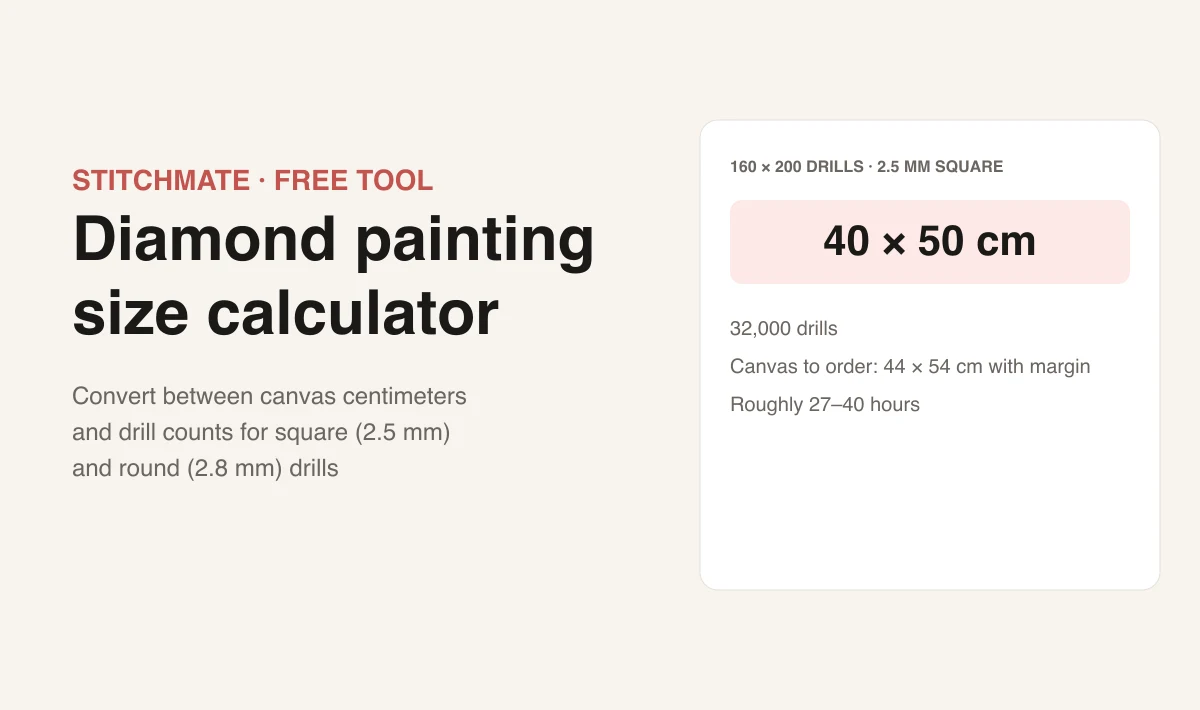
The one sizing rule worth knowing before your first kit: bigger canvases give images room to breathe. Because each drill is a 2.5–2.8 mm pixel, a small canvas simply doesn't have enough of them to render a face well. For a portrait, treat 30 × 40 cm as the sensible minimum; simple high-contrast designs can go smaller. The diamond painting size calculator shows exactly how many drills any canvas size holds and what level of detail it can carry, before you spend money on a kit.
Custom diamond paintings from your own photos
Once the first kit is finished, most people have the same thought: could I do this with my own photo? Yes — custom kits are a huge part of the hobby. You upload a photo, the vendor's software converts it into a drill chart, and a printed canvas with matching drills arrives in the mail. Pet portraits, wedding photos, and memorial pieces are the classics.
The catch is that conversion quality varies wildly from vendor to vendor. The conversion is automated, and automation handles some photos beautifully and others badly — faces can flatten into odd color blobs, backgrounds can dissolve into "confetti" (scattered single drills that are tedious to place), and you typically don't find out until the canvas is unrolled on your table.
The fix is simple: see an honest preview before you commit. Stitchmate's photo to diamond painting converter is free, runs in your browser with no signup, and shows you the actual drill-by-drill chart your photo produces — every color, every cell, at any canvas size. We don't sell kits, so the preview has no reason to flatter your photo. If the conversion looks great, order the custom kit with confidence; if the face turns to mush at 30 × 40 cm, you've learned that for free and can try a larger size or a different crop. And if you'd rather design a chart from scratch instead of converting a photo, the diamond painting pattern maker gives you full drawing tools on a drill grid.
FAQ
Are diamond painting and diamond art the same thing?
Is diamond painting hard?
How long does a diamond painting take to finish?
What do the DMC numbers on the drill bags mean?
Can I turn my own photo into a diamond painting?
Try Diamond Painting Design for Yourself
Open the free editor, pick round or square drills, and design your own diamond painting chart — or convert a photo and see the honest drill-by-drill preview.
Try Stitchmate FreeNo account required. Works in your browser.
Related Guides & Tools
How to Do Diamond Painting
The full step-by-step for your first canvas — setup, placing technique, working in sections, and finishing.
Square vs Round Drills
The one real choice in every kit — coverage, speed, detail, and special drills compared in depth.
Diamond Painting Tools
What comes in the kit, what each tool does, and which upgrades are actually worth buying.
Diamond Painting Size Calculator
Drill counts, finished dimensions, and detail level for any canvas size — before you order.
Photo to Diamond Painting
Convert any photo to a drill chart and preview it honestly before committing to a custom kit.
Diamond Painting Pattern Maker
Design charts from scratch with drawing tools, DMC color matching, and printable PDF export.