Diamond Painting Tools & Accessories: What You Actually Need
Every kit ships with a working pen, wax, and tray. Here's what's genuinely worth adding on top — and what you can skip until your third kit. No affiliate links; we sell nothing.
Diamond painting has a gadget problem. Search for accessories and you'll find spinning organizers, LED tweezers, drill vacuums, and 47-piece "starter bundles" — most of it aimed at people who haven't finished their first kit yet.
Here's the thing: every kit already ships with everything you need to finish it. The question isn't "what do I need" — it's "what's actually worth adding." This guide sorts the whole accessory landscape into four honest tiers. Stitchmate is a free chart maker, not a shop, so there are no affiliate links here and nothing for us to sell you — which makes the verdicts easy to give straight.
The short answer
Your kit includes: the canvas, the drills, a pen, wax, and a grooved tray. That's a complete toolset. You can finish the kit with nothing else.
Worth buying: a light pad (especially for dark canvases or evening sessions), multi-placer pen tips, a small roller for pressing finished sections, fine-tip tweezers, and a roll of washi tape. Together they cost less than most kits and improve every session.
Nice to have once you're hooked: proper storage — screw-top jars labeled by DMC code — and drill trays with lids.
Skip for now: drill vacuums, rolling organizer carts, and anything sold as a "complete accessory bundle." More on why below.
If you're brand new and still figuring out the workflow itself, start with the how to diamond paint guide — the tools make more sense once you've seen where each one fits in the process.
The essentials every kit includes
Three tools come in every kit. They're usually basic versions, but basic works — and knowing what makes a good one tells you whether an upgrade is ever worth it.
The pen (drill pen or applicator pen). A hollow-tipped stylus. You press the tip into wax, then touch it to a drill, and the drill sticks to the tip long enough to place it on the canvas. Kit pens are lightweight plastic and perfectly functional. What makes a better one: a bit of weight and a wider barrel, which matter over multi-hour sessions the same way a good pen beats a disposable one — less grip fatigue, steadier placement. Ergonomic and metal-bodied pens exist and are a reasonable small upgrade if your hand cramps, but they place drills exactly as well as the freebie.
The wax. A small square or tin of pink or clear putty. One thing to get straight early, because the terms get mixed up constantly: wax is the pickup medium, adhesive is the canvas. Wax lives in the pen tip and grabs drills; the adhesive is the sticky layer printed on the canvas that holds them permanently. Wax never touches the canvas. When your pen stops picking up drills, the wax plug in the tip has collected dust and lost its tack — dig it out, reload from the tin, carry on. A single tin outlasts several kits, so "premium wax" is one of the least necessary upgrades in the hobby.
The tray. A shallow plastic dish with ridges along the bottom. Pour drills in, give it a gentle shake, and the ridges flip most of them face-up so the pen can grab them. Kit trays are fine. Better ones have a pour spout on the corner — which sounds trivial until you've funneled drills back into a bag without one — and a larger flat lip for resting the pen.
The drills themselves come in the kit too, sorted by color into numbered bags — typically 1,000- or 2,000-count bags, or measured by the gram (roughly 210–230 square drills per gram). Kits pad each color by about 10–30% over what the canvas needs, which is why every diamond painter slowly accumulates a leftover pile. If you're curious what drills actually are — resin facets, square versus round, why square drills are 2.5 mm and rounds are 2.8 mm — the drills guide covers all of it.
One habit that costs nothing and belongs in the essentials: photograph your legend on day one. The legend — the chart that maps each symbol to a drill color — is a single sheet of paper, and lost legends are a community-wide misery. Half-finished canvases become unfinishable when the symbol key disappears. Thirty seconds with your phone is complete insurance.
Genuinely worth buying
These five earn their place. None is required; all of them make sessions noticeably better.
A light pad. The most-recommended accessory in the hobby, and correctly so. It's a slim LED panel — the kind artists use for tracing — that sits under the canvas and glows through it. Where it matters most: dark canvases. On navy, black, or deep-toned backgrounds, the printed symbols sink into the color and reading the chart becomes squinting work. Backlighting makes the symbols pop instantly. It's also the difference between stopping when daylight fades and comfortably working evening sessions. A3 size covers most canvases; a basic no-name panel does the job as well as a branded one. Verdict: buy it as soon as you know you like the hobby — or immediately, if your first kit has a dark background.
Multi-placer pen tips. Wider tips that pick up 3, 5, or 9 drills in a straight line and lay them all at once. On backgrounds — the huge single-color regions where diamond painting slows to a grind — a 3-tip literally triples your placement rate, and once your alignment is confident, a 5-tip does the same again. The 9-tip is harder to line up and worth it mainly on very large canvases. Most upgrade pens ship with the full set of tips. Verdict: buy them; backgrounds are where projects go to stall.
A roller or brayer. A small hand roller for pressing finished sections down firmly into the adhesive. You can press with a rolling pin or a heavy book, but a brayer does it evenly without popping drills sideways, and well-seated drills are what keep a finished piece from shedding. Roll each section as you complete it rather than saving it all for the end. Verdict: cheap, does one job well, buy it.
Fine-tip tweezers. Most kits include a basic pair; a good angled pair is better. Tweezers are your correction tool — straightening a crooked row, rotating a square drill that landed 15 degrees off, lifting a wrong color without disturbing its neighbors. Square drills especially reward this, since a single rotated square is visible from across the room. Verdict: worth the couple of dollars for a decent pair.
Washi tape. The unglamorous sleeper pick. The adhesive on your canvas extends past the design area, and the protective film never covers the edges well once you start peeling it back in sections. Exposed adhesive grabs lint, pet hair, sleeves, and dust — permanently. A border of washi tape around the design area seals the exposed sticky margin, and because washi is low-tack, it lifts off cleanly when you finish. Verdict: a roll costs almost nothing and saves the edges of every canvas you'll ever work.
Nice to have
None of this improves the act of placing drills. It improves everything around it — and it starts mattering around your second or third kit, when the leftover drills pile up.
Storage containers. The upgrade path is: kit baggies, then a single divided container, then the endgame — small screw-top jars, labeled by DMC code. The DMC number is the important part. Nearly every kit maps its colors to DMC codes, which makes DMC the universal color language for drills — leftovers labeled "DMC 310" from one kit can top up a shortage in any future kit, while leftovers labeled "kit 4, bag 12" are trash with extra steps. Check any code against the DMC color chart for diamond painting to see the actual color. And if you're planning a custom project and wondering how many drills you'll actually need to keep on hand, the size calculator turns canvas dimensions into drill counts per color.
Drill trays with lids. Once you own more than one tray, lids change how you work: pour a session's colors into separate trays, snap the lids on when life interrupts, and nothing spills into the couch. Cheap, stackable, quietly excellent.
Fix tools. A small kit of correction odds and ends — extra adhesive dots for spots where the canvas glue failed, a scraper for lifting misplaced sections, glue pen for re-seating a popped drill on a finished piece. You won't need it often, which is exactly why it's nice-to-have rather than essential. Buy it when you first hit a dead patch of adhesive, not before.
Skip it for now
Some accessories exist because the hobby is popular, not because the work needs them.
Drill vacuums. Battery-powered mini vacuums for sucking spilled drills off the floor. They work, roughly as well as the crevice attachment you already own, and a spilled tray is a once-in-a-while event, not a daily workflow problem. Skip it — this is a gadget in search of a job.
Elaborate organizer systems. Rolling carts, 100-jar racks, foam-lined carrying cases with molded slots for every tool. If you have three kits' worth of leftovers, you need about a dozen jars and a shoebox. The big systems make sense for people with fifty kits behind them, and by the time that's you, you won't need an accessories guide to tell you. Skip it until your third kit, minimum.
"Complete accessory bundles." The 40-piece sets bundle one useful thing (multi-placer tips) with padding: novelty wax shapes, six identical trays, stickers, a magnifier you'll never use. Buy the five items in the worth-buying list individually and you'll spend less and use all of it.
The honest pattern across all three: diamond painting's appeal is that it's simple. A pen, wax, a tray, and patience. Accessories that protect that simplicity — light pad, washi tape, labeled jars — age well. Accessories that add apparatus around it mostly don't.
Quick reference
| Item | What it does | In the kit? | Verdict |
|---|---|---|---|
| Drill pen | Places drills via wax-loaded tip | Yes | Kit pen is fine; upgrade only for comfort |
| Wax | Pickup medium for the pen tip | Yes | Kit supply outlasts the kit — don't upgrade |
| Grooved tray | Flips drills face-up for pickup | Yes | Fine as-is; pour spouts are handy |
| Tweezers | Straightens rows, fixes misplaced drills | Usually | Worth a better angled pair |
| Light pad | Backlights canvas; rescues dark canvases | No | Buy — best upgrade in the hobby |
| Multi-placer tips (3/5/9) | Lays rows of drills at once | Sometimes | Buy — backgrounds go 3–5× faster |
| Roller / brayer | Presses finished sections into adhesive | No | Buy — cheap and keeps drills seated |
| Washi tape | Seals exposed adhesive edges from lint | No | Buy — costs nothing, saves every canvas |
| Screw-top jars | Stores leftovers, labeled by DMC code | No | Nice to have from kit two or three |
| Lidded drill trays | Spill-proof pause between sessions | No | Nice to have |
| Fix tools | Repairs dead adhesive, popped drills | No | Buy when you first need it, not before |
| Drill vacuum | Picks up spilled drills | No | Skip — your vacuum already does this |
| Organizer carts / racks | Stores a large collection | No | Skip until your collection earns it |
One last note, since this is the part we can actually help with: the tools above serve whatever chart you put under them. If you'd rather work a design of your own than another kit, you can build a chart from scratch or convert a photo at photo to diamond painting — free, in your browser, no signup. The export includes a legend with exact drill counts per color, which pairs nicely with those labeled jars.
FAQ
What's the difference between diamond painting wax and adhesive?
Do I need a light pad for diamond painting?
Why did my pen stop picking up drills?
How should I store leftover drills?
How many drills come in a bag?
Are multi-placer pen tips worth it?
Design Your Own Diamond Painting
Create a custom diamond painting chart from scratch or from a photo — round or square drills, DMC-matched colors, and a printable legend with drill counts.
Try Stitchmate FreeNo account required. Works in your browser.
Related Guides & Tools
How to Diamond Paint
The full beginner workflow these tools plug into — setup, technique, and finishing.
Diamond Painting Drills Explained
Square vs round, sizes, finishes, and what those numbered bags actually contain.
What Is Diamond Painting?
The craft from zero — where it came from, how it works, and why it hooks people.
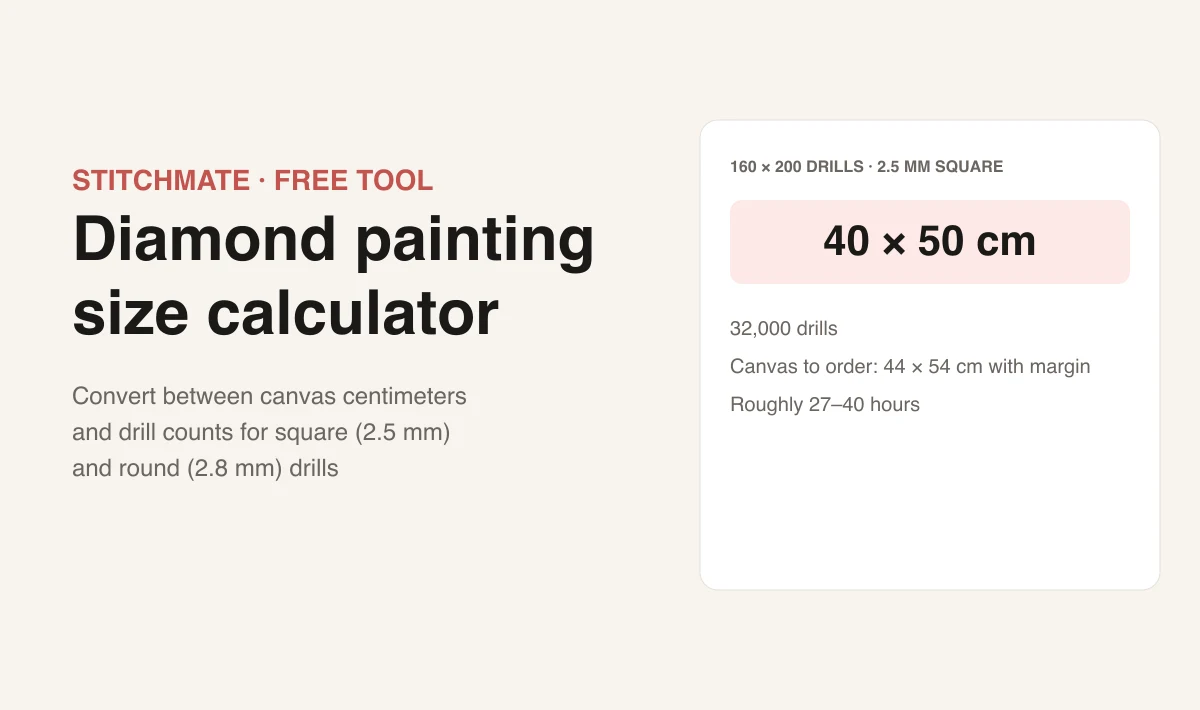
Diamond Painting Size Calculator
Turn canvas dimensions into drill counts — useful for planning storage and custom projects.

DMC Color Chart for Diamond Painting
Look up any DMC code — the universal color language for labeling leftover drills.
Photo to Diamond Painting
Convert any photo into a diamond painting chart with a drill-count legend. Free, no signup.