| CYC | Category | Common names | Knit gauge (sts / 4 in) | Needles |
|---|---|---|---|---|
| 0 | Lace | Fingering, 10-count thread | 33–40 | 1.5–2.25 mm |
| 1 | Super fine | Sock, fingering, baby | 27–32 | 2.25–3.25 mm |
| 2 | Fine | Sport, baby | 23–26 | 3.25–3.75 mm |
| 3 | Light | DK, light worsted | 21–24 | 3.75–4.5 mm |
| 4 | Medium | Worsted, afghan, aran | 16–20 | 4.5–5.5 mm |
| 5 | Bulky | Chunky, craft, rug | 12–15 | 5.5–8 mm |
| 6 | Super bulky | Super bulky, roving | 7–11 | 8–12.75 mm |
| 7 | Jumbo | Jumbo, roving | 6 and fewer | 12.75 mm and up |
Knitting calculator
Knitting gauge calculator
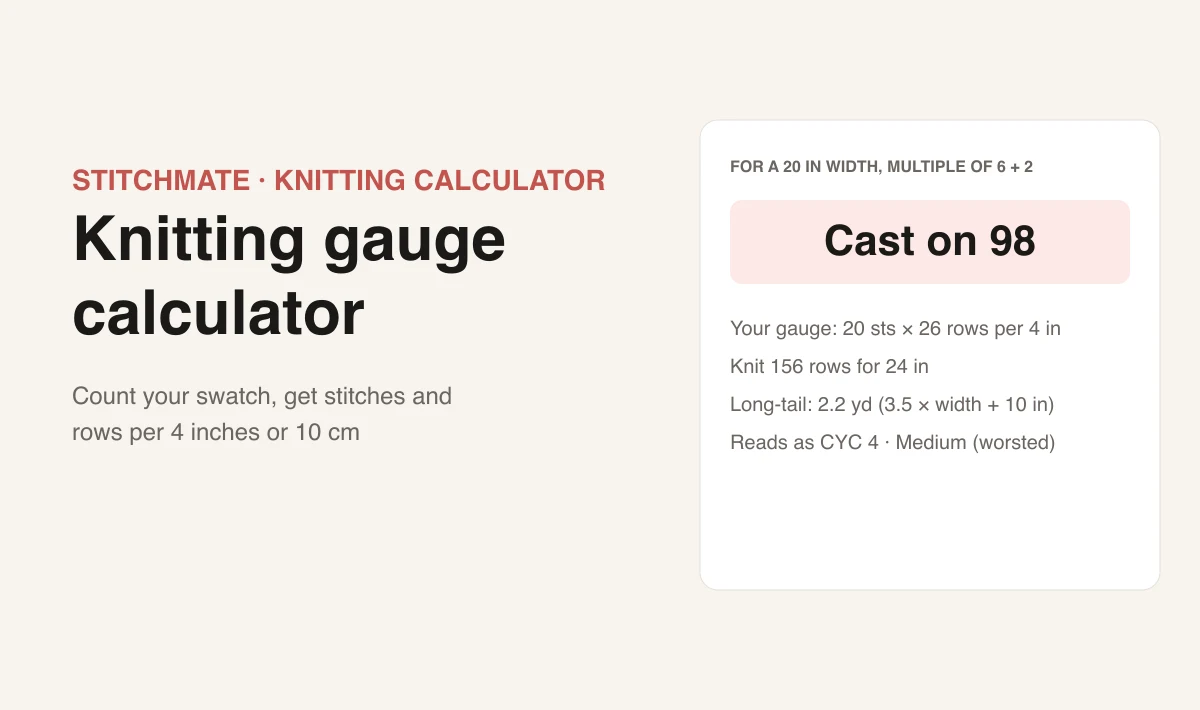
Count your swatch, get stitches and rows per 4 inches or 10 cm, then turn that into stitches to cast on for the width you want, rows to knit, a pattern re-gauged to your tension, and how long a long-tail cast-on tail to pull.
Gauge from a swatch
20
4
26
4
Count across the widest span you can, away from the edges, and include half stitches. Wash and block the swatch first if the finished piece will be.
Results
20 sts × 26 rows
per 4 in
5
Stitches per inch
6.5
Rows per inch
19.7 × 25.6
Per 10 cm
0.77
Stitch shape (height ÷ width)
Reads as CYC 4 · Medium
Worsted, afghan, aran. The Craft Yarn Council lists 16–20 sts per 4 in and needles of 4.5–5.5 mm (US 7–9) for this weight. Row gauge isn't standardised, so yours is the only one that counts.
Charting a motif at this gauge?
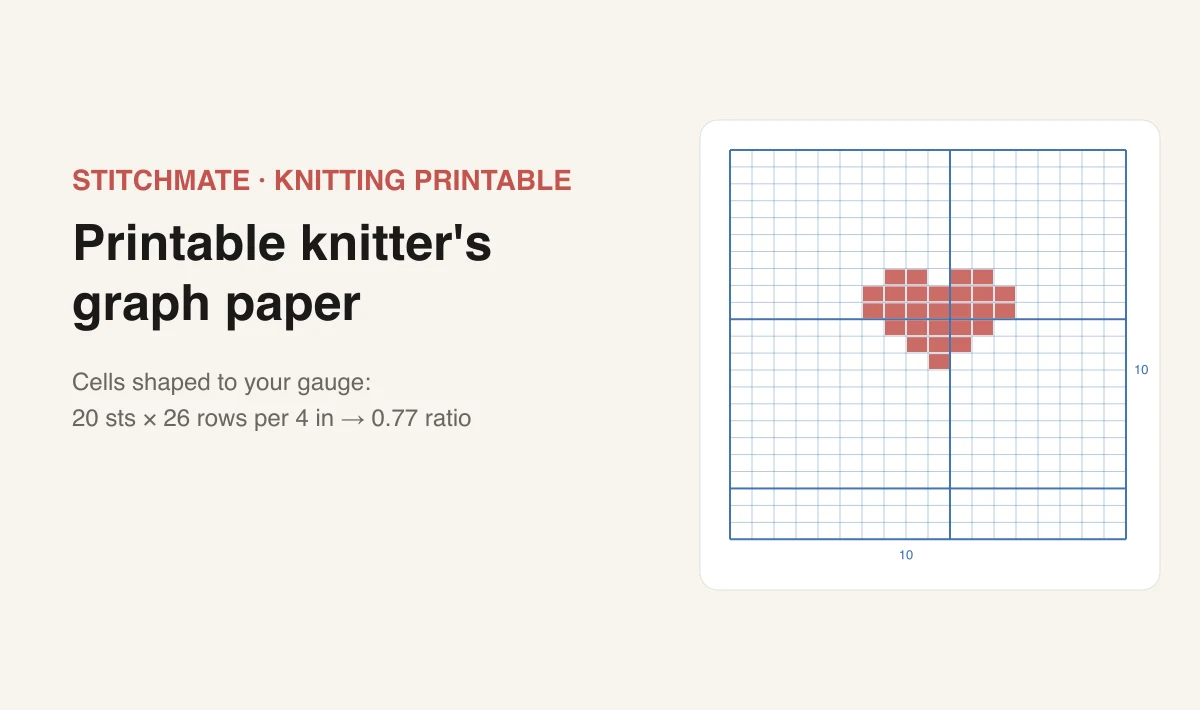
Square graph paper draws a knitted picture about 23% taller than it will knit up. The knitter's graph paper takes these two numbers and prints cells in the right proportion.
Four calculations, one gauge
Everything in knitting sizing comes back to one number pair: stitches and rows over 4 inches (10 cm). Get that from a swatch and the rest is arithmetic. This page does the arithmetic in four tabs that share it.
Gauge turns what you counted into stitches and rows per inch, per 4 inches and per 10 cm, and tells you which Craft Yarn Council weight band that reads as. Cast on turns gauge and a width into stitches, rounded to your stitch pattern's repeat, plus rows for the length. Convert re-gauges a pattern written for a different tension. Long tail estimates how much yarn to pull before a long-tail cast-on, three ways, because no single rule is right for every yarn.
Gauge from a swatch
The calculator asks for stitches counted over how many inches, not stitches per 4 inches, on purpose. Counting across the whole middle of a 6-inch swatch and dividing by the width you measured is more accurate than laying a 4-inch window on the fabric and reading it off, especially near the cast-on and edges where the stitches distort. Count half stitches.
Three things move gauge more than people expect: washing and blocking (measure the swatch the way the finished piece will live), the stitch pattern (stockinette, ribbing and cables all differ, so swatch in the pattern stitch), and needle material (metal versus wood can shift a gauge by a stitch or more over 4 inches).
The weight readout uses the Craft Yarn Council's knit gauge ranges:
The council publishes stitch gauge only. Row gauge is not standardized anywhere, which is why every "typical" row count you see, including the presets on our knitting graph paper, is a starting point and your swatch is the answer.
Stitches to cast on
The formula is gauge × width, and the part people skip is the rounding. If the pattern stitch is "multiple of 6 + 2", the count has to be 6 × something + 2 before selvedge stitches go on, because selvedge stitches sit outside the repeat. The calculator shows both legal counts either side of the raw figure, the number of whole repeats, and the width that count really makes, so a 12.8-inch piece at 5 stitches per inch with a 16-stitch repeat and 2 selvedge stitches each side comes out as 4 repeats, 64 pattern stitches, cast on 68.
Rows for a length work the same way with row gauge, which is the one number a pattern's "knit until piece measures" instruction lets you ignore. When the pattern counts rows instead, or when a colorwork chart has a fixed row count, it matters.
Matching a pattern's gauge
If your swatch does not match the pattern, you have two choices, and the calculator supports both.
Change the numbers. New stitch count = pattern count × (your gauge ÷ pattern gauge). A 110-stitch body written for 22 stitches per 4 inches is 100 stitches at 20. Row counts scale by the row-gauge ratio separately. This is easy for rectangles and blankets and gets hairy for garments with shaping, where every decrease row also moves.
Change the needle. More stitches per 4 inches than the pattern means a tighter fabric: go up a needle size. Fewer means looser: go down. Then swatch again, because the change per size is not a constant. Stitch gauge usually moves first; row gauge follows less predictably, and it is entirely normal to match stitches and miss rows. That is fine when the pattern says "knit to length" and a problem when it counts rows, so check both.
The long-tail cast-on tail
The long-tail cast-on uses the tail as one of its two strands, so you have to pull enough before you start and there is no way to add more. Three estimates are in common use and they do not agree with each other, which is why the calculator shows all three.
- By width, the method the Knitting Guild Association recommends: 3.5 × the finished width plus about 10 inches for weaving in, or 3 × for lace weight. Sensible for most yarns; drifts for very firm (sock) or very loose (shawl) fabric.
- An inch per stitch plus six inches. The rule everybody learns first. It is calibrated for medium (worsted) yarn on a mid-size needle and under-estimates for bulky, over-estimates for fingering.
- Wrap ten: wrap the yarn ten times around the needle you will use, unwind, measure, and scale to your stitch count. This one is measured in your yarn on your needle, so it is the most honest of the three. Add 10% for a twisted German or old Norwegian cast-on.
If the estimates disagree by a lot, they usually do, take the longest. Or sidestep it: cast on with the working yarn from one ball and the "tail" from a second ball (or the other end of a center-pull cake), then cut the second strand. No tail math, two ends to weave in instead of one.
Needle sizes
Metric is the one system that means the same thing everywhere; US and old UK numbers vary by brand and run in opposite directions. The Craft Yarn Council lists no US number for 3 mm, 7 mm or 7.5 mm, and some brands label 3.5 mm as US 4.
| mm | US | Old UK | mm | US | Old UK |
|---|---|---|---|---|---|
| 2.0 | 0 | 14 | 5.0 | 8 | 6 |
| 2.25 | 1 | 13 | 5.5 | 9 | 5 |
| 2.75 | 2 | 12 | 6.0 | 10 | 4 |
| 3.0 | — | 11 | 6.5 | 10½ | 3 |
| 3.25 | 3 | 10 | 7.0 | — | 2 |
| 3.5 | 4 | — | 8.0 | 11 | 0 |
| 3.75 | 5 | 9 | 9.0 | 13 | 00 |
| 4.0 | 6 | 8 | 10.0 | 15 | 000 |
| 4.5 | 7 | 7 | 12.75 | 17 | — |
A note on terms
US and UK knitting vocabulary differs in the places that matter here. Gauge is tension in the UK. Bind off is cast off. Stockinette is stocking stitch. Yarn weights carry the Craft Yarn Council number in North America and just the name (4-ply, DK, aran, chunky) in the UK; they line up, but "4-ply" is fingering, not four strands of anything.
Crochet gauge
The same swatch-and-divide arithmetic works for crochet, with two caveats. Swatch in the stitch you will actually use, because single, half double and double crochet gauge very differently in the same yarn. And for C2C crochet, the unit is a block of three double crochets rather than a stitch, so measure blocks per 4 inches instead; the crochet pattern maker works in blocks from the start.
Charting a motif at your gauge
Knit stitches are wider than they are tall, roughly 4 to 5 across for every 5 to 7 up. A picture drawn on square graph paper knits up squashed by about a quarter. The knitter's graph paper generator takes the stitch and row gauge you just measured and prints cells in that exact proportion, numbered the way a colorwork chart reads.
Related Guides & Tools
Knitter's graph paper
Printable grid with cells shaped to your gauge, numbered right to left and bottom to top.
Cross stitch graph paper
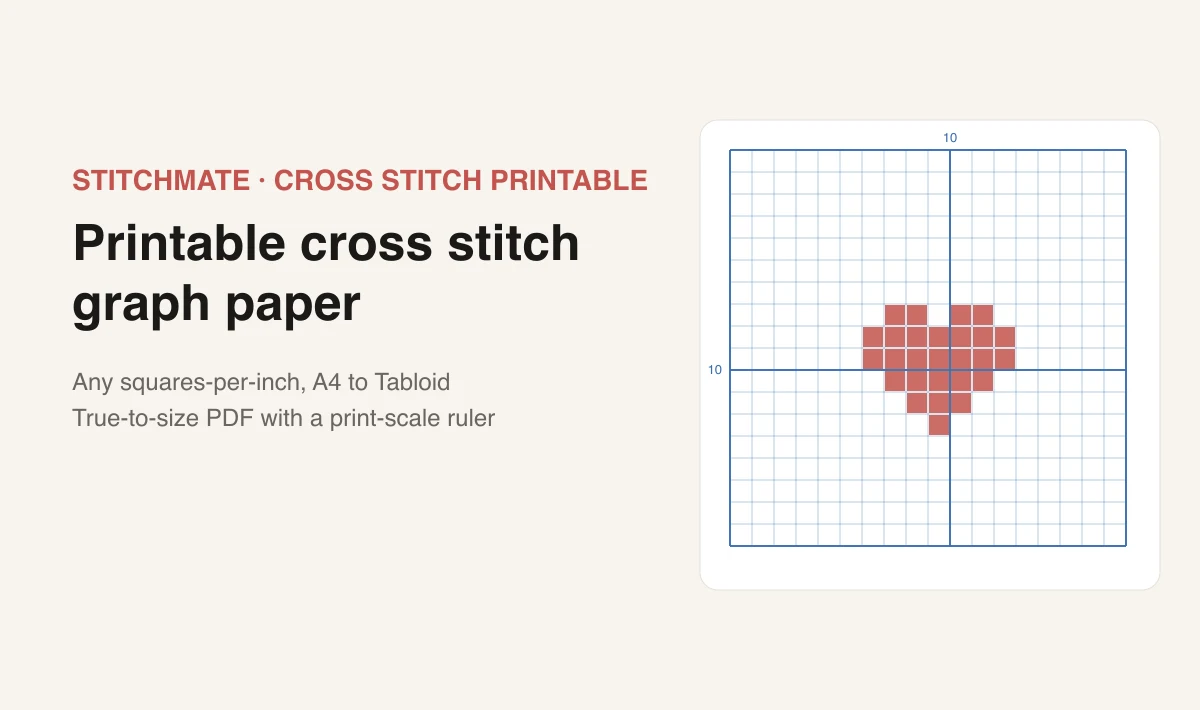
Square-celled paper at any count for cross stitch, needlepoint and beads.
QR code to pattern
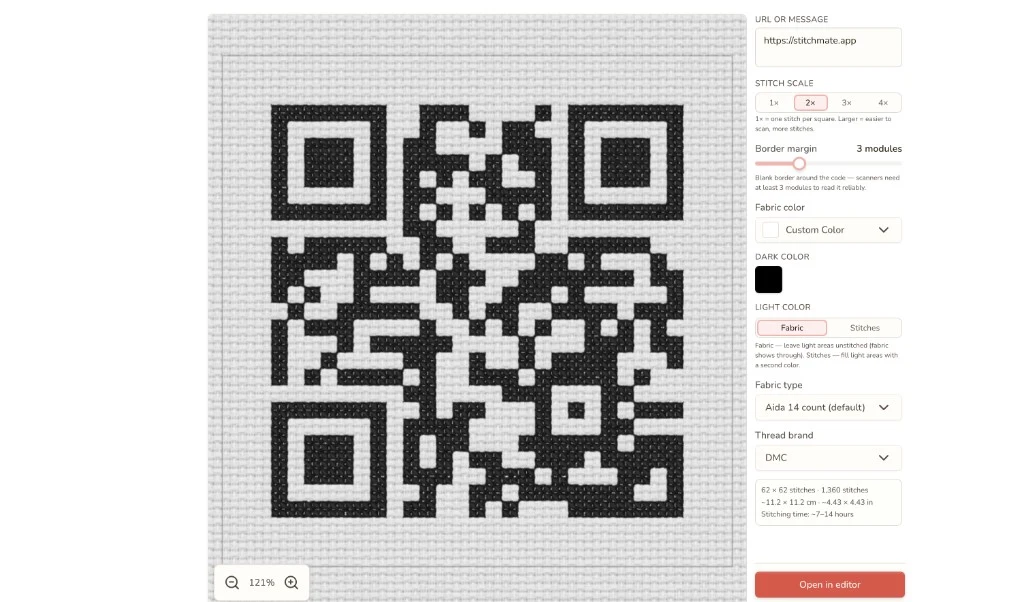
A scannable QR code as a two-color grid, ready to chart in any craft.
All tools
Calculators, color charts, converters and printables, all free.
FAQ
How do I calculate knitting gauge?
Knit a swatch at least 6 inches square, wash and block it the way you will treat the finished piece, then count stitches across the widest span you can measure away from the edges and divide by that width in inches. Do the same for rows. Multiply by 4 for stitches per 4 inches, the way patterns quote it. Counting over 6 inches and dividing is more accurate than trusting one 4-inch segment, and half stitches count.
How many stitches do I cast on for a given width?
Stitches per inch times the width you want. At 20 stitches per 4 inches (5 per inch), a 20-inch-wide piece needs 100 stitches. If the stitch pattern says "multiple of 6 + 2", round to the nearest count that fits that rule first, then add any selvedge stitches on top. The calculator shows both legal counts either side of the raw number so you can round whichever way suits the fabric.
What if my gauge does not match the pattern?
Multiply the pattern's stitch count by your gauge divided by the pattern's gauge. A 110-stitch piece written for 22 stitches per 4 inches becomes 100 stitches at 20. Or change needles: more stitches per 4 inches than the pattern means your fabric is tighter, so go up a size and re-swatch; fewer means looser, so go down. Row gauge drifts on its own and only changes lengths, so check it separately.
How long should the tail be for a long-tail cast-on?
Three rules of thumb, none exact. About an inch per stitch plus six inches, which suits worsted-weight yarn. Or 3.5 times the finished width plus 10 inches (3 times for lace). Or wrap the yarn around the needle ten times, measure that, and scale it to your stitch count, adding 10% for a twisted cast-on. The calculator shows all three; pull the longest, or cast on from two balls and cut the second afterwards.
What do the Craft Yarn Council numbers 0 to 7 mean?
They are the standard yarn weight categories: 0 lace, 1 super fine (fingering, sock), 2 fine (sport), 3 light (DK), 4 medium (worsted, aran), 5 bulky, 6 super bulky, 7 jumbo. Each has a published knit gauge range, for example 16 to 20 stitches per 4 inches for medium. The calculator reads your swatch gauge back against those ranges. It is a guide only: the gauge in your pattern always wins.
Is per 4 inches the same as per 10 cm?
Near enough that ball bands treat them as the same thing. 4 inches is 10.16 cm, a 1.6% difference, smaller than the variation between two swatches by the same knitter. The calculator converts exactly if you switch units, but you will not go wrong reading one as the other.
Does it work for crochet gauge?
The arithmetic is the same: stitches and rows counted over a measured span, then multiplied out to a width or length. Swatch in the stitch you will use, since single, half double and double crochet all gauge differently. The long-tail tab is knitting-only, and for C2C blankets the unit is a block rather than a stitch; the C2C crochet pattern maker sizes those directly.
Is this free?
Yes. No account, no limits, nothing sent to a server. It runs entirely in your browser.
See how your photo converts
Cross stitch is a real commitment — real thread, real hours, real frustration if the pattern doesn't work. Stitchmate lets you see exactly what you're getting into before you buy the first skein.
Upload an image, adjust the settings, check the FLOW Score — about 30 seconds to know if it'll work. Everything up to PDF export is free, no account needed.
Upload Your Photo Free