| Weight (CYC) | Typical gauge (sts × rows / 4 in) | Cell ratio |
|---|---|---|
| Lace (0) | 34 × 44 | 0.77 |
| Fingering (1) | 28 × 36 | 0.78 |
| Sport (2) | 24 × 32 | 0.75 |
| DK (3) | 22 × 30 | 0.73 |
| Worsted (4) | 20 × 26 | 0.77 |
| Aran (4) | 18 × 24 | 0.75 |
| Bulky (5) | 14 × 20 | 0.70 |
| Super bulky (6) | 10 × 14 | 0.71 |
Knitting printable
Printable knitter's graph paper
Enter your stitch and row gauge and get graph paper whose cells are the shape of your stitches, wider than tall, so the motif you draw is the motif you knit. Stitches count right to left, rows bottom to top, like a colorwork chart. A4, Letter, Legal, A3 or Tabloid, with a printed ruler to check the scale.
Knitter's graph paper
Gauge
20
26
From your blocked swatch, in stockinette. Cell ratio 0.77 — each cell is 5.1 × 3.9 mm on paper.
Starting points only — row gauge is not standardised, so measure your own swatch when it matters.
5
Bigger cells are easier to draw in; actual size shows the motif at knitted scale.
10
Stitches count right to left and rows bottom to top, like a colorwork chart.
Paper
0.4
Style
Preview
37 × 65 stitches × rows
7.4″ × 10.0″ of grid (18.8 × 25.4 cm)
100%
Print at 100%
In the print dialog set scale to 100% (or “Actual size”) — not Fit to Page, which silently shrinks the grid. The sheet includes a 1-inch and 1-cm ruler; check them with a real ruler before you start charting. More on print scaling.
20 sts × 26 rows per 4 in · A4 portrait · knitted at this gauge, the whole sheet is 7.4″ × 10.0″ (18.8 × 25.4 cm). Work out your cast-on.
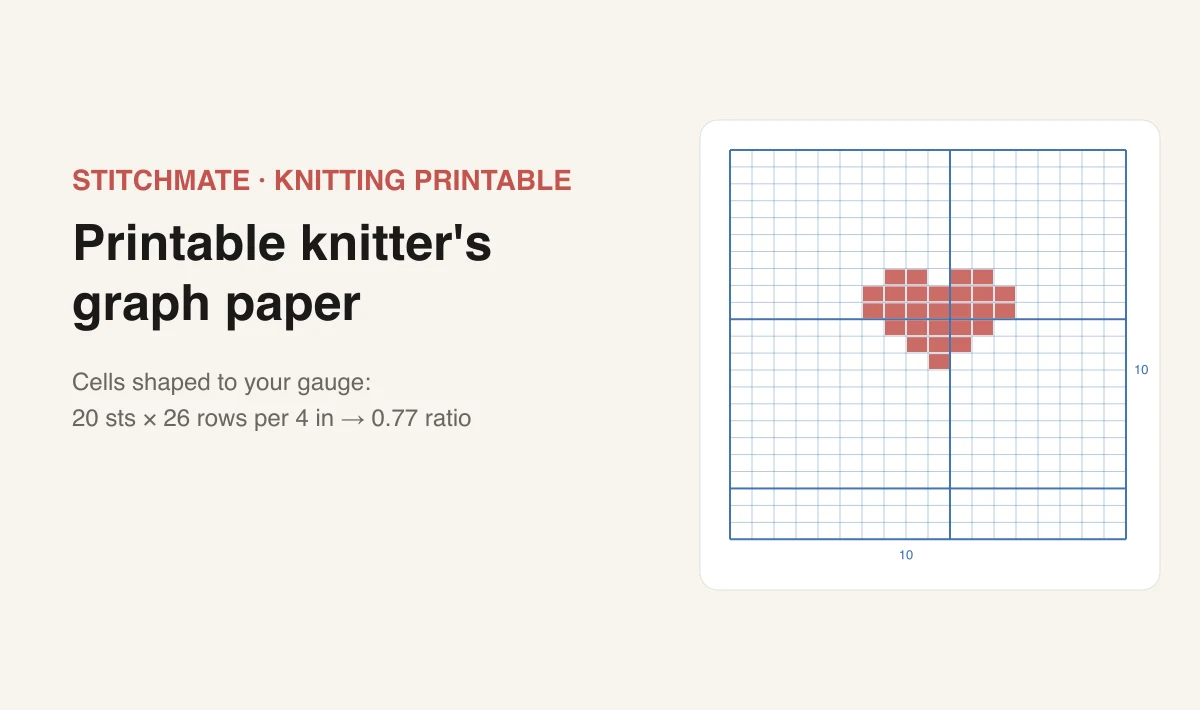
Why square graph paper lies to knitters
A knitted stitch is a V, and the V is wider than it is tall. At 20 stitches and 26 rows per 4 inches, a common worsted gauge, one stitch is 0.2 inches wide and 0.154 inches tall, a ratio of about 0.77. Draw a motif on ordinary square paper and every shape you knit from it will be shorter than you drew it by that ratio: a circle becomes an oval, a square becomes a wide rectangle, and lettering looks flattened.
Every serious colorwork designer works on paper whose cells have the stitch's proportions. That is all this generator is: enter your gauge, and the cells come out that shape. Stockinette ratios run from roughly 0.6 for bulky yarn to 0.85 for fine fingering; your swatch will tell you yours, and the two boxes at the top of the tool take it directly.
Enter your gauge, not a yarn weight
The tool asks for stitches and rows per 4 inches (or per 10 cm) because that is what a swatch gives you and what a pattern quotes. Cast on a swatch of at least 6 inches, work it in stockinette (or the stitch you will use), wash and block it, and count across the middle.
If you have not swatched, the yarn-weight chips fill in typical stockinette gauges. The stitch counts sit inside the Craft Yarn Council's published ranges for each weight; the row counts are the usual pairings you see on ball bands and in patterns. They are a place to start and nothing more. Row gauge is not standardized by the Craft Yarn Council or anyone else, it varies with needle material, fiber and the knitter, and it is the number that decides the cell shape. When the motif matters, measure.
Already measured a swatch in the gauge calculator? Those are the two numbers to type in here.
Scale: drawing size versus actual size
Gauge sets the shape of the cells. A second control sets their size on paper, and the two are separate on purpose.
By default the paper prints at 5 stitches per inch regardless of gauge, because that is a comfortable cell to color in with a pencil and most people are drawing, not measuring. Press actual size and the scale snaps to your real gauge, so a 40-stitch motif occupies the 8 inches it will occupy in worsted yarn. That is the setting for checking whether a yoke motif fits, or for laying the paper against a finished swatch.
How the numbering works
Knitting charts are read the way the fabric is made: row 1 at the bottom, right-side rows right to left, and stitch 1 at the right edge. This paper numbers itself that way. Stitch numbers run right to left along the bottom edge; row numbers run bottom to top on the right edge; bold lines fall every 10 by default so you can find stitch 37 without counting.
For flat knitting, wrong-side rows read left to right, and knitters like the even row numbers on the left. Switch numbering to 4 sides for that. For knitting in the round, every round reads right to left, and the default right-and-bottom numbering is exactly what a round-worked chart shows.
Print at 100%
A PDF carries its size in absolute units, so the file is right; the print dialog is what goes wrong. Fit to Page, Shrink oversized pages and Scale to fit all reduce the sheet by a few percent to clear the printer's edge margin. At drawing scale that does not matter much. At actual size it does: 3% off is more than a stitch over a 40-stitch motif.
Set the scale to 100% (Adobe and Preview call it Actual size; Chrome Default; Firefox has a Scale field) and turn off any fit or shrink option. Then check the printed 1-inch and 1-cm bars above the grid against a real ruler. If both are short by the same proportion, the print was scaled; fix the setting and reprint. If the bars are right but the cells look wrong, the gauge is wrong, not the printer.
Charting colorwork on paper: a short method
- Mark the center. The crosshair prints in the middle of the grid. Motifs are placed from the center outwards, and a chart centered on the paper is a chart centered on the piece.
- Draw the outline in whole cells before any color. Curves are staircases at this resolution, and deciding where each step falls is the design.
- Count colors per row and the longest run of each. In stranded knitting, a run of more than 5 to 7 stitches of one color leaves a float on the back that has to be caught. In intarsia every separate color area is a bobbin. A motif that looks fine on paper can be miserable to knit; this is the moment to simplify.
- Mark the repeat with a heavy box if the motif tiles, and check the stitch count of the repeat divides into your cast-on.
- Keep a legend at the side: color, yarn, and how many stitches of each in the motif, which is the same number you need to estimate yarn.
Or chart it on screen
Paper is good for thinking and bad for changing your mind. Stitchmate's editor draws on a grid with undo, per-color stitch counts and a printable chart, and its photo converter turns an image into a color grid in one step. Fair warning: the editor's cells are square today, so use it for placement and color counts and this paper for the true proportions until a knitting mode ships.
Related Guides & Tools
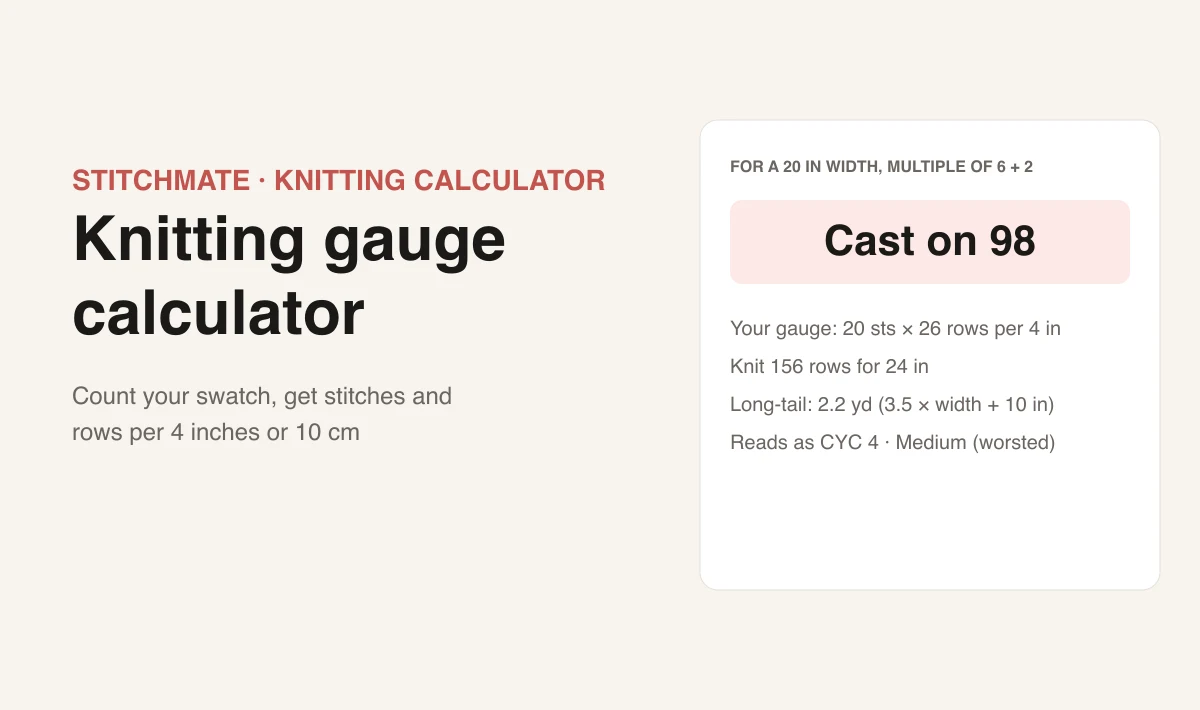
Knitting gauge calculator
Gauge from a swatch, stitches to cast on, pattern conversion and long-tail cast-on length.
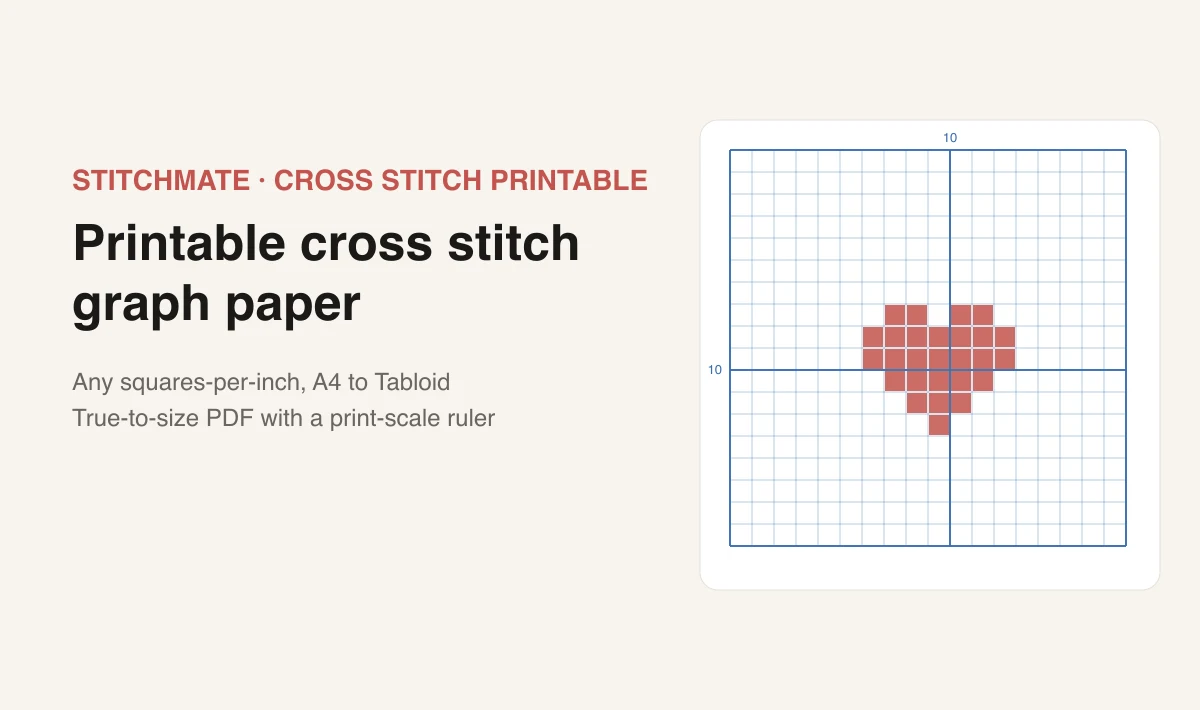
Cross stitch graph paper
The square-celled version, at any fabric count, for cross stitch, needlepoint and beads.
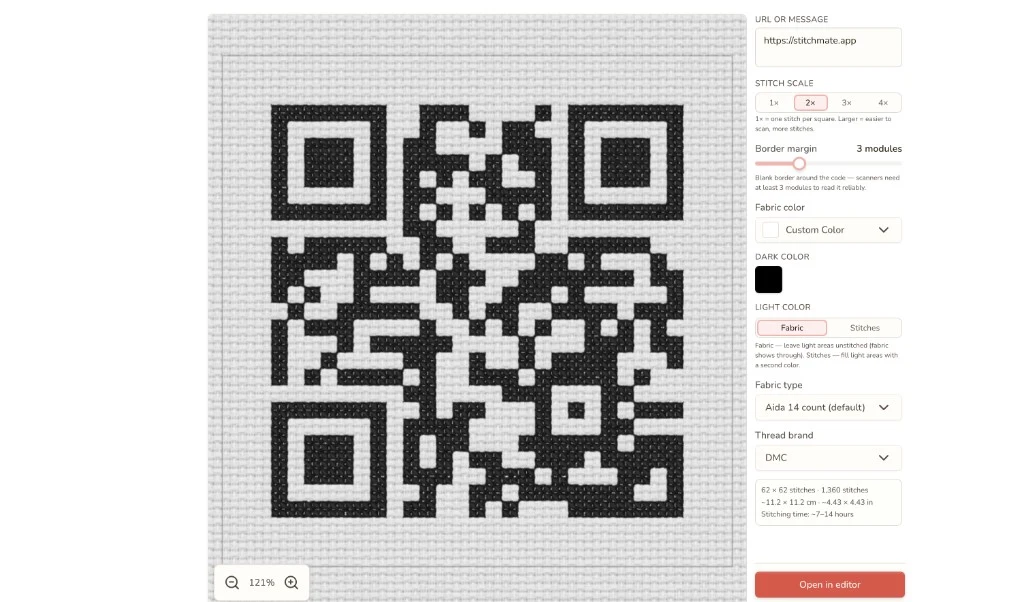
QR code to pattern
A working QR code as a two-color grid: the classic knitted-QR project starts here.
Pixel art to chart
Sprites and pixel art on a stitch grid, and what changes when the cells are not square.
FAQ
Why does knitting need special graph paper?
Because a knit stitch is wider than it is tall. At a typical worsted gauge of 20 stitches and 26 rows per 4 inches, each stitch is about 0.77 times as tall as it is wide. Draw a circle on square graph paper and knit it, and you get an oval squashed by about a quarter. Paper with cells in the ratio of your gauge shows the motif the way it will actually knit up.
What ratio should I use?
Your own. Knit and block a swatch, count stitches and rows over 4 inches, and type both numbers in; the generator works out the cell shape. If you have not swatched yet, the yarn-weight presets give typical stockinette gauges (worsted 20 × 26, DK 22 × 30, fingering 28 × 36) as a starting point. Row gauge is not standardized by anyone, so treat presets as a sketch and your swatch as the truth.
How are the numbers arranged?
The way a colorwork chart reads. Stitch numbers run right to left along the bottom, so stitch 1 is at the right edge where a right-side row starts. Row numbers run bottom to top on the right side, with row 1 at the bottom. Turn on 4-sided numbering to add the left and top too, useful for flat knitting where wrong-side rows read left to right.
Does the sheet print at actual size?
Only if you tell it to. By default the cells are drawn at 5 stitches per inch, which is a comfortable size to draw in. The "actual size" button sets the scale to your real gauge so the sheet shows the motif at knitted scale, and a 20-stitch-wide motif on paper is the 4 inches it will be in yarn. Either way, print at 100% and check the printed ruler; "Fit to Page" shrinks everything by a few percent.
Can I make paper for a big colorwork panel?
Yes. Turn on "cover a bigger design", enter the width in stitches and height in rows, and the generator tiles as many sheets as it takes with a 5-cell overlap for taping. The numbering continues across sheets from the design edge, so stitch 1 is still the right-hand edge of the whole panel, not of each page.
Is this graph paper free?
Yes: no account, no watermark, no limits. It runs in your browser and nothing is uploaded. Download as PDF for printing, or PNG and SVG to drop into other software.
See how your photo converts
Cross stitch is a real commitment — real thread, real hours, real frustration if the pattern doesn't work. Stitchmate lets you see exactly what you're getting into before you buy the first skein.
Upload an image, adjust the settings, check the FLOW Score — about 30 seconds to know if it'll work. Everything up to PDF export is free, no account needed.
Upload Your Photo Free