Blackwork Cross Stitch: What It Is and How to Start
Blackwork is built from the same straight stitches cross stitchers already use for outlines — no crosses at all. Here's what it is, how it differs from cross stitch, and a fill pattern to stitch first.
Look closely at the collars and cuffs in a Holbein portrait of the Tudor court and you'll see fine black geometric lines on white linen. That's blackwork, and it's built from the same thing cross stitchers already know as backstitch: straight thread segments running between the holes of a gridded fabric. No crosses at all.
That shared grid is why "blackwork cross stitch" gets searched so often. The two techniques live on the same fabric, use the same floss, read from the same kind of chart, and combine well in one design. But they produce very different results — one fills squares with color, the other draws open patterns with line — and treating blackwork as cross stitch with the crosses left out is where most first attempts go wrong.
This guide covers what blackwork is, how it differs from cross stitch, the two stitches it's worked in, what fabric and thread to use, how to read a fill chart, and a starter fill you can stitch this evening. If you already know backstitch, you're most of the way there.
What blackwork is
Blackwork is a form of counted-thread embroidery: every stitch is placed by counting the threads of the fabric rather than following a design drawn onto it. The stitches are straight lines that run between grid intersections, and the lines assemble into geometric, repeating patterns — lattices, diamonds, stepped crosses, small flowers and stars — that fill an area the way a printed fabric fills a shape.
Traditionally it was worked in black silk on white or cream linen, which is where the name comes from. In England it's associated with the Tudor court of the early 16th century, and by tradition it arrived with Catherine of Aragon, which is why older sources also call it "Spanish work." That attribution is a story rather than a documented fact — geometric black-on-white embroidery existed in several places before her — but the association stuck. What is documented is the portraiture: Hans Holbein the Younger painted Henry VIII's court in such detail that the blackwork on their collars, cuffs, and smocks is legible almost stitch for stitch, and the reversible double running stitch the technique uses is still called the Holbein stitch after him. The Victoria and Albert Museum holds surviving 16th-century pieces if you'd rather see the originals than the paintings.
Two things changed between then and now. First, color: modern blackwork is worked in any single color — deep navy, burgundy, forest green, even white on black linen — and "blackwork" describes the technique, not the thread. Second, shading: 20th-century designers worked out that the same motif stitched with fewer lines reads as a light tone and with more lines as a dark one, so a blackwork piece can model a face, a pear, or a landscape in graduated density using one color of thread. That's the version taught today by the Royal School of Needlework and most contemporary designers.
Blackwork vs cross stitch
| Blackwork | Cross stitch | |
|---|---|---|
| Basic unit | A straight line segment between two grid intersections | An X filling one square |
| Coverage | Open, geometric — fabric shows through | Solid — squares of color cover the fabric |
| Thread | One strand for fills, two for outlines | Usually two strands on 14-count |
| Fabric | Evenweave or linen preferred; Aida works | Aida most common; evenweave for a smoother finish |
| Color | Traditionally one color; tone comes from density | Many colors; tone comes from thread choice |
| Reversibility | Reversible if worked in Holbein stitch | Not reversible |
| Time per square | Fast per stitch, but fills are dense and every line is counted | Slower per stitch, less counting inside solid color areas |
| Forgiveness | One miscounted line breaks the repeat and shows | A misplaced X hides inside a color block |
The phrase blackwork cross stitch doesn't name a separate technique. It shows up for two reasons. Chart designers combine the two — cross stitched motifs with blackwork fills for backgrounds, clothing, or shading — and sell the result as a cross stitch chart with a blackwork element. And cross stitchers who already own Aida and floss try blackwork on the fabric they have, which works well and is how most people start. Either way, if you can read a cross stitch chart and work a backstitch, you have the skills. What's new is the counting discipline, because a fill pattern has no solid color blocks to hide a mistake in.
The stitches
Blackwork is worked in one of two stitches, and most modern charts accept either.
Holbein stitch (double running stitch)
The Holbein stitch is a running stitch worked twice along the same path. On the first journey you stitch every other segment — thread over one square, under the next, over, under — leaving a dashed line. On the return journey you come back along the same path and fill the gaps, so the dashes join into a continuous line.
Two properties follow from that. The line is reversible: the back looks identical to the front, because each length of thread is on the surface exactly once on each side. And it lies flatter than backstitch, because there's no doubled thread anywhere — a backstitch line carries twice the thread on the reverse, which lifts the front slightly. On tablecloths, bookmarks, and anything where the back will be seen, Holbein stitch is the traditional choice, and on a fine 32-count linen the flatness is visible.
The cost is planning. A fill pattern has branches, and on the return journey you have to detour into each branch and come back out without leaving a gap or doubling a segment. Designers who chart for Holbein often mark the route with numbered steps. It rewards a little forethought, and a common beginner problem is working the first journey too tightly, which makes the return pass pucker.
Backstitch in blackwork
Most modern blackwork charts are stitched in plain backstitch, and there's nothing wrong with that. Backstitch produces the same line on the front, needs no route planning, handles branching fills without any thought, and is the stitch cross stitchers already know. The back is untidier and the line stands a touch prouder, which doesn't matter on a framed piece.
The technique itself — grid intersections rather than square centers, one to three squares per segment, no knots — is covered in detail in backstitch in cross stitch, and everything there applies here. The one habit to add for blackwork is consistency of segment length. A fill motif repeated 200 times shows every segment that was stitched two squares long where the others were one.
Fabric and thread
Fabric. Blackwork's natural home is evenweave or linen at 28 or 32 count, stitched over two threads — each line segment spans two fabric threads, which gives 14 or 16 stitches to the inch. The individual threads let you place diagonals and half-square details cleanly, and the smooth surface shows fine lines well. The evenweave guide covers counting over two if you haven't stitched on it before.
Aida at 14 or 16 count works too, and it's quicker to count because the holes are obvious. The trade-off is that Aida's woven blocks give the fabric a visible texture between your lines, and you can't stitch over one thread for fine detail. For a first project on fabric you already own, 14-count Aida is a reasonable place to start; move to evenweave when you want the finish. The fabric types guide compares the options.
Thread. One strand of six-strand cotton floss for fill patterns is the standard; two strands for outlines and borders that should read heavier than the fills. That mirrors backstitch convention, and for the same reason — with two strands, a dense fill turns into a smudge. Black is DMC 310 if you're using DMC; any single dark color works, and the pattern reads best against a fabric with strong contrast. For a shaded piece, keep to one color and let density do the work. Metallic thread — a gold blending filament laid with the black, or a few metallic outline lines — is a traditional accent and still looks right, but keep it to accents. Metallics fray and twist more than cotton, and a fill worked in metallic alone is slow going.
Needle. A blunt tapestry needle: size 26 for 28-count evenweave and 14-count Aida, size 28 for 32-count linen. You want the needle to slip between fabric threads, not pierce them.
Reading a blackwork chart
A blackwork chart looks like the backstitch layer of a cross stitch chart with the crosses removed. Lines are drawn between grid intersections, and every line is one or more stitches. If you've read backstitch on a chart, you can read this; how to read a cross stitch pattern covers the shared conventions.
Three things are specific to blackwork:
The repeat unit. A fill pattern is defined by a small tile — often 4×4 or 6×6 squares — that repeats in every direction. Charts usually show the tile once, framed, and then the area it fills. Find the tile, stitch one repeat, and check it against the chart before you carry on; an error in the tile propagates across the whole area.
Fill versus outline. A blackwork chart distinguishes outlines — the edges of shapes, usually a heavier line in two strands — from fills, the repeating pattern inside them. Fills stop at the outline, and where a motif is cut off by the edge of the shape you stitch the partial motif, not a whole one. The outline is usually worked first so you know exactly where the fill stops.
Density shading. When a chart shades an area, it uses the same motif at different densities: a light version with the fewest lines, a medium version with more segments added, and a dark version with the tile fully drawn. Charts show the variants side by side, usually labeled light, medium, and dark, or one, two, and three. Because the tiles share the same skeleton, the transitions between tones read as continuous shading rather than as separate regions — and if you look closely at a shaded blackwork portrait, that's the whole trick.
A starter fill pattern
Here's a classic square-in-diamond lattice on a 4×4 repeat. + marks a grid intersection (a hole on evenweave, a corner on Aida), - and | are horizontal and vertical stitches one square long, and / and \ are diagonal stitches across one square.
One repeat of the tile is a diamond with a 2×2 square set inside it, the square's corners touching the diamond's sides:
+   +   +   +   +
    /   \
+   +---+---+   +
/ |       | \
+   +   +   +   +
\ |       | /
+   +---+---+   +
    \   /
+   +   +   +   +
One repeat of the square-in-diamond blackwork fill on a 4×4 grid.
Tiled two by two, the diamonds join into a continuous lattice:
+   +   +   +   +   +   +   +   +
    /   \           /   \
+   +---+---+   +   +---+---+   +
/ |       | \   / |       | \
+   +   +   +   +   +   +   +   +
\ |       | /   \ |       | /
+   +---+---+   +   +---+---+   +
    \   /           \   /
+   +   +   +   +   +   +   +   +
    /   \           /   \
+   +---+---+   +   +---+---+   +
/ |       | \   / |       | \
+   +   +   +   +   +   +   +   +
\ |       | /   \ |       | /
+   +---+---+   +   +---+---+   +
    \   /           \   /
+   +   +   +   +   +   +   +   +
The same square-in-diamond fill tiled two by two into a continuous lattice.
Each diamond is eight diagonal stitches with its points at the midpoints of the tile's four edges. The 2×2 square inside it touches the diamond on all four sides — each corner of the square shares a hole with the diagonal that passes through it, so nothing floats.
Stitching route. Notice that the diagonals of neighboring diamonds line up into long straight lines running across the whole area. That's how to stitch them: work one continuous diagonal, a stitch across every square from corner to corner, from one edge of the area to the other. In Holbein stitch, go over one square and under the next, then fill the gaps on the way back; in backstitch, work it straight through. Do all the diagonals leaning one way, then all the diagonals leaning the other way. You now have a lattice of empty diamonds. Finally, work each square as a closed loop of eight stitches, starting at a corner that already holds a lattice stitch, and travel to the next square on the back behind a lattice line.
For a first attempt, mark out a 12×12 area — three repeats each way — in one strand on 14-count Aida or 28-count evenweave over two. It takes an hour or two and teaches everything the technique asks of you: counting a repeat, holding a consistent segment length, and traveling tidily on the back.
Combining blackwork with cross stitch
The most common way cross stitchers use blackwork is as a fill inside a cross stitch design: a lattice for a background wall or sky, a repeating motif for a garment or a tablecloth in a scene, a shaded fill for a shadow or the ground beneath a motif. It adds texture and tone to an area without the hours a solid cross stitched fill would take, and the contrast between a solid region of Xs and an open line pattern next to it is the point.
Three things to get right:
Strand counts. Match the blackwork to the cross stitch it sits beside. If the crosses are two strands on 14-count, work the fill in one strand and the outlines in two, so the fill reads as background and the outlines match the weight of the cross stitched shapes. A one-strand fill next to two-strand crosses is the standard pairing, and it looks deliberate.
Stitch order. Cross stitch first, then lines — the same rule as for backstitch. Complete every cross stitched area, then work blackwork outlines, then fills. Fills that border a cross stitched area should meet it cleanly at the shared holes; if you stitch the fill first, the crosses push under it and the line distorts.
Fabric. If the design combines both, the fabric has to suit both. Aida is fine — it's what most people bought for the crosses, and blackwork fills on Aida look good. Evenweave over two is the better finish for both, and there's no compromise involved: cross stitch over two and blackwork over two share the same grid.
Worked out in advance on a chart, the combination stitches cleanly. Improvised onto a finished cross stitch piece, it's harder, because the fill's repeat won't line up with your shape boundaries. Chart it first.
Charting blackwork in pattern software
Blackwork is charted the same way backstitch is, because structurally it is backstitch: line segments between grid intersections, each with a color. Any pattern editor that draws backstitch can chart a blackwork fill, and there's nothing blackwork-specific about the tool you use.
In the Stitchmate editor, the backstitch tool draws single segments or connected paths between grid intersections, snapping to stitch corners and their midpoints, in any color from your palette and at a strand count you set per line. A fill pattern is drawn as its tile once, then stepped across the area with the backstitch select tool: select the lines of one repeat and Alt-drag the selection to duplicate it, 4×4 at a time. (The normal cell copy/paste does not carry backstitch, so use the select tool for lines.) Outlines go in as two-strand lines, fills as one-strand lines, and the legend lists them by color and strand count. When you export a PDF, the lines print on the chart with their own backstitch legend, and you can add backstitch-only overlay pages that show the lines on an empty grid — for a dense fill, much easier to read than lines drawn over symbols.
To be plain about what this is: a general backstitch tool. There's no blackwork mode, no library of fill motifs, and no automatic shading — you chart every line yourself. For a fill you're designing, that's what you'd want anyway.
FAQ
What is blackwork cross stitch?
Is blackwork the same as cross stitch?
What is the Holbein stitch?
What fabric is best for blackwork?
How many strands for blackwork?
Can you do blackwork on Aida?
Is blackwork good for beginners?
Chart your own blackwork fill
Draw the repeat once with the backstitch tool, select and Alt-drag it across the area, and export a chart with its own line legend.
Open the pattern makerFree to use. No account required.
Related Guides & Tools
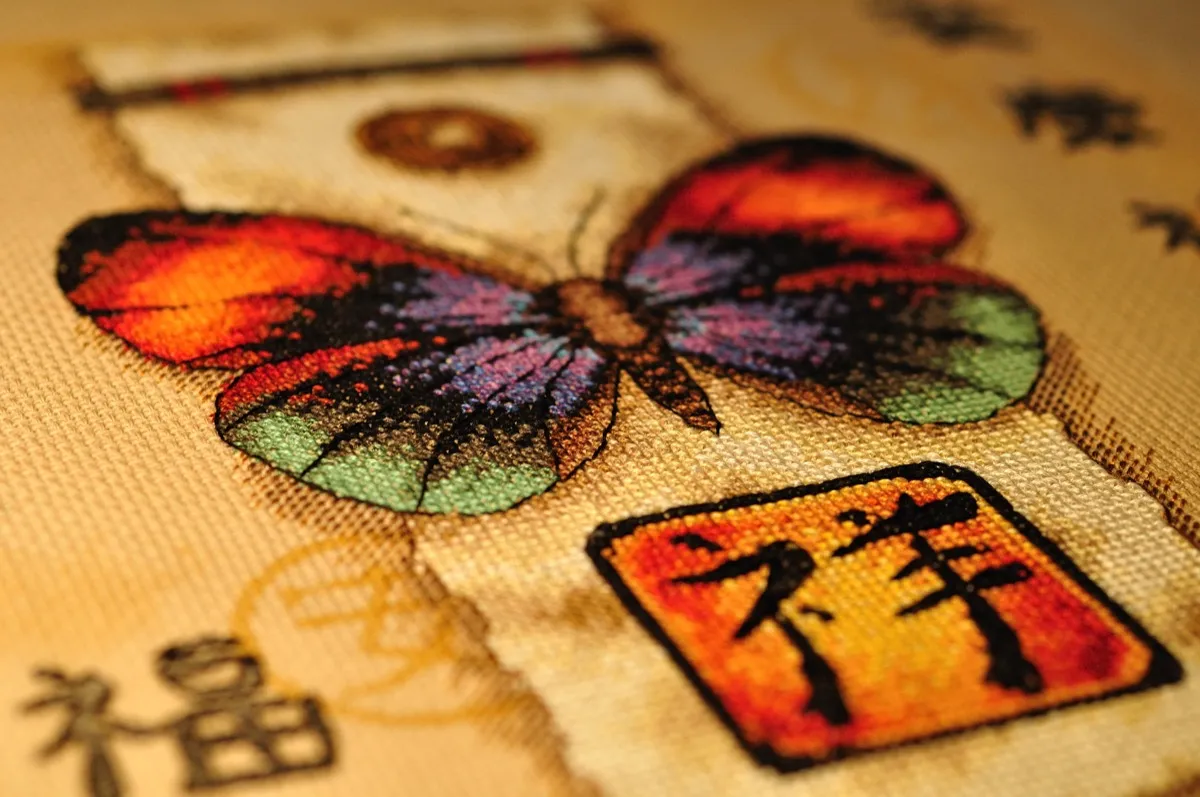
Backstitch in cross stitch
The three rules of backstitch, strand counts by fabric, how to read it on a chart, and the mistakes that show — all of which apply to blackwork.
Evenweave fabric guide
Stitching over two threads, Lugana vs Cashel vs Jobelan, and when evenweave beats Aida — the fabric blackwork was made for.
Cross stitch fabric types
Aida, evenweave, or linen? Compare fabrics by count, difficulty, and finished look.
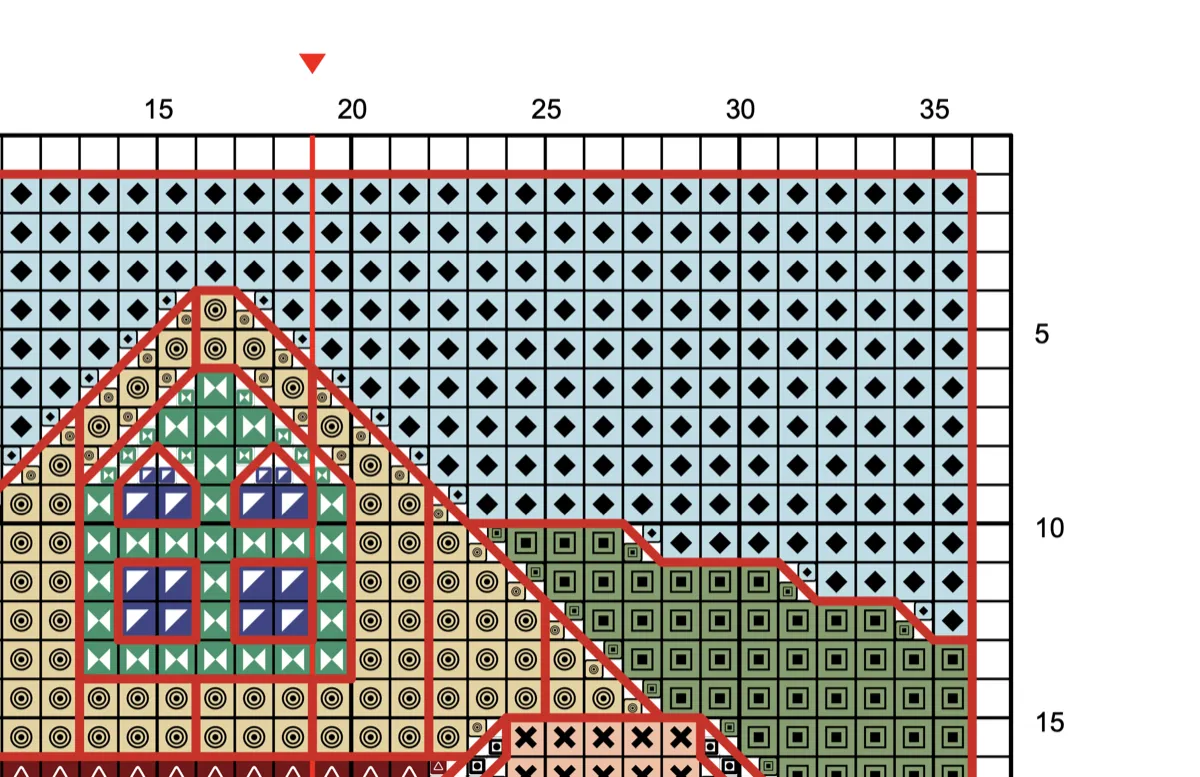
How to read a cross stitch pattern
Symbols, the key, backstitch lines, and chart conventions shared with blackwork charts.
Cross stitch glossary
Blackwork, backstitch, evenweave, fabric count, and every other term you will meet in a chart.