Needlepoint Background Stitches: How to Choose the Right One
The background is usually the biggest area on the canvas, so the stitch you pick for it sets the speed, the texture, and the thread bill of the whole project. Here is how the common choices compare.
The default needlepoint background stitch is basketweave, tent stitch worked in diagonal rows: flat, durable, and kind to the canvas. The common alternatives are brick (faster, softly textured, still gentle on the canvas), nobuko (for skies, water, and snow), mosaic and scotch (small and large woven squares), and skip tent (an open stitch that lets the canvas or the paint show through). Which one is right depends on how big the area is, how the finished piece will be used, and how much you want the background to say.
Background stitches compared
| Stitch | Type | Texture | Speed vs basketweave | Canvas distortion | Snag risk | Best for |
|---|---|---|---|---|---|---|
| Basketweave | Diagonal (tent) | Flat, even | Baseline | Very low | Very low | Anything, especially pieces that get used |
| Brick | Straight | Soft running bond | Faster | Very low | Low | Pillows, walls, general backgrounds |
| Mosaic | Diagonal units | Small, tidy squares | Faster | Low to moderate | Low | Medium areas, clothing, upholstery |
| Nobuko | Diagonal | Broken diagonals with shimmer | Faster | Moderate | Moderate | Skies, water, snow |
| Scotch | Diagonal units | Bold squares | Faster | Moderate to high | Moderate | Framed pieces, geometric backgrounds |
| Skip tent | Open diagonal | Light, see-through | Much faster | Low | Low | Painted canvases, airy backgrounds |
"Speed" here means how fast the area fills, not how fast each stitch goes in. Longer stitches cover more canvas per stitch, but they're also more fiddly to keep even, so the real gain is smaller than the stitch lengths suggest.
The six stitches, one by one
Basketweave is tent stitch worked in diagonal rows, and the reason most experienced stitchers default to it. The front is perfectly flat, the back builds up a woven layer that makes the piece hard-wearing, and because each row pulls the opposite way to the last, the canvas stays square. Its only drawback is time. A large background in basketweave is a lot of stitches, though many stitchers find the rhythm relaxing. The basketweave guide covers the method and the ridge mistake to avoid.
Brick is straight stitches over two canvas threads, each column offset by one. It covers faster than basketweave, has a subtle woven look, and barely distorts the canvas because the stitches pull vertically. It's the most common upgrade from basketweave and a good first decorative stitch. The catch is coverage: straight stitches show the canvas more than diagonals do, so you need a fuller thread. More in the brick stitch guide.
Mosaic builds tiny squares from three diagonals: short, long, short. Each unit covers a two-by-two block of canvas, and the units sit side by side in a grid. The texture is small enough to sit behind a detailed design without fighting it, and the stitches are short, so it wears well. It's a good choice when basketweave feels too plain and brick too obvious.
Nobuko alternates diagonals over one and over three canvas intersections, in rows that nest together. The long stitches catch the light unevenly, which suggests movement: ripples on water, wind in the sky, glinting snow. Because every stitch slants the same way, it pulls the canvas more than brick or basketweave. The nobuko guide has the diagram and working order.
Scotch is mosaic's bigger cousin: five diagonals filling a three-by-three square, longest in the middle. The squares are bold enough to read as a pattern from across the room, which makes scotch a design choice more than a background filler. It's often alternated with tent-stitch squares or worked in two colors as a checkerboard. Its long diagonal stitches distort the canvas noticeably and snag more easily, so it's best on framed work.
Skip tent works tent stitch on every other diagonal row, leaving canvas showing between them. It's the fastest way to cover a background and gives an airy, lightweight look. On a painted canvas, the paint between the stitches becomes part of the design. It only works where the canvas or paint underneath looks good, so it's rarely used on blank canvas.
These six cover most of what you'll see on finished pieces. Stitch dictionaries list dozens more for backgrounds, including T-stitch, Byzantine, jacquard, corduroy, oatmeal, and wicker. The needlepoint stitches guide maps out the families they belong to.
How to choose a background stitch
Four questions settle most decisions.
How will the piece be used? This matters most. Belts, bags, and pillows get rubbed, leaned on, and handled, and long stitches snag. For those, stick with basketweave, brick, or mosaic. Framed pieces, ornaments, and wall hangings can carry any stitch.
How busy is the design? A detailed subject (a portrait, a floral, lettering) wants a quiet background: basketweave, mosaic, or brick in a color close to the paint. A simple subject can stand a more active background, and a background stitch can sometimes do half the design work, like nobuko water under a single boat.
How big is the area? Decorative stitches need room to show their repeat. Brick needs a few bricks in each direction, scotch needs several squares, and nobuko needs a few rows. In a narrow strip between design elements, most of the stitches would be compensating stitches and the texture disappears. Use tent there and save the decorative stitch for the open areas.
What does the area represent? Sometimes the answer is literal: brick for a wall, nobuko or a horizontal stitch for water, an open stitch for air. If nothing suggests itself, the background is just a background, and basketweave is never wrong.
When you're unsure, audition. Stitch a one-inch square of each candidate in the margin of your canvas, outside the design area, and look at them from a few feet away next to the design.
Backgrounds on painted canvases
Most hand-painted canvases are painted with tent stitch in mind: the color changes fall on individual intersections, and the paint is meant to be covered completely. A decorative background stitch changes that in two ways.
First, longer stitches don't follow painted edges as precisely as tent does. Where the background meets the design, switch to tent stitch for the last few rows so the edge follows the paint. Second, open stitches like skip tent show the painted canvas between stitches, so the background paint must be even and the thread color has to work with it. One way to make that look deliberate is a thread a shade lighter or darker than the paint, so the open texture reads as a choice rather than thin coverage.
A local needlepoint shop can help here. Stitch guides, the paid per-canvas stitching plans many shops sell, often specify the background stitch, and seeing how a designer approached a background is a good way to learn.
How much thread a background needs
Backgrounds are where people run out of thread, because they're the biggest area on the canvas and decorative stitches don't follow tent-stitch estimates.
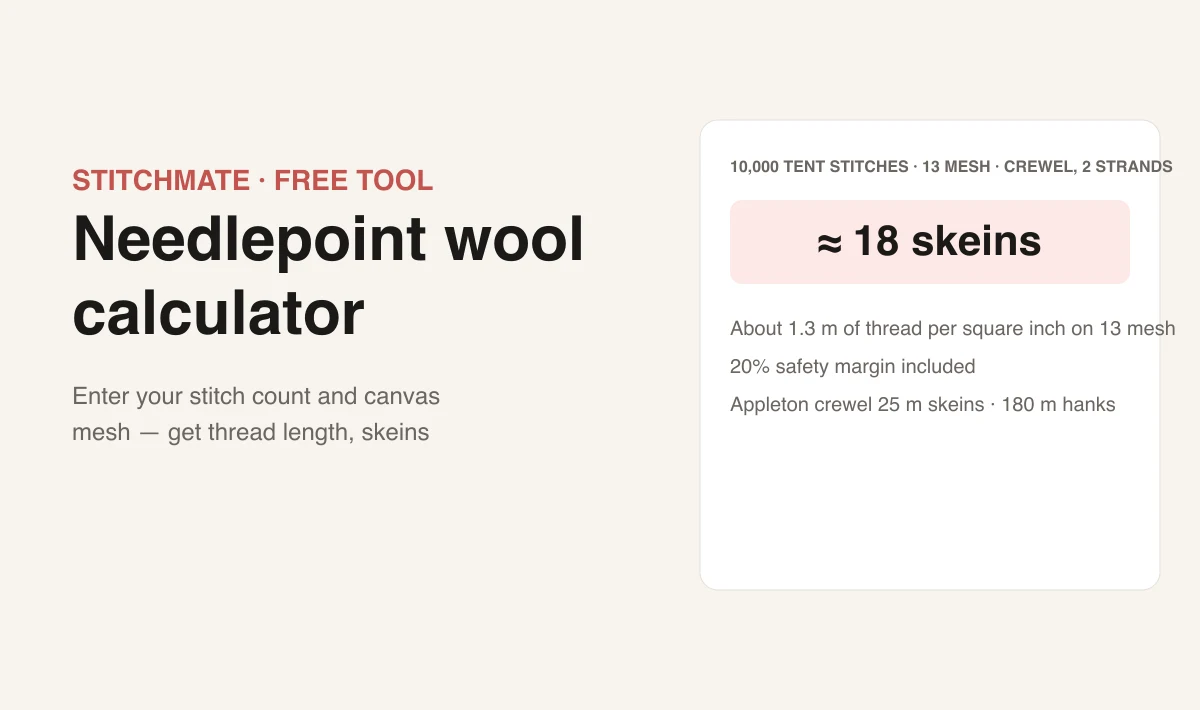
Start with the tent-stitch figure. The needlepoint wool calculator turns the background's size into skeins, and your chart tells you how big the background is. Then adjust for the stitch with a test:
- Cut a length of your background thread and measure it, say 18 inches.
- Stitch a one-inch square in your chosen stitch, in the canvas margin.
- Measure what's left. The difference is the thread per square inch for that stitch, thread, and tension.
- Multiply by the background's area, then add about 20% for waste and compensating stitches.
Buy the whole background's thread at once, from the same dye lot. A dye-lot change in the middle of a plain background is visible from across the room, and it's the most common reason a finished piece gets restitched.
Common mistakes
Choosing by the swatch, not the piece. A stitch that looks lovely in a two-inch sample can overwhelm a busy design. Audition it next to the design, not on its own.
Long stitches on a pillow. Nobuko and scotch look great on the day you finish them, then snag after a few months on the sofa. Match the stitch to the piece's life.
Ignoring distortion. Large areas of a diagonal decorative stitch can skew the canvas well out of square. Work on stretcher bars, keep tension light, and plan to block the piece.
Starting the background first. Stitch the design areas first and the background last. The edges come out cleaner, and you'll know exactly how much background is left before you buy thread.
FAQ
What is the best stitch for a needlepoint background?
What is the fastest needlepoint background stitch?
Which background stitches distort the canvas least?
What background stitch should I use for a pillow?
Do decorative background stitches use more thread?
Can I mix background stitches in one piece?
Further reading
- Unwind Studio: Best needlepoint stitches for background areas — a wider list of background stitches with photos
- RSN Stitch Bank — the Royal School of Needlework's searchable library of stitch diagrams
- KC Needlepoint Stitch Vault — numbered diagrams for dozens of decorative stitches
- American Needlepoint Guild — chapters, classes, and correspondence courses
Chart the Design, Choose the Background Later
Stitchmate (stitchmate.app) charts needlepoint in tent and petite stitch on any mesh from 10 to 24. Chart your design with a flat background, then pick its stitch on the canvas.
Try Stitchmate FreeNo account required. Works in your browser.
Related Guides & Tools
Brick Stitch
The most common decorative background — diagrams, working order, and variations.
Nobuko Stitch
Long and short diagonals for skies, water, and snow.
Basketweave Stitch
The default background, and how to work it without ridges.
Needlepoint Stitches
The full map — the tent family plus every decorative stitch worth knowing.
Needlepoint Thread Guide
Ply and strand counts per mesh, the starting point for any background.
Needlepoint Wool Calculator
Turn a stitch count into skeins and hanks before you buy.