Fuse Bead Sizes and Pegboards: Mini, Midi, Maxi, and the 29×29 Board
Three bead sizes, one default, and a board that is smaller than most beginners expect. Here is what each size actually changes about a project — and the arithmetic that turns a pattern into a shopping list.
Two numbers decide the physical shape of a fuse bead project: how wide one bead is, and how many pegs are on the board. Everything else — finished size, how many beads to buy, whether the design fuses in one pass or five — falls out of those two by multiplication. This page is the reference for both.
Three sizes, one default
Fuse beads come in three sizes, and the naming is consistent across brands with one exception: what Hama calls Maxi, Perler sells as Biggie. Same bead, different label.
| Size | Bead width | Beads per cm | Beads per inch | 29×29 board finishes at |
|---|---|---|---|---|
| Mini | 2.6 mm | ~3.8 | ~9.8 | ~7.5 cm / 3.0 in |
| Midi | 5 mm | 2 | ~5.1 | ~14.5 cm / 5.7 in |
| Maxi (Biggie) | 10 mm | 1 | ~2.5 | ~29 cm / 11.4 in |
Midi is the default in every sense. It is what a bag means when it does not say a size, what a pattern assumes when it does not specify, the cheapest bead per unit, and the size with the widest color selection — the Artkal S palette alone runs to 210 colors in Midi. Unless a project has a specific reason to be tiny or chunky, it is a Midi project.
Sizes are not interchangeable within one piece: Mini beads do not sit on a Midi board, and mixing sizes in one design is not a thing the craft does. The size decision is made once, at the start, and it decides the board you use too.
Which size to use
Midi (5 mm) — the general-purpose choice. Coasters, magnets, ornaments, keychains, wall pieces, and every photo conversion. Two beads per centimeter is a comfortable working scale: fine enough that a face reads at a sensible size, coarse enough that you can place beads for an hour without your eyes complaining.
Mini (2.6 mm) — for detail in a small footprint. Jewelry, small sprites with a lot of shading, anything that has to stay pocket-sized while carrying more than a handful of colors. The trade is real: the beads are small enough that tweezers become genuinely useful rather than optional, and a spill is a much worse afternoon.
Maxi / Biggie (10 mm) — aimed at young children, where large beads and large pegs are the point. One bead per centimeter means a design gets big quickly: a 29-bead-wide pattern finishes at 29 cm, so plan for wall space rather than a shelf.
A useful way to think about detail: the bead count is the resolution, and the bead size only decides how big the finished pixel grid ends up. A 100×100 design has exactly the same amount of detail in Mini as in Maxi — it is 26 cm across in one and a meter across in the other.
How big a pegboard really is
The standard square pegboard is 29×29 pegs. In Midi beads that is about 14.5 cm — 5.7 inches — square, and 841 beads when it is filled edge to edge. Perler, Hama, Artkal, and the generic sellers all converge on this size, which is why so many published patterns are drawn to fit inside 29×29.
That is smaller than most beginners picture. A coaster fits comfortably. A mug-sized character sprite fits. A portrait does not — photo conversions almost always want 60 to 100 beads across, which is two to four boards wide before you have started.
One bead sits on one peg, so board capacity is just pegs across × pegs down. A "peg" is always the stud on the board, never the bead — worth keeping straight when a listing describes a board by its peg count.
Square, hexagon, and shaped boards
Beyond the standard square, boards come in a hexagon, a circle, and assorted shapes — hearts, stars, letters — sold in multipacks. They matter less than they look like they should:
- Square boards are the workhorse, and the only shape that tiles cleanly into larger designs. If you buy one board, buy this one; if you buy four, buy four of these.
- Hexagon and circle boards are for pieces whose outline is the point — a round coaster, a hex tile. A design drawn on a square grid can still be placed on them, but the grid has to fit inside the shape.
- Shaped boards are single-purpose. Pleasant to own, rarely the thing you reach for twice.
Patterns are drawn on a rectangular bead grid, which maps to a square board without any translation. That is the practical reason square boards dominate: the pattern and the board are the same shape.
Designs bigger than one board
Standard boards interlock at the edges, so a larger design is not a problem — it is a layout. Four square boards joined in a 2×2 grid give a 58×58 working area, about 29 cm of Midi beads. Nine give 87×87. There is no practical ceiling beyond table space.
Two things change once a design spans boards:
- Fuse in sections, with overlap. Iron across a seam rather than stopping at it, so beads on both sides of the join fuse to each other. A seam that gets ironed as two separate halves stays visible as a line — and can come apart.
- Keep the boards from shifting. Interlocked boards still slide on a smooth table. Work on a surface you can carry the whole assembly on, since it has to travel to the ironing board intact.
The alternative — fusing each board separately and joining the pieces afterwards — works for grid-friendly designs where the seam falls on a natural edge, but it leaves a weaker join and a visible line. Fusing across the seam is the better default. The full fusing method, seams included, is in how to iron fuse beads.
Turning a pattern into a shopping list
Three multiplications get you from a pattern to what you need to own:
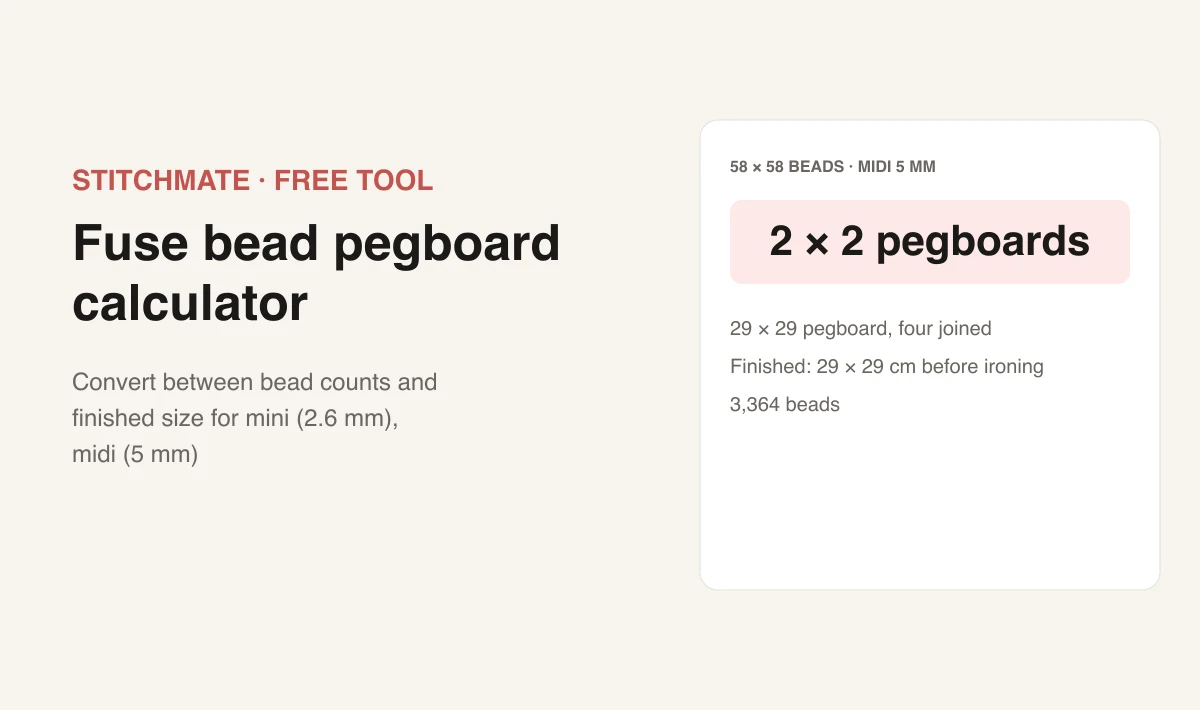
- Finished size = beads across × bead width. A 58-bead-wide Midi design is 58 × 5 mm = 29 cm.
- Total beads = beads across × beads down. That same 58×58 design is 3,364 beads — then add 10% for the ones that roll under the sofa.
- Boards needed = ⌈across ÷ board width⌉ × ⌈down ÷ board height⌉. 58 ÷ 29 = 2 in each direction, so four boards.
The fuse bead pegboard calculator does all three for any bead size and any board, in both directions — enter a finished size and it tells you the bead count instead.
The per-color half of the shopping list comes from the pattern itself. A pattern made in the fuse bead pattern maker lists a bead count for every color alongside the total, so you know it needs 412 white and 38 of that one red — which is the number that actually decides whether you have enough. Converting a photo? Photo to fuse beads sets the bead dimensions up front, so the size and board math above is settled before a single bead is placed.
FAQ
What size are Perler beads?
What is the difference between Mini and Midi beads?
How big is a standard pegboard?
How many beads fit on a pegboard?
Can you connect pegboards together?
What size bead should a beginner start with?
Design at Exactly the Size You Need
Set the bead dimensions, design on a real bead grid, and get a printable pattern with a per-color bead list. Free, no signup.
Try Stitchmate FreeNo account required. Works in your browser.
Related Guides & Tools
What Are Fuse Beads?
The craft explained from scratch — how it works, the brand names, and what you need to start.
How to Iron Fuse Beads
Medium heat, slow circles, the open-centers test, and how to handle seams across boards.
Pegboard Calculator
Bead counts to finished size to boards needed, for any bead size and board.

Bead Brand Conversion Chart
Match a color across Perler, Hama, and Artkal palettes when the pattern is in the wrong brand.