What Are Fuse Beads? The Craft Explained for Beginners
The pixel-art craft with a hundred names and one method: place beads on a pegboard, cover, iron, done. Here's what fuse beads actually are — and which name means what.
Fuse beads are small tubes of colored plastic that you arrange on a studded board — a pegboard — and then fuse together with a household iron, turning a grid of loose beads into one solid piece of pixel art. That's the entire craft in a sentence: place, cover, iron, done.
You've almost certainly seen them under a brand name rather than the generic one. In the US they're usually called Perler beads (and frequently misspelled "pearler beads" in searches); in Europe the same craft goes by Hama beads. They're also known as melty beads or iron beads. All of these are the same thing — small plastic beads that fuse under heat — and everything on this page applies to every one of them.
How the craft works
The workflow has four moves, and the first one is where all the time goes:
- Place beads on the pegboard. The pegboard is a plastic board covered in a grid of small studs — pegs — and each bead slips onto one peg. (A useful vocabulary note: the peg is the stud on the board, never the bead itself.) You follow a pattern the way a cross stitcher follows a counted grid: each square of the design is one bead of one color, so a design's size reads as beads wide × beads tall. This is the pixel-art heart of the craft — the bead grid is the image, one bead per pixel.
- Cover the finished design with ironing paper. A sheet goes over the beads so the iron never touches plastic directly.
- Iron on medium heat, in slow circles. The heat softens the tops of the beads just enough that neighbors bond to each other while staying on their pegs.
- The design fuses into one piece. Cool it flat, flip it, fuse the other side, and the grid of loose beads is now a solid, bendable-but-sturdy panel — a finished coaster, magnet, ornament, or wall piece.
Steps 2 through 4 have real technique to them — how hot, how long, and how to tell when it's done — and that's the subject of the full ironing and fusing guide. Step 1 needs only patience and a pattern.
One craft, many names
The naming mess is worth two minutes, because it's the main thing that confuses beginners comparing products.
"Fuse beads" is the craft's generic name — the one that describes what the beads do rather than who sells them. Every brand's beads are fuse beads.
The brand names get used like generic names, regionally. In the US, "Perler beads" functions the way "Kleenex" does — people say it to mean any fuse bead, whoever made it. In the UK and Europe, "Hama beads" plays exactly the same role. Neither usage is wrong in conversation; just know that a "Perler bead pattern" and a "Hama bead pattern" and a "fuse bead pattern" are the same kind of pattern.
The practical takeaway for searching and shopping: treat all these names as one keyword family, and check the size (next section) rather than the name on the bag — size, not brand, is what determines whether beads fit your pegboard and your pattern.
Bead sizes at a glance
Fuse beads come in three sizes, and one of them is the overwhelming default:
- Midi — 5 mm. The standard. When a pattern, pegboard, or bag of beads doesn't specify a size, it means Midi. It's the cheapest per bead and comes in by far the widest range of colors.
- Mini — 2.6 mm. Half the size, double the detail — and considerably fiddlier to place.
- Maxi (Biggie) — 10 mm. The jumbo size, made for small hands: Hama brands it Maxi, Perler brands it Biggie.
Sizes don't mix on one board — each needs a pegboard with matching peg spacing. The sizes and pegboards guide covers the details, including the standard 29×29 pegboard and the math for patterns that span several boards.
The brand landscape
Four names cover most of what you'll see on shelves and in search results. They're competitors in the ordinary sense — same craft, different companies — and the differences that matter to a beginner are region and price, not technique:
Perler is the standard in the US — the brand you'll find in American craft stores and the name most American patterns and tutorials assume. Its 10 mm line is the "Biggie" mentioned above.
Hama is the long-established European original, from Denmark, and the default name for the craft across the UK and EU. Hama's instructions, sizes, and accessories mirror Perler's almost exactly — the two ecosystems are parallel, not different.
Artkal is the newer challenger, selling directly online rather than through craft-store shelves, and it competes on price and range — a large palette at budget-friendly prices. Its published ironing instructions are also the most specific of the three (160–180°C, for the curious).
Coco and MARD are budget palettes you'll mainly meet on marketplace listings — inexpensive bulk beads that pattern tools commonly support alongside the big three.
None of this is a ranking. Beads from any of these brands are placed on a pegboard and fused under ironing paper exactly the same way, and a pattern designed for one brand's palette can be color-matched to another's.
Why people love it
Fuse beads occupy a sweet spot no other craft quite hits. The floor is on the ground: a five-year-old can place beads, there is no technique to learn before the work looks right, and a small design finishes in one sitting — instant gratification that cross stitch can't offer. But the ceiling is genuinely high: because the craft is literally pixel art in plastic, the same pegboard that holds a kid's rainbow heart also holds meticulous video-game-style sprites, portraits spanning many interlocking boards, and the work of the adult bead-sprite community, where multi-thousand-bead pieces are normal.
It's also cheap to try. Beads are sold loose and in bulk, a pegboard costs a few dollars, and the "special equipment" is the iron you already own.
Getting started
The complete starter list: beads (Midi, 5 mm — the default everything assumes), a pegboard (the standard square is 29×29 pegs), ironing paper, a household iron, and a pattern.
The pattern is the interesting part. You can follow an existing design, or make your own: Stitchmate's free fuse bead pattern maker lets you draw a design bead by bead — or convert a photo — with real brand palettes for color matching, and gives you a printable pattern plus a bead list telling you exactly how many beads of each color to have on hand. No signup, runs in the browser.
Then place your beads, and when the board is full, head to the ironing guide for the fusing step — it's five minutes of reading that prevents every classic first-timer mistake.
FAQ
Are Perler beads and fuse beads the same thing?
What's the difference between Hama beads and Perler beads?
What are melty beads?
What do you need to start with fuse beads?
Do fuse beads need a special iron?
Make Your First Fuse Bead Pattern
Draw a design bead by bead or convert a photo — real brand palettes, a bead list with exact counts, and a printable PDF. Free, no signup.
Try Stitchmate FreeNo account required. Works in your browser.
Related Guides & Tools
How to Iron Fuse Beads
The fusing step in full — setup, medium heat, the open-centers test, cooling flat, and the flip.
Bead Sizes and Pegboards
Mini, Midi, and Maxi compared, the 29×29 board, and how many boards a pattern needs.
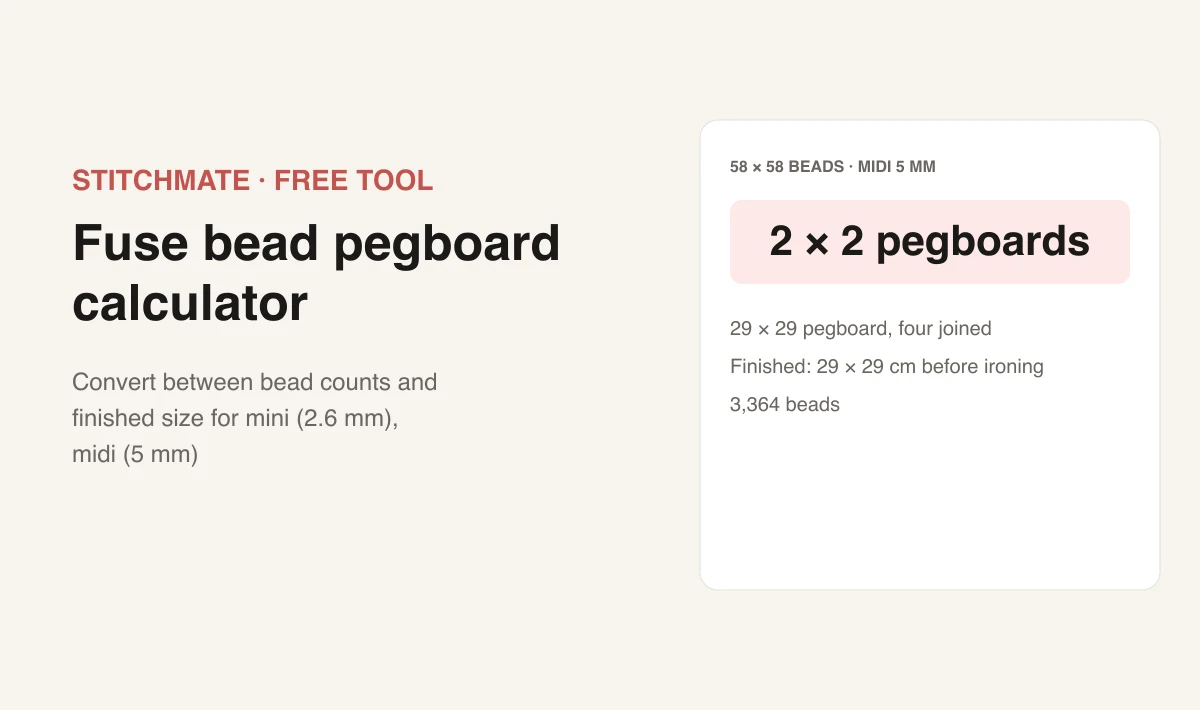
Pegboard Calculator
Pattern size to boards needed to finished dimensions — the math, done for you.
Fuse Bead Pattern Maker
Design patterns on a bead grid with real brand palettes and a printable bead list.