Types of Cross Stitch Stitches: Full, Half, Quarter, Three-Quarter, Backstitch, and French Knot
Most charts are 95% full crosses. It's the other 5% — the halves, quarters, three-quarters, outlines, and knots — that make a pattern look finished, and they're the ones nobody explains.
Quick answer: the types of cross stitch stitches you will meet in almost every chart come to six. The full cross does the coverage, the half stitch does backgrounds, the quarter and three-quarter stitches do curves and diagonal edges, backstitch does outlines, and the French knot does dots. Everything else is a specialty stitch you can go years without meeting.
This guide is about working each one: leg order, where the needle goes in, when a pattern calls for it, and what it's called in the editor when you draw it yourself. For how each looks as a symbol on a printed chart, the pattern reading guide covers that side and this one won't repeat it.
The six at a glance
Here are the partial stitches as the editor renders them in thread, and the same cells in the flat chart view underneath. Left to right: a full cross, two half stitches, four quarter stitches, four three-quarter stitches, and two half-fill stitches.
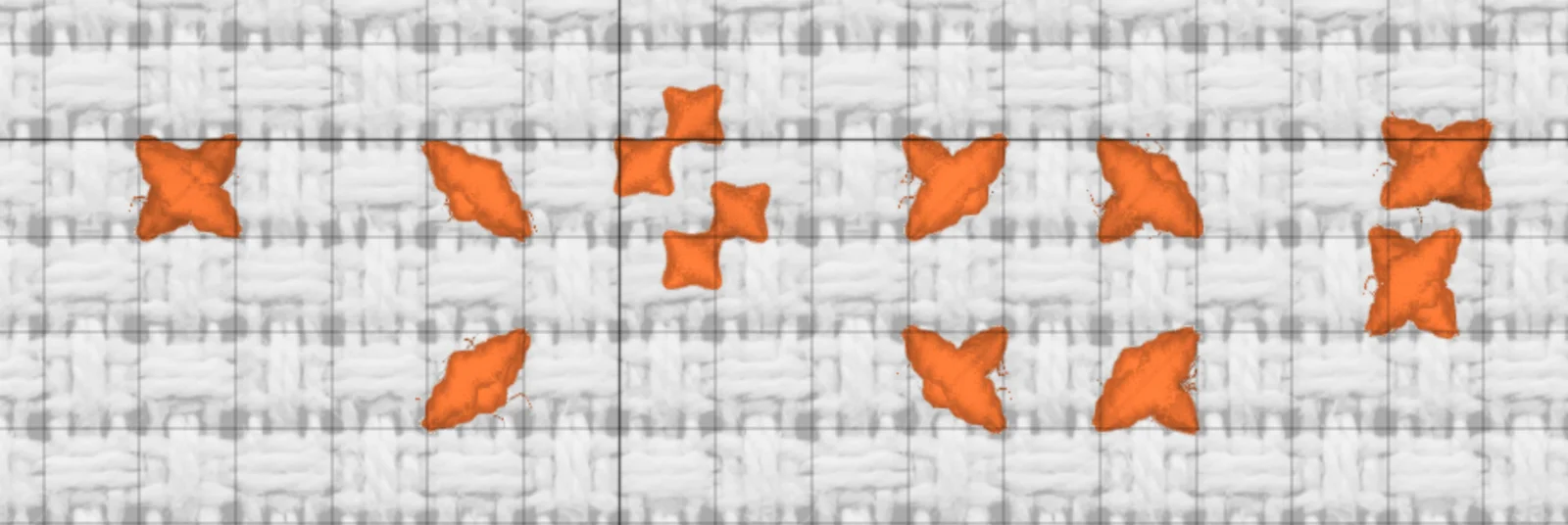
Realistic view. Left to right: full cross · half stitches · quarter stitches · three-quarter stitches · half-fill stitches.
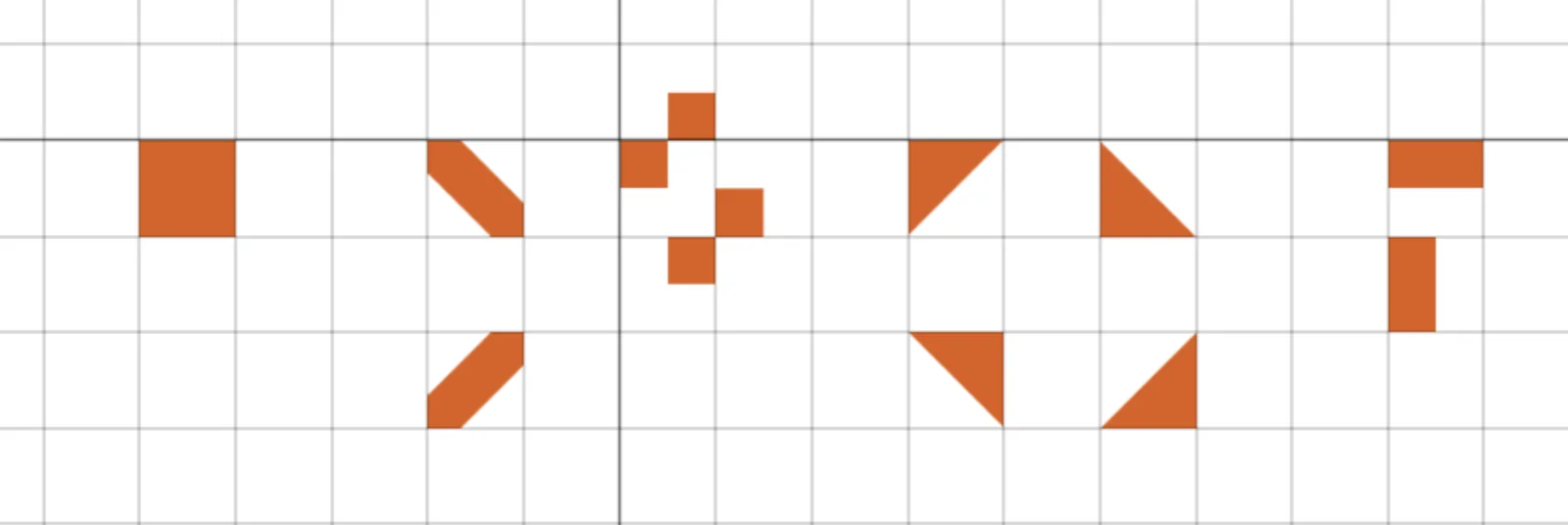
Chart view of the same cells. This is the shape each stitch takes on the printed grid before symbols are added.
Backstitch and French knots aren't in the strip because they don't live in a cell: backstitch runs along the grid lines and a French knot sits on a point. DMC's own step-by-step stitch diagrams show the needle path for each.
Full cross stitch
What it is. Two diagonal legs that cross in the center of one square of Aida (or one block of two threads on evenweave). It's the unit everything else is measured against: a "100 × 100 pattern" means 100 × 100 full crosses.
How to work it. Bring the needle up in the bottom-left hole, down in the top-right; that's the first leg, running /. Then up in the bottom-right, down in the top-left for the second leg, running \. Which leg goes first doesn't matter, but the top leg must face the same way on every stitch in the piece, or the light catches them differently and the finished work looks mottled. For a row of the same color, most stitchers lay all the first legs across the row (/ / / /), then come back with the second legs (\ \ \ \). That's the Danish method; doing each cross completely before moving on is the English method. Both are fine. Mixing them mid-row is what shows.
When patterns use it. Everywhere. A photo-converted chart is 90 to 100 percent full crosses.
In Stitchmate. The default brush stitch is a full cross, drawn as a filled square in chart view and as a real X in the realistic view. Two strands on 14-count is the normal coverage; the Aida count guide has the strands-per-count table.
Half stitch
What it is. The first leg only: one diagonal across the square, no return. It covers half the fabric and reads lighter and softer than a full cross, because the Aida shows through.
How to work it. Up bottom-left, down top-right, and stop. Move to the next square. Keep the direction consistent across the whole area, and match it to the top leg of your full crosses so the two textures sit together instead of arguing.
When patterns use it. Skies, water, distant backgrounds, hair, anything that should recede behind the subject. Designers also use halves to fade an edge without changing color. On a chart, half stitches usually get a lighter or smaller version of the color's symbol, or the symbol printed in one corner, which the pattern reading guide explains.
In Stitchmate. "Half stitch" in the brush's partial-stitch options, in either diagonal direction; it draws as a diagonal bar in chart view. After a photo conversion, add them with the brush in Merge mode where a lighter tone is wanted rather than another thread color. The brush handbook page covers the Merge mode that builds a cell from parts.
Quarter stitch
What it is. A short leg from one corner of the square to its center. It covers one quadrant. On Aida there's no hole at the center of a square, so the needle pierces the fabric block itself; on evenweave the center is a real hole, which is why evenweave stitchers find partials easier.
How to work it. Up in the corner, down in the center. That's the whole stitch. The trick is the needle and a firm hand so the center point stays put: a blunt tapestry needle pushes the fabric threads apart at the center, which works on Aida; a crewel needle pierces the center cleanly and is the better choice on evenweave or linen.
When patterns use it. Almost never alone. A quarter stitch is nearly always the small partner of a three-quarter stitch in the same square, in a different color, so that a color boundary can run diagonally through the square instead of stepping around it. Faces, petals, the curve of a cheek, the edge of a letter.
In Stitchmate. "Quarter stitch", placed in any of the four corners. In chart view it's a small square in that corner. The editor lets a cell hold a quarter in one color and a three-quarter in another, which is exactly how a real chart works.
Three-quarter stitch
What it is. A full diagonal leg plus a quarter leg: three corners covered, one left empty. It's the workhorse of curves.
How to work it. Work the quarter leg first, from its corner into the center, then the full diagonal over it: the long leg anchors the short one and hides where it ends. The corner the pattern leaves empty tells you which diagonal is the full one, because the quarter leg starts from the corner opposite the empty one. If the same square also holds a quarter stitch in another color, work the three-quarter first so the quarter's center point lands on top and the color boundary stays crisp. Peacock & Fig's fractional stitches video walks through the same corner logic on real fabric.
When patterns use it. Wherever a shape's edge runs at 45 degrees. A circle drawn in full crosses has a stair-step edge; the same circle with three-quarters on the diagonals looks round from a foot away. Portrait charts lean on them heavily, which is one reason they take longer than their stitch count suggests.
In Stitchmate. "Three-quarter stitch" in one of four orientations; the chart view draws a triangle covering three corners. Add them after a photo conversion with the brush in Merge mode along diagonal color edges, and use them sparingly: every partial is one more decision at the needle.
Backstitch
What it is. A line stitch worked on top of finished cross stitches, along the grid lines rather than across the squares. Each stitch goes backward into the end of the previous one, so the line has no gaps. It's the outline, the eyelash, the lettering, the whisker.
How to work it. Come up one square ahead of where the line starts, go down at the start point, come up two squares ahead, go down at the end of the previous stitch. Repeat. Every stitch is worked backward into the last one. Backstitch can run horizontally, vertically, or diagonally, and a single stitch can span more than one square when the chart shows it that way, though anything over two squares tends to snag and is better broken up. Use one strand, and work it last, after every cross stitch it crosses is in place, or the crosses will bury it. The backstitch guide goes through the three rules, common mistakes, and when to skip it altogether.
When patterns use it. Outlines of shapes, facial features, text, borders, and fine detail that would need dozens of tiny color changes if drawn in crosses.
In Stitchmate. It has its own tool, not a brush mode: press K, click to place endpoints, and lines snap to grid intersections and half-points. Auto-outline draws backstitch around a color area in one click. In the PDF, backstitch prints as lines over the grid with its own legend entry, and the Pattern Keeper export counts exactly how many segments that app will drop, because it doesn't track backstitch. The backstitch tool page has every option.
French knot
What it is. A small raised dot of thread, made by wrapping the thread around the needle and pulling the wraps down to the fabric. It's the only stitch here with real height.
How to work it. Come up where you want the knot. Hold the thread taut with your other hand, wrap it around the needle once or twice (two wraps for a plumper knot), then put the needle back down right beside where it came up, not in the same hole, or the knot pulls through. Keep tension on the wraps as you pull the needle through so the knot tightens on the surface. Practice ten on scrap fabric; the tension is the whole skill. If knots defeat you, a colonial knot makes a similar dot with a figure-eight wrap and is harder to pull through by accident. Peacock & Fig's French and Colonial knot video shows the wrap and the tension, and Lord Libidan's French knot notes cover the loose-knot problem.
When patterns use it. Eyes, flower centers, berries, dots on an "i", snow, and texture in samplers. Charts mark them with a dot or a small circle in the color's symbol, usually on a grid intersection rather than in a square.
In Stitchmate. French knots can be placed on the chart as their own stitch type and get a legend entry in the PDF. Not every export target understands them: Pattern Keeper does not display French knots, so stitchers tracking there will need the PDF legend for those.
You'll also meet
Four stitches that show up in samplers and specialty charts but almost never in a converted photo:
- Smyrna cross (also called double cross stitch): a full cross with an upright cross on top, eight legs in one square. Texture for borders and sampler bands.
- Petite stitch: a full cross worked at quarter size, so four fit in one square. Fine detail on evenweave.
- Long stitch: a straight stitch spanning several squares. Used for stems, rays, and lettering serifs.
- Blended threads: not a stitch but a thread choice, one strand each of two colors in the needle. The thread blending guide explains when it beats adding a color.
The editor also has half-fill stitches (the two on the right of the strips above): a full cross packed into the top, bottom, left, or right half of a cell. They're a chart convention for straight-edged half coverage rather than a traditional hand stitch, and most stitchers work them as two crosses over one thread on evenweave, or as a half-height cross on Aida.
Side by side
| Stitch | Covers | Strands (14-count) | Common use | Chart symbol convention |
|---|---|---|---|---|
| Full cross | Whole square | 2 | Everything | Full-size symbol |
| Half stitch | Half, on the diagonal | 2 | Backgrounds, sky, water | Small or lighter symbol, or symbol in one corner |
| Quarter stitch | One corner | 2 | Partner of a three-quarter for a diagonal color change | Symbol tucked into the corner |
| Three-quarter stitch | Three corners | 2 | Curves and diagonal edges | Symbol offset toward the covered corners |
| Backstitch | A line along grid lines | 1 | Outlines, text, detail | Solid line, colored or keyed in the legend |
| French knot | A raised dot on a point | 1 to 2, two wraps | Eyes, flower centers, dots | Dot or small circle |
Symbol conventions vary by designer; the PDF quality guide shows what a well-made chart does with them.
See every stitch type on your own pattern
Draw with full, half, quarter, and three-quarter stitches, add backstitch and French knots, and export a chart that keys each one.
Open the pattern makerFree to use. No account required.
FAQ
How many types of cross stitch stitches are there?
What's the difference between a half stitch and a full cross stitch?
What is the difference between a quarter stitch and a three-quarter stitch?
Do I need to stitch the partial stitches?
Which stitch do I use for outlines?
Can pattern software use partial stitches when it converts a photo?
Related Guides & Tools
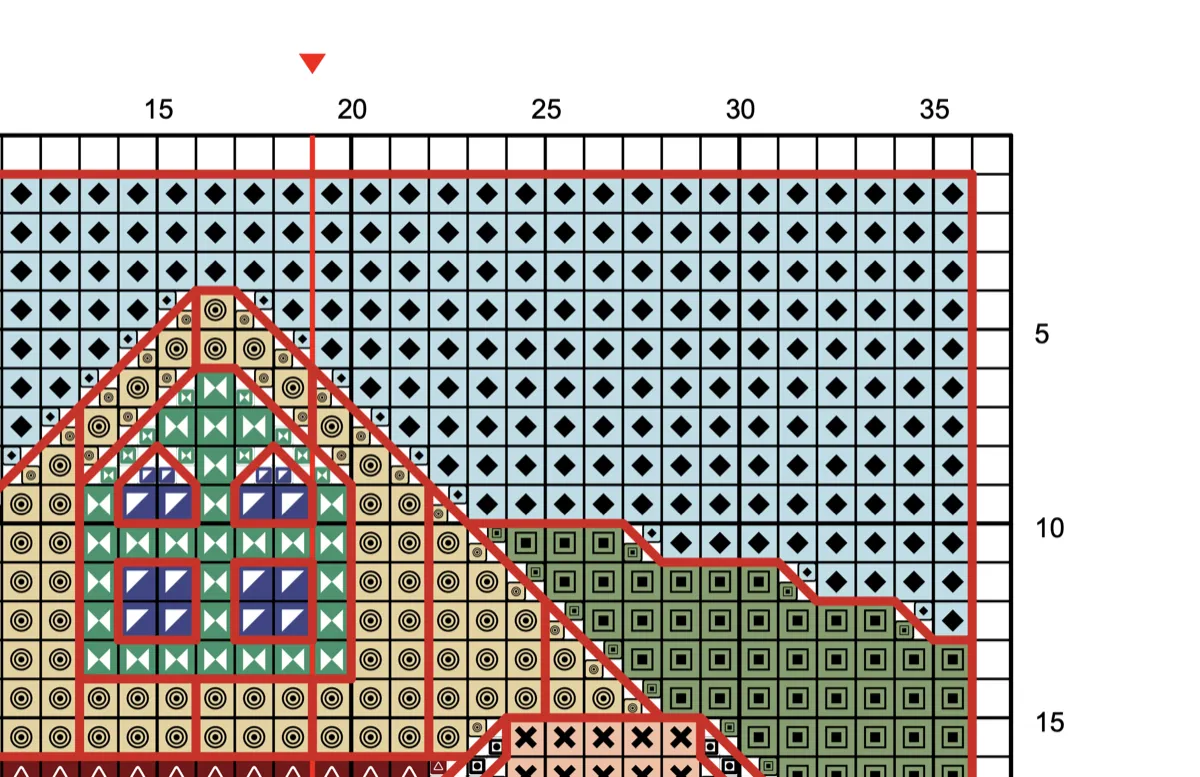
How to Read a Cross Stitch Pattern
What each stitch type looks like on a chart, plus keys, center marks, and page references.
Backstitch in Cross Stitch
The three rules, how to read backstitch on a chart, and when to skip it.
Thread Blending Guide
Two colors in one needle: when blending beats adding a color.

Aida Count Explained
11 vs 14 vs 16 vs 18 count, strands per count, and finished sizes.
Cross Stitch Glossary
210 terms, stitch types, and the fabric count reference charts.
Backstitch Tool
Draw, select, and auto-outline backstitch lines in the editor.