Needlepoint canvas calculator
Enter your design size in stitches and your canvas mesh — get finished dimensions in inches and cm, the canvas size to buy with margins, tapestry needle size, a time estimate, and the chart resize that keeps your size on a different mesh.
Canvas Calculator
One chart square = one canvas intersection = one tent stitch. Converting a cross stitch chart? Use its stitch dimensions directly.
13 mesh is the standard for wool; 18 mesh for fine detail.
3" per side is the safe default — blocking and finishing both need bare canvas to hold onto.
Mesh count = stitches per inch
Finished size = stitches ÷ mesh. The same chart gets smaller on finer mesh — and Aida count works identically, so a chart sized for 14-count Aida lands closest to its original size on 13 or 14 mesh. Details in the chart conversion guide.
Results
| Mesh | This chart finishes at | Same size needs |
|---|---|---|
| 10 mesh | 13.0" × 10.4" | 100 × 80 st |
| 13 mesh (selected) | 10.0" × 8.0" | — |
| 18 mesh | 7.2" × 5.8" | 180 × 144 st |
"Same size needs" is the chart resize that keeps your current finished size on another mesh — the 13 ↔ 18 conversion needlepointers usually do by hand.
The needlepoint pattern maker designs on a true mesh grid and resizes charts between mesh counts — or convert a photo at exactly the stitch dimensions above. Free, in your browser.
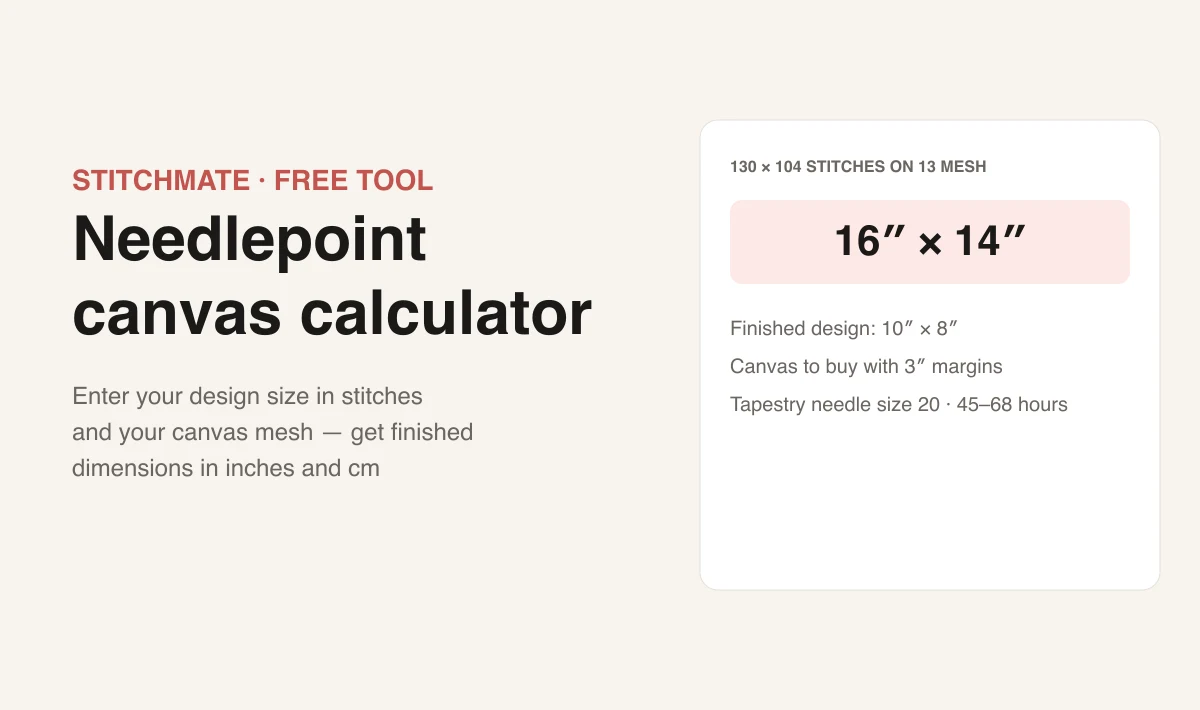
The math behind the calculator: finished size = stitches ÷ mesh count, then add margins to get the canvas you buy. Mesh count is stitches per inch — 13 mesh means 13 tent stitches per inch of canvas — so the same chart finishes smaller on finer mesh and larger on coarser mesh.
Worked example
A 130 × 104 stitch chart on 13 mesh canvas:
- Finished design: 130 ÷ 13 = 10 inches wide; 104 ÷ 13 = 8 inches tall (25.4 × 20.3 cm)
- Canvas to buy: add 3 inches per side → 16 × 14 inches
- Total stitches: 130 × 104 = 13,520
- Needle: size 20 tapestry needle
- Time: 13,520 stitches at 200–300 per hour ≈ 45–68 hours
The same chart on 18 mesh finishes at 7.2 × 5.8 inches — and if you wanted the full 10 × 8 inches on 18 mesh, you'd need the chart resized to 180 × 144 stitches. That second conversion is the one needlepointers usually do by hand on paper; the calculator's mesh table does both directions for every common mesh.
Choosing a mesh count
13 mesh is the workhorse: wool-friendly, easy to see, and what most kits and painted canvases use. 18 mesh doubles the stitch density for fine detail at roughly double the stitching time per square inch. 10 mesh is fastest and boldest. The full comparison — thread pairings, project types, and the detail-versus-deadline tradeoff — is in the mesh count guide, and canvas types (mono, interlock, penelope) are a separate decision from mesh size.
Converting cross stitch charts
Aida count and mesh count are the same unit, so a cross stitch chart's stitch dimensions drop straight into this calculator — a chart "for 14-count Aida" lands closest to its designed size on 13 or 14 mesh. Whether the chart itself will work on canvas is the whole-stitch question, covered in using cross stitch patterns for needlepoint.
Planning the whole project
Canvas is one line on the shopping list. The wool calculator estimates skeins from your stitch count, the thread guide pairs fibers to mesh, and if you're designing the chart yourself, the needlepoint pattern maker works on a true mesh grid and resizes charts between mesh counts — so the "same size needs" number becomes a one-click resize.
Related Guides & Tools
Needlepoint Mesh Count Guide
Every common mesh compared — detail, speed, threads, and finished size.
Needlepoint Canvas Types
Mono vs interlock vs penelope, and the needle size chart.
Cross Stitch Patterns for Needlepoint
Aida-to-mesh sizing and the whole-stitch rule.
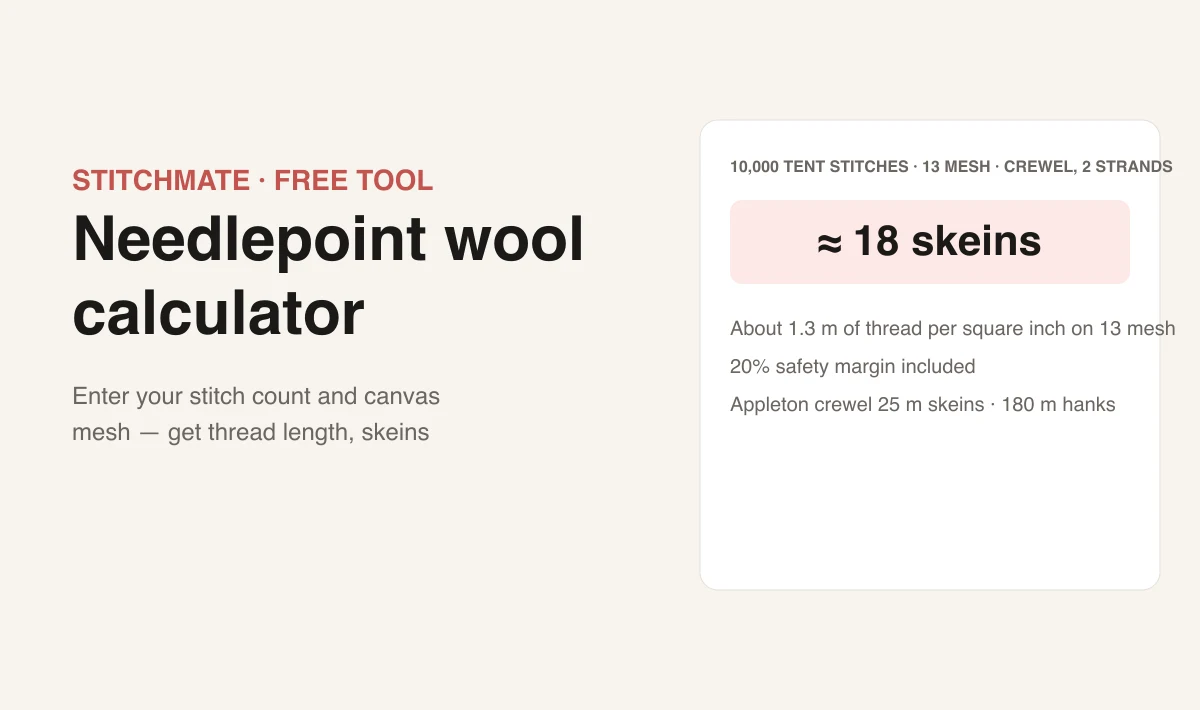
Needlepoint Wool Calculator
Skeins and hanks of Appleton wool from your stitch count.
Needlepoint Stocking Patterns
Stocking sizes, stitch counts, and timelines by mesh.
Photo to Needlepoint Converter
Convert a photo at exactly the stitch dimensions you need.
FAQ
How do I calculate needlepoint canvas size?
What do 13 mesh and 18 mesh mean?
How much margin do I need around a needlepoint design?
What size needle for 13 mesh canvas?
How do I convert a design between 13 mesh and 18 mesh?
Does Aida count equal mesh count?
How long does a needlepoint project take?
See how your photo converts
Cross stitch is a real commitment — real thread, real hours, real frustration if the pattern doesn't work. Stitchmate lets you see exactly what you're getting into before you buy the first skein.
Upload an image, adjust the settings, check the FLOW Score — about 30 seconds to know if it'll work. Everything up to PDF export is free, no account needed.
Upload Your Photo Free