Can You Use a Cross Stitch Pattern for Needlepoint? Yes — Here Is the Rule
Needlepointers have been stitching from cross stitch charts for decades. It works — as long as the pattern follows one rule. Here is the rule, the sizing math, and the thread swaps.
The short answer: yes — if the pattern uses only whole stitches, a cross stitch chart works for needlepoint exactly as printed. Treat every square on the chart as one intersection on your canvas, stitch it in tent stitch instead of an X, and the design comes out the same.
Needlepointers have quietly relied on this for decades. Ask on r/Needlepoint how to chart your own design and the standing answer is "use cross stitch software and stitch it in tent" — though which of those programs actually handles the needlepoint half is its own question. The two crafts share the same grid; only the stitch and the ground change. What trips people up isn't the concept — it's the three places where charts don't translate, and the sizing math when your chart says "14-count Aida" and your canvas says "13 mesh."
The whole-stitch rule
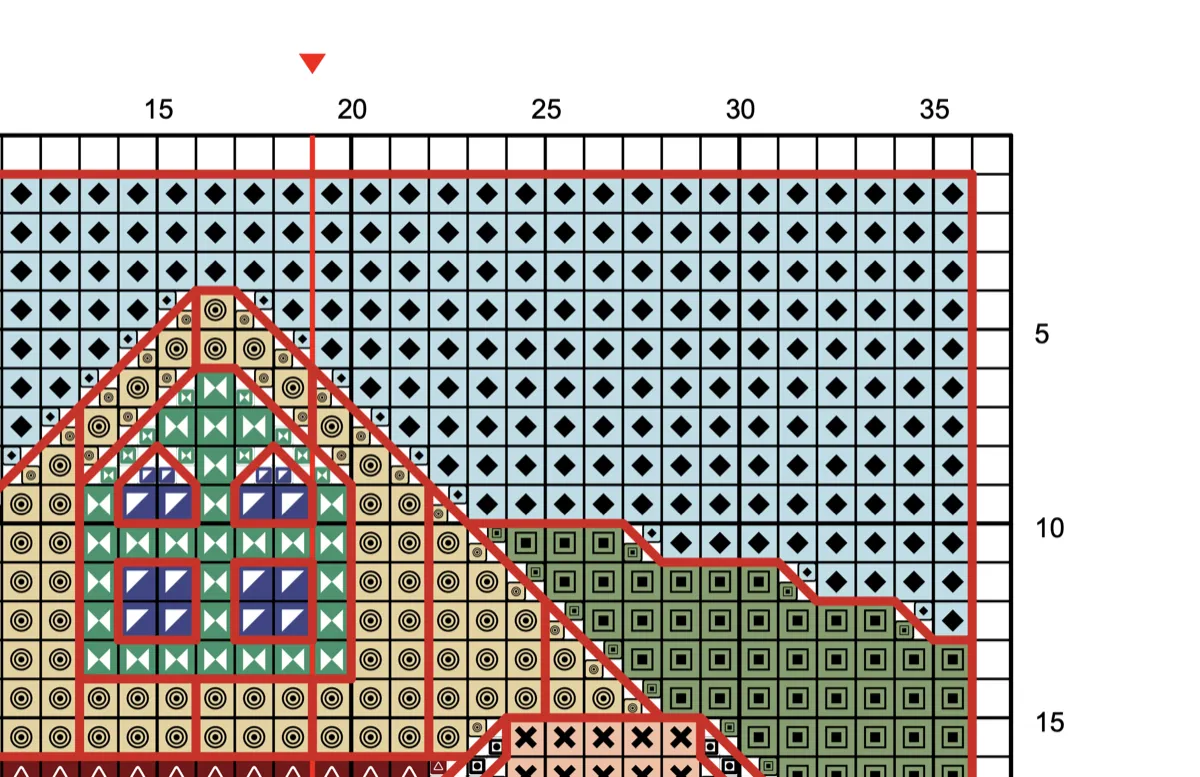
A cross stitch chart is a grid of colored squares. A needlepoint canvas is a grid of thread intersections. As long as every square on the chart is a full stitch, the mapping is perfect: one square, one tent stitch.
The rule breaks the moment a chart leans on fractional stitches — quarters, halves, three-quarters — or on backstitch outlines to carry detail. A quarter stitch occupies a corner of a square; tent stitch has no corner to give it. You can sometimes fake fine detail with petit point on finer canvas, but a chart that's 20% fractionals is fighting you the whole way.
So before buying or converting a chart, zoom in on the legend and the busiest areas:
| Chart feature | Translates to canvas? |
|---|---|
| Whole stitches only | ✅ Perfectly |
| A few fractionals at edges | ⚠️ Stitch them as whole stitches — usually invisible |
| Heavy fractional shading (faces, fur) | ❌ Will look wrong in tent stitch |
| Backstitch outlines (thin lines over the grid) | ❌ Mostly lost — see below |
| French knots, beads | ⚠️ Possible, but plan substitutes |
Many samplers, geometric designs, florals, and most photo-converted charts are whole-stitch by construction. Heavily "painterly" designs with fractional shading are the ones to avoid.
One chart square = one canvas intersection
This is the mental shift, and it takes about five minutes. In cross stitch you work into the holes of the fabric, forming an X across a square. In needlepoint you work over the intersections where canvas threads cross, laying one diagonal stitch — tent stitch — over each.
Practical consequences:
- Count intersections, not holes. A 100-square-wide chart covers 100 intersections, which involves 101 canvas threads. If you count holes the way you do on Aida, you'll drift by one — the classic off-by-one that shows up two hours later.
- All stitches slant the same way. Every tent stitch leans like a forward slash (/). There's no top leg to cross, no "which way do your Xs face" question. Symbol-dense charts actually get easier on canvas.
- Full coverage is the goal. Cross stitch leaves fabric showing by design; needlepoint covers the canvas completely. That's a thread-weight question, not a chart question — covered below.
Sizing: Aida count vs mesh count
Aida count and mesh count are the same idea: stitches per inch. So the sizing math carries straight over — divide stitch count by mesh:
| Chart size | On 14-ct Aida | On 18-mesh | On 13-mesh | On 10-mesh |
|---|---|---|---|---|
| 80 × 80 | 5.7" | 4.4" | 6.2" | 8.0" |
| 140 × 140 | 10.0" | 7.8" | 10.8" | 14.0" |
| 200 × 200 | 14.3" | 11.1" | 15.4" | 20.0" |
Two things to notice. First, a chart "designed for 14-count" lands very close to its original size on 13-mesh — the counts are near neighbors, which is convenient because 13-mesh is the workhorse canvas your local shop actually stocks. Second, moving to 18-mesh shrinks the design by about a quarter; moving to 10-mesh grows it by 40%. Mesh count is your size dial. The mesh count guide covers the tradeoffs, and the fabric calculator does the arithmetic with margins included.
One warning from the "I wish I'd known" file: buy canvas with generous margins — at least 2–3 inches on every side beyond the design area. Blocking and finishing both need it, and blank canvas is the cheap part of this craft.
What doesn't translate (and what to do about it)
Fractional stitches
The honest answer: drop them. Round each fractional up to a whole stitch in whichever of its colors dominates. On a chart with scattered edge fractionals this is invisible from a foot away. On a chart built around fractional shading, the result loses its modeling — pick a different chart, or move to a finer mesh where the smaller stitch size restores some of the detail.
Backstitch outlines
Backstitch runs between grid squares — thin lines over the top of finished stitching. Tent stitch has no equivalent that sits on the grid. Your options, in order of how often they're the right call:
- Omit the backstitch. Most designs survive without outlines better than you'd expect, especially at 18-mesh where the stitches are small.
- Re-draw the outline as a line of whole stitches in a dark color. Works for bold, cartoonish designs; too heavy for delicate ones.
- Add surface embroidery over the finished piece. Legitimate and traditional — but now you're doing freehand embroidery on top of needlepoint, which is its own skill.
If a chart's personality lives in its backstitch — lettering with serifs, fine whiskers, delicate borders — it's a poor conversion candidate. Check the legend before you commit: reading the chart carefully up front costs two minutes.
French knots and beads
These actually work fine on canvas — needlepointers use both. Just size them to your mesh: a knot that reads as a berry on 18-mesh reads as a boulder on 10-mesh.
Swapping floss for needlepoint thread
The chart's DMC color numbers are still useful — as colors. The floss itself usually isn't, because six-stranded cotton sized for Aida won't cover canvas at common mesh sizes. The working substitutions:
| Canvas | What covers it |
|---|---|
| 18-mesh | DMC stranded cotton at 3–4 strands, perle #8, silk, or 1 strand of crewel wool |
| 13/14-mesh | Persian wool (2 ply), tapestry wool, Appleton crewel (2–3 strands), perle #5 |
| 10-mesh | Tapestry wool, Persian wool (3 ply) |
Match the chart's colors to a wool or silk line either by eye at the shop or in software — Stitchmate's thread library includes DMC and Appleton wool, so a chart's floss palette can be remapped to wool colorways in one step. The needlepoint thread guide goes deeper on coverage per mesh.
The test that saves projects: stitch a 1-inch square in your chosen thread before starting. Canvas showing through means add a strand or go heavier; thread bunching means the opposite.
Converting a chart, step by step
- Audit the chart. Whole stitches only, or close to it? Minimal backstitch? Under ~20 colors is comfortable for a first counted canvas project.
- Pick your mesh. 13-mesh to stay near the Aida-designed size and use wool; 18-mesh to shrink it and keep cotton or silk. Do the division before buying canvas.
- Choose threads. Map the chart's colors to threads that cover your mesh. Test-stitch a square.
- Mark your canvas. Find the center of the canvas and the center of the chart (most charts mark it with arrows). Baste a center line if the design is large — counting mistakes on canvas are annoying to rip.
- Stitch in tent. Use basketweave for areas and backgrounds, continental for single lines and details. Every X on the chart becomes one diagonal stitch.
- Block when done. Tent stitch pulls the canvas diagonally; blocking pulls it back square.
If you'd rather let software do steps 1–3, Stitchmate imports charts (including PDF patterns), converts them to needlepoint mode with tent stitch rendering, and lets you resize between mesh counts and remap the palette — then export a fresh chart at whatever print size your eyes prefer.
A note on copyright
Everything above applies to charts you've bought or designs you own. Converting a purchased cross stitch chart for your own personal stitching is normal use — designers sell charts precisely so you can stitch them, and stitching one in tent instead of crosses harms no one. What's not okay is copying someone's painted canvas design into a chart, or redistributing a converted chart. The needlepoint community takes design ownership seriously, and so do we: convert what's yours, stitch what you bought.
FAQ
Can I use any cross stitch pattern for needlepoint?
Does 14-count Aida equal 14-mesh canvas?
Can I stitch a cross stitch kit's chart on canvas?
What is the difference between counted needlepoint and a painted canvas?
Do I need needlepoint software to convert a chart?
Convert a Chart to Needlepoint
Import a cross stitch pattern or a photo, switch it to needlepoint mode with tent stitch rendering, resize between mesh counts, and remap floss colors to wool.
Try Stitchmate FreeNo account required. Works in your browser.
Related Guides & Tools
What Is Tent Stitch?
The diagonal stitch every converted chart is worked in — and the three ways to stitch it.
Needlepoint Mesh Count Guide
How 10, 13, and 18-mesh change finished size, thread choice, and project time.
Needlepoint Thread Guide
Wool, silk, and cotton coverage for every common mesh — with brands and ply counts.
Needlepoint vs Cross Stitch
The two crafts side by side — materials, techniques, cost, and difficulty.
How to Read a Cross Stitch Pattern
Symbols, legends, and center marks — the chart-reading skills both crafts share.
Photo to Needlepoint Converter
Skip the cross stitch chart entirely — convert any photo straight to a tent stitch chart.
Needlepoint Stocking Patterns
A classic chart-your-own project — sizes, timelines, and design rules for stockings.
Needlepoint Canvas Types
Buying blank canvas for the first time — mono vs interlock, and the needle size chart.