How to Frame a Diamond Painting (and Other Ways to Display It)
Diamond paintings come in metric sizes with a border, and glass hides the sparkle. Here is how to pick the right frame, mount the canvas flat, and display it well.
To frame a diamond painting, flatten it, seal it if it won't be behind glass, then measure the drilled area (not the whole canvas) and choose a frame whose opening fits it. Most people skip the glass because it hides the sparkle. Mount the canvas flat on foam board or a canvas panel inside the frame, or wrap it onto stretcher bars for a frameless gallery look.
| At a glance | |
|---|---|
| Measure | The drilled design, not the canvas (kits include a border) |
| Common sizes | 30 × 40 cm ≈ 12 × 16 in · 40 × 50 cm ≈ 16 × 20 in · 60 × 80 cm |
| Glass | Usually skipped; if used, add spacers |
| Mounting | Foam board or canvas panel with double-sided tape, or stretcher bars |
| Before | Flatten, press drills, and seal if there's no glass |
Measure the drilled area, not the canvas
Diamond painting kits are sold by canvas size, and the canvas usually includes a blank border around the design, often a few centimeters on each side. Buy a frame for the listed size and the design may float in a band of bare canvas, or the frame may hide the outer drills. Measure the drilled area with a ruler before you shop.
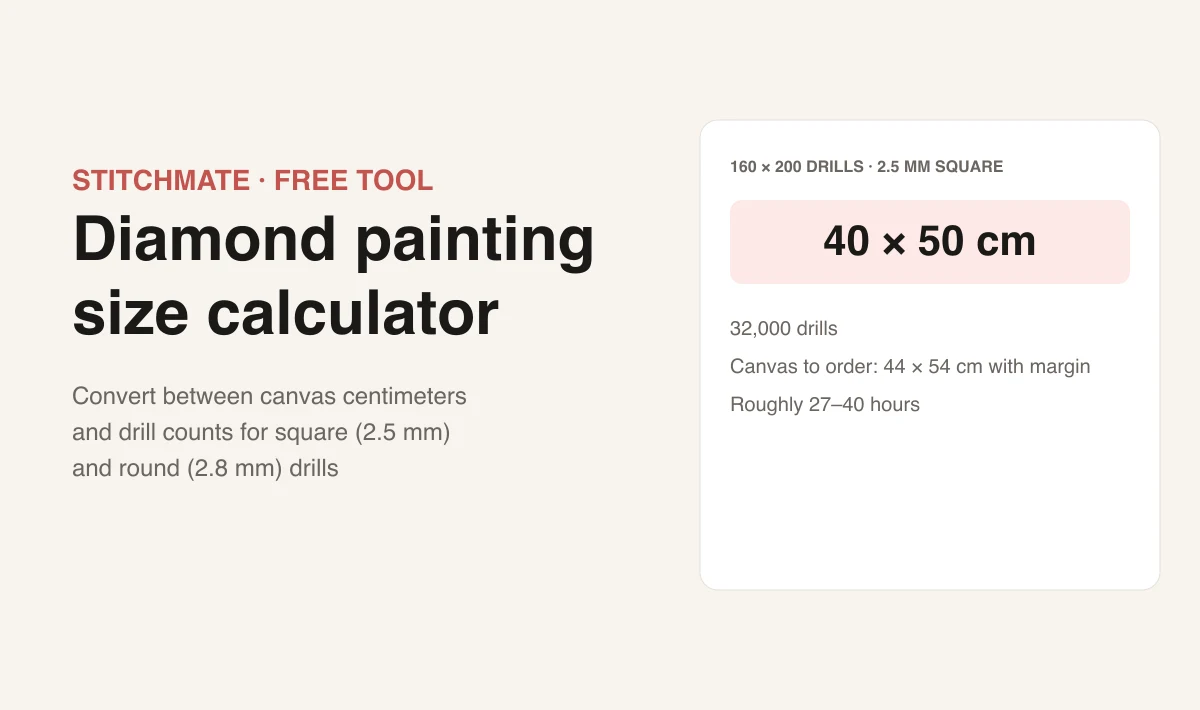
If you made the chart yourself, the drill count tells you the size exactly. Square drills are about 2.5 mm, so 4 drills make 1 cm; round drills are about 2.8 mm. A design 160 square drills wide is 160 × 2.5 mm = 40 cm. The diamond painting size calculator does this conversion for any drill count and shape, so you can choose the frame before you start.
Frame sizes for common kits
Kits come in metric sizes, and standard frames in the US come in inches, so a few sizes line up well and others don't:
| Kit canvas | In inches | Nearest standard frame | Notes |
|---|---|---|---|
| 30 × 40 cm | 11.8 × 15.7 | 12 × 16 in | Check the drilled area first; it may be smaller |
| 40 × 50 cm | 15.7 × 19.7 | 16 × 20 in | The most common kit size; frames sold for diamond painting come in this size |
| 60 × 80 cm | 23.6 × 31.5 | Not a common US size | Custom frame, stretcher bars, or a larger frame with a mat |
A mat (a card border inside the frame) solves most mismatches: choose a frame a size up and a mat opening cut to the drilled area. It also gives a sealed painting a little breathing room from the glass if you use glass.
Glass or no glass?
Most finished diamond paintings are framed without glass. The whole point of the piece is how the drill facets catch light, and glass adds reflections and flattens that sparkle.
The tradeoff is dust. An open canvas collects dust between drills over time, which is why a painting framed without glass should be sealed first; a sealed surface can be dusted with a soft brush.
If you want glass anyway, for dust protection in a kitchen or a child's room, use a frame with spacers or a shadowbox-depth frame, so the glass sits a few millimeters off the drills instead of pressing on them. Glass pressed flat against the drills can knock them out of line.
How to mount the canvas
Whatever frame you choose, the canvas needs to be flat and fixed so it doesn't ripple. Flatten it first under weight for a day or two; Diamond Art Club covers getting creases out of a rolled canvas. Then choose a mounting method:
- Foam board or mat board with double-sided tape. The simplest. Cut the board to the frame's backing size, lay strips of strong double-sided tape across it, and press the canvas on from the center outward, smoothing as you go. It sits perfectly flat in the frame.
- A canvas panel or wrapped canvas. Stick or staple the diamond painting onto a craft-store canvas panel or a stretched art canvas, wrapping the border around the edges. It can hang on its own with no frame at all.
- Stretcher bars. For a gallery-wrapped look, wrap the border around wooden stretcher bars and staple it on the back, working from the middle of each side outward so the drilled area stays square. You need roughly 2 inches of border on each side to wrap, and the painting should be sealed first, because a stretched canvas flexes.
Center the design before anything sticks down: mark the middle of the board and the middle of the drilled area, and line them up.
Displaying without a frame
Frames aren't the only option:
- Poster hangers, wooden rails that clamp the top and bottom edges, give a clean modern look for no-glass display.
- Washi tape or clips on a wall or board work for a temporary display.
- Smaller pieces as objects. Sealed small paintings make coasters, notebook and journal covers, cards, and ornaments.
- Rotating display. Many diamond painters finish faster than they have wall space. Store finished pieces flat between sheets of paper and swap what's on the wall.
For hanging height, a common rule is to place the center of the piece about 57 inches from the floor, roughly average eye level. Hang it where light comes from the side, not straight on; angled light is what makes the drills sparkle.
Framing mistakes to avoid
Buying the frame for the canvas size. The listed kit size usually includes the border. Measure the drilled area.
Framing a curled canvas. A canvas straight from its shipping tube ripples inside the frame. Flatten it under weight first.
Glass pressing on the drills. Without spacers, glass can shift drills. Use spacers or skip the glass.
Skipping the sealer on an open frame. Without glass, dust settles between unsealed drills and is hard to remove.
Trimming before mounting. Cut off the border only after you know how the canvas will be mounted; stretcher bars and wrapped panels need that border.
FAQ
What size frame do I need for a diamond painting?
Should I put glass over a diamond painting?
Do I need to seal a diamond painting before framing?
Can you put a diamond painting on stretcher bars?
How high should I hang a diamond painting?
Further reading
- Diamond Art Club: How to frame a diamond painting — framing options with photos
- Drill n Dazzle: Frame and display guide — display ideas beyond the frame
- Repair and Refinish: Seal, frame, and hang a diamond painting — the whole finishing sequence
- Paint With Diamonds: Sealing — the step before framing
Design One That Fits Your Frame
Make a diamond painting chart from your own photo, sized in drills to fit the frame you already have.
Make a Diamond PaintingFree to use. No account required.
Related Guides & Tools
How to Seal a Diamond Painting
Brush-on vs spray sealer, step by step — the step before framing.
Diamond Painting Size Calculator
Turn a drill count into a finished size before you buy the frame.
How to Do Diamond Painting
The full beginner workflow, from first drill to finished canvas.
Diamond Painting Drills
Square vs round drills and their sizes — the numbers behind finished size.